Calc 1 -- Practice for Quiz 8 (Fall 2026)
Overview
The practice set works through ten Calc 1 problems on Newton’s method, the Mean Value Theorem, L’Hôpital’s rule, and continuity, emphasizing how to translate each question into the right equation before calculating. It gives Newton iterations for polynomial roots and intersections, finds Mean Value Theorem points by equating instantaneous and average rates of change, and handles indeterminate limits with logarithms and repeated differentiation; careful algebra checks matter, including a sign slip in the final limit calculation.
Key takeaways
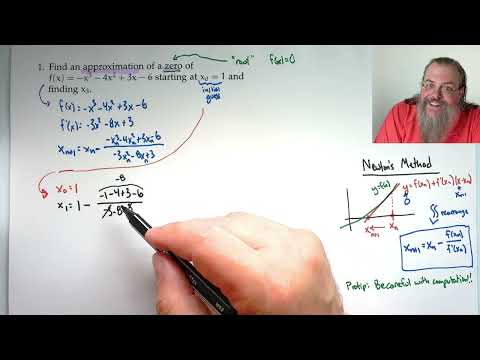
- Newton’s method uses xₙ₊₁ = xₙ − f(xₙ)/f′(xₙ); for the cubic −x³ − 4x² + 3x − 6 starting at 1, the three iterates are 0, 2, and 26/25.
- To use Newton’s method on an intersection, solve f(x) − g(x) = 0; the function definition, derivative, and arithmetic must all be checked because the intersection example’s reported iterates conflict with its displayed equations.
- The Mean Value Theorem requires an interior point c where f′(c) equals the interval’s average rate of change, and a piecewise function can yield multiple valid points, as shown by 6/7, −2/3, and −3/2.
- Before applying L’Hôpital’s rule, verify that the expression is a quotient in the 0/0 or ∞/∞ form; logarithms can convert exponential indeterminate forms such as 1^∞ into a differentiable quotient.
- For the repeated L’Hôpital example, differentiating f(x)g(x) twice gives f″g + 2f′g′ + fg″, and the supplied values yield −4/5.
- For ((n − 5)/(n + 5))^(3n), the logarithmic limit is −30, so the original limit is e^(−30); the transcript’s final spoken e^30 contains a sign error.
Chapters
- Newton’s method approximates a zero by replacing the curve near a current guess xₙ with its tangent line.
- Setting the tangent line’s y-value to zero gives xₙ₊₁ = xₙ − f(xₙ)/f′(xₙ).
- The method starts from a supplied guess and repeats the correction step; the number of requested iterations determines the final subscript.
- For f(x) = −x³ − 4x² + 3x − 6, the derivative is f′(x) = −3x² − 8x + 3.
- Starting from x₀ = 1, the worked iterations give x₁ = 0, x₂ = 2, and x₃ = 26/25.
- Check each substitution and arithmetic step carefully, since repeated Newton iterations can magnify small calculation errors.
- To find ⁴√5, define f(x) = x⁴ − 5 so that the desired number is a zero.
- The recurrence is xₙ₊₁ = xₙ − (xₙ⁴ − 5)/(4xₙ³), with initial guess x₀ = 1.
- The two requested iterations give x₁ = 2 and x₂ = 53/32.
- An intersection of f(x) and g(x) satisfies f(x) = g(x), so define h(x) = f(x) − g(x).
- For f(x) = x^(5/2) and g(x) = x² + 3, the target becomes a zero of h(x) = x^(5/2) − x² − 3.
- The derivative used in the Newton recurrence is h′(x) = (5/2)x^(3/2) − 2x.
- The stated intersection equation and x₀ = 1 are substituted into the Newton recurrence to estimate the x-coordinate.
- The worked calculation reports x₁ = 4 and x₂ = 67/24, while its displayed substitutions contain arithmetic inconsistencies with the stated functions.
- Verify both function values and derivatives at each iterate before trusting a simplified Newton result.
- The Mean Value Theorem requires continuity on the closed interval and differentiability in its interior.
- For f(x) = x log x on [3, 9], the average rate of change simplifies to (5/2) log 3.
- Since f′(x) = log x + 1, the theorem’s point satisfies log c + 1 = (5/2) log 3, giving c = exp((5/2) log 3 − 1).
- For the interval [0, b], the midpoint is b/2, and the condition to impose is f′(b/2) = [f(b) − f(0)]/b.
- The polynomial is f(x) = 16x⁵ − 66x⁴ − 14x² + 27x − 104.
- Substituting f(b) and f(0) = −104 into the average-rate quotient cancels the constant terms and allows division by b.
- Differentiating and substituting b/2 gives f′(b/2) = 5b⁴ − 33b³ − 14b + 27.
- Equating this to the average rate, 16b⁴ − 66b³ − 14b + 27, cancels the linear and constant terms.
- The remaining equation factors as 11b³(b − 3) = 0; b = 0 is a degenerate interval, so b = 3.
- For the interval [−2, 2], the Mean Value Theorem equation is g′(c) = [g(2) − g(−2)]/4.
- Evaluate g(2) with the nonnegative branch and g(−2) with the negative branch of the piecewise definition.
- Careful grouping of the endpoint terms gives an average rate of change of 4.
- The two derivative branches are 16 − 14x for x ≥ 0 and 16 + 26x + 12x² for x < 0.
- Setting the nonnegative branch equal to 4 gives c = 6/7; solving the negative-branch quadratic gives c = −2/3 and c = −3/2.
- All three values lie inside [−2, 2] and in the branch where each was found, so all satisfy the theorem.
- L’Hôpital’s rule applies to an appropriate quotient with indeterminate form 0/0 or ∞/∞, subject to differentiability and limit conditions.
- The limit involving (4x² + e) raised to 1/log(2x) is not initially a quotient of either required form.
- Taking the logarithm of the unknown limit converts the exponent into a quotient that can be checked for ∞/∞.
- Writing the target as L and taking logarithms gives log L = limₓ→∞ log(4x² + e)/log(2x).
- Both numerator and denominator tend to infinity, so L’Hôpital’s rule can be applied to the transformed quotient.
- Differentiating the logarithms and simplifying produces a limit with leading terms 8x²/(4x² + e).
- The transformed quotient tends to 2 because its numerator and denominator have leading terms 8x² and 4x².
- That result is log L = 2, not the original limit itself.
- Exponentiating gives L = e².
- For limₓ→₂ f(x)g(x)/h(x), the supplied values f(2) = g(2) = h(2) = 0 establish a 0/0 form.
- Differentiate the numerator with the product rule, giving f′(x)g(x) + f(x)g′(x), and differentiate the denominator as h′(x).
- At x = 2, the resulting expression is still 0/0, so a second application is needed.
- Differentiating the first numerator again yields f″g + 2f′g′ + fg″; the denominator becomes h″.
- Using f′(2) = 4, g′(2) = −3, h″(2) = 5, and the supplied zero values gives −4/5.
- The repeated differentiation is valid because the functions are assumed twice differentiable.
- The piecewise function assigns g(0) = a and uses a quotient expression when x ≠ 0.
- Continuity at zero requires limₓ→₀ g(x) = g(0), so a must equal the limit of the quotient branch.
- The initial expression has terms with division by x, producing an indeterminate difference that must be combined before applying L’Hôpital’s rule.
- A common denominator of 3x(e^(−2x))(x + 3) combines the quotient terms into one fraction.
- The combined numerator is x + 3 − 3e^(−2x), which tends to zero at x = 0.
- The denominator also tends to zero, so the limit is now in the 0/0 form required for L’Hôpital’s rule.
- The numerator derivative is 1 + 6e^(−2x), while the denominator requires a three-factor product rule.
- At x = 0, the numerator derivative is 7 and the denominator derivative is 9.
- The limit is 7/9, so choosing a = 7/9 makes the function continuous at zero.
- The final limit is ((n − 5)/(n + 5))^(3n), an indeterminate 1^∞ form.
- Set the limit equal to L and take logarithms to obtain log L = limₙ→∞ 3n log((n − 5)/(n + 5)).
- Rewrite the expression as a quotient with 1/n in the denominator, choosing the arrangement that simplifies differentiation.
- The logarithmic numerator is split as 3 log(n − 5) − 3 log(n + 5), producing a 0/0 quotient after the rewrite.
- After differentiation and algebraic simplification, the limit becomes −30n²/(n² − 25).
- A further L’Hôpital step, or comparison of leading terms, gives log L = −30.
- Since the logarithm of the requested limit is −30, exponentiating gives the mathematically consistent result e^(−30).
- The transcript’s spoken final answer drops the negative sign and says e^30, conflicting with its own preceding result of −30.
- Track the sign when undoing a logarithm: the exponential preserves the value in the exponent.
Transcript excerpt
0:00 Time for us to do some more practice. We are just finishing up the last parts of differentiation. So we get to do Leo's rule, N's method, mean value theorem. Beautiful, beautiful ideas. Now, as always, remember to do as much as you can by yourself first. The best way to learn math is to do math. Pause. Try it yourself. Then you can unpause and say, "Hey, did Steve figure it out because I already figured it out and I I hope I did and we can always compare answers. All right, let's begin with number one. Find an approximation of a zero of f(x) is - xub - 4x^2 + 3x - 6 starting at x0 = 1 and finding x3.
0:58 Okay, let's look at this problem. Make sure we understand what we're being asked to use. Now, we kind of know because of the topics we covered in the last week, but what are some clues here? Well, there's a couple of important words at the very beginning, approximation and zero. So, one thing about approximation is we're not finding an exact value. So, we're trying to do a technique that is after finding an approximate value. And if we think about all the techniques that we've done, you know, often times we're like, oh, it's exactly this or it's exactly that. So where have we done approximation? That is Newton's method. So N's method is one of the few places where we said,
1:46 oh, let's approximate. And it it sort of embraces the idea of linear approximation. So Nun's method and linear approximation both involve approximation. So wait, how do we split the tie? That's where this notion of zero comes in. So when this is talking about find a zero, this is also another way of saying find
This is the start of the transcript. Save this video free for the whole transcript, searchable and time-coded.
In this course
Related notes
Summary, takeaways, and chapters were generated by AI from the video's transcript and may contain errors. The video belongs to its creator, Beard Meets Calculus.