Substitution rule (indefinite) (Calc 1; Lecture 3-9; Fall 26)
Overview
Steve Butler connects the substitution rule for indefinite integrals to the chain rule, showing how to replace an inner expression and its differential, integrate in the new variable, and return to the original variable. He builds toward the method with quick algebra review, applications of both fundamental theorems of calculus, and worked substitutions including cases that require rewriting the integrand or adjusting a constant.
Key takeaways
- Substitution reverses the chain rule: when an integrand contains a composition and the derivative of its inner function, changing to u=g(x) can reduce it to a basic integral.
- A strong substitution candidate usually pairs an inner expression with a nearby derivative factor, as in u=t³+t with du=(3t²+1)dt.
- A substitution can still work when its differential differs by a constant: for u=z⁵+1, du=5z⁴dz, so the integral uses the factor 1/5.
- After integrating in u, replace u with the original expression; an indefinite integral also requires +C.
- The fundamental theorem evaluation F(b)-F(a) requires the integrand to be continuous across the interval; applying it to 1/x² from -1 to 1 incorrectly crosses a vertical asymptote and misses a divergent integral.
- Differentiating a proposed antiderivative is a practical way to verify it, as checking e^(x²) recovers 2xe^(x²).
Chapters
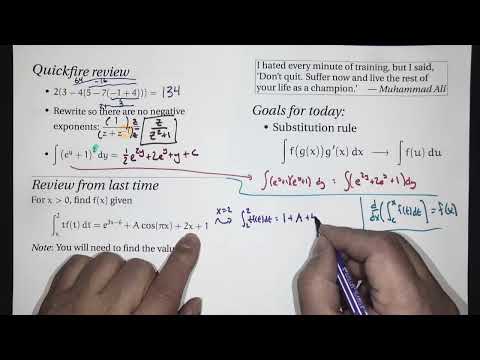
- Evaluating nested parentheses one layer at a time gives 134.
- Multiplying the expression with a negative power by z/z rewrites it without negative exponents as z/(z²+1).
- Expanding (eʸ+1)² gives e²ʸ+2eʸ+1, which integrates term by term to ½e²ʸ+2eʸ+y+C.
- For the equation involving ∫ₓ² t f(t) dt, setting x=2 makes the integral zero and determines the unknown constant a=-6.
- Differentiating an integral with a variable lower bound introduces a negative sign, so the left side becomes -x f(x).
- Differentiating the right side and dividing by -x yields f(x)=-(3e^(3x-6)+6πsin(πx)+2)/x.
- Steve Butler uses Muhammad Ali’s training quote to encourage students to practice foundational skills even when the work is difficult.
- The substitution rule is introduced as an integration counterpart to the chain rule, which differentiates compositions such as f(g(x)).
- For a continuous integrand, an antiderivative F evaluates a definite integral by F(b)-F(a), without needing to add a constant.
- ∫₀²(2x-3)dx equals -2, illustrating that a definite integral is signed area, not necessarily positive area.
- ∫₀π sin(θ)dθ equals 2, while ∫₀¹1/(t²+1)dt equals arctan(1)-arctan(0)=π/4.
- The arctangent result evaluates a limit previously represented by a difficult Riemann sum.
- The formal antiderivative calculation for ∫₋₁¹1/x² dx gives -2, but 1/x² has a vertical asymptote at x=0 inside the interval.
- The integral is actually divergent with positive infinite area, so the ordinary fundamental theorem cannot be applied across the singularity.
- Butler flags improper integrals as a topic for a later calculus course and advises checking for asymptotes before using the theorem.
- The chain rule gives d/dx[f(g(x))]=f′(g(x))g′(x), suggesting how to reverse a composition when integrating.
- Set u=g(x) and du=g′(x)dx so the integral can be rewritten entirely in terms of u and du.
- Look for an inner function and its derivative; constants can be moved to compensate when the differential is off by a constant.
- After integrating, replace u with its original expression and include +C for an indefinite integral.
- For ∫2x e^(x²)dx, set u=x² and du=2x dx to obtain ∫eᵘdu=eᵘ+C, then return to e^(x²)+C.
- Differentiating e^(x²) gives 2xe^(x²), providing a direct check of the antiderivative.
- For ∫sin(eᶿ)eᶿdθ, set u=eᶿ and du=eᶿdθ to obtain -cos(eᶿ)+C.
- For ∫(3t²+1)(t³+t)⁴dt, u=t³+t turns the integral into ∫u⁴du, giving (t³+t)⁵/5+C.
- Butler recommends checking for substitution before expanding a product, since expansion can create many terms and more opportunities for algebra errors.
- A useful substitution has both an inner expression, such as a powered function, and a nearby factor matching its derivative.
- If a proposed substitution produces a derivative that is not present and cannot be generated easily, as with the initial guess for the final example, try rewriting the integrand.
- Rewrite z⁴(z⁵+1)⁴ dz to expose the inner expression z⁵+1 and the matching factor z⁴.
- With u=z⁵+1, du=5z⁴dz, so z⁴dz=du/5; the missing factor of 5 is handled as a constant.
- Integrating (1/5)∫u⁴du and substituting back gives (z⁵+1)⁵/25+C.
Transcript excerpt
0:00 We start with our quick fire review. Yay! Okay, and lots of parentheses. A two and then there's parentheses three minus four and a parentheses five minus seven another parentheses minus one plus four and lots and lots of parentheses. And and oh my goodness, I think is it did I miscount one two oh no good good good those are the right number of parentheses. Phew. I was worried I I was missing one. All right, so so here's our problem. Basically make sure you know how to deal with parentheses. What does this become when you work it out? 134 Yeah.
0:48 Just it's an onion problem. Work one layer at a time. This is three. Three * 7 21 5 minus 21 negative 16 negative 16 * negative four 64. All right, so up to 64 plus three is 67 * two is 134. You don't have to do these in your head. You're allowed to write things down. The next problem rewrite so there are no negative exponents. Now there's nothing fundamentally wrong with this expression, but we say hey I don't like negative exponents. I want to get rid of them because really a negative exponent is a fraction in disguise. And we don't like fractions. So how can we rewrite this expression
1:36 so there's no negative exponent? What does this become? It becomes Z over Z squared plus one. And that's it. That's the answer. Now how do you get there? Say well okay how would I get rid of that Z to the negative one? It's like one over Z. How do I 1/z not a fraction? I'd multiply it by z. So really the key here is to recognize oh, multiply by a z/z. And then when you do that, of course multiplying by z/z is multiplying by
This is the start of the transcript. Save this video free for the whole transcript, searchable and time-coded.
In this course
Related notes
Summary, takeaways, and chapters were generated by AI from the video's transcript and may contain errors. The video belongs to its creator, Beard Meets Calculus.