Calc 1 -- Practice for Quiz 9 (Fall 2026)
Overview
Steve Butler walks through ten Calculus 1 practice problems, showing how to rewrite integrands into familiar forms, apply antiderivative rules, and use initial conditions to determine constants. He also develops Riemann-sum estimates for displacement and area, including right, midpoint, and left endpoints, and demonstrates algebraic techniques such as difference of squares, scaling for arctangent integrals, and polynomial long division.
Key takeaways
- When an integrand is unfamiliar, rewrite it into known forms first: expanding and dividing terms by t turns the first problem into powers of t plus a special 1/t logarithm term.
- Initial conditions select specific antiderivatives: integrating acceleration to velocity and then position requires applying v(1) = e and s(1) = e separately to determine two constants.
- For Riemann sums, calculate the interval width and sample points before evaluating heights; the displacement example uses four width-1 right intervals and estimates 3.4 centimeters.
- Endpoint choice and monotonicity determine whether a Riemann sum overestimates: right endpoints on an increasing function use the highest height in each subinterval.
- Algebra can expose standard antiderivative rules: difference of squares simplifies the acceleration fraction, while long division turns a rational function into a polynomial plus an arctangent form.
- For 1/(x² + a²), rescaling to 1/(u² + 1) requires accounting for the change in the input; in the x² + 9 example, the resulting arctangent term is -6 arctan(x/3).
Chapters
- Steve Butler frames repeated problem-solving as a way to build confidence with unfamiliar calculus tasks.
- His core antiderivative routine is to check whether a rule applies, rewrite the expression if needed, then try again.
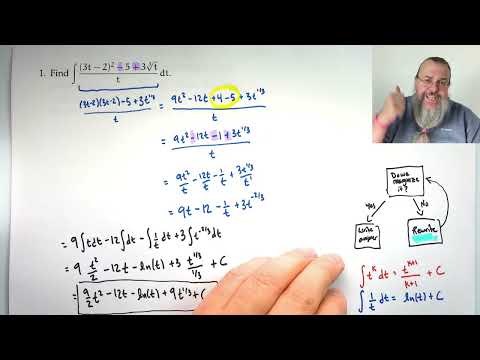
- The first integral contains ((3t - 2)^2 - 5 + 3∛t)/t.
- Butler rewrites ∛t as t^(1/3), expands (3t - 2)^2, and combines 4 - 5 into -1.
- Linearity allows the numerator's four terms to be separated before simplifying by t.
- Dividing each term by t produces 9t, -12, -1/t, and 3t^(-2/3).
- The 1/t term uses the special antiderivative ln|t| rather than the power rule.
- The rewrite converts the original fraction into terms covered by basic integration rules.
- Term-by-term integration gives (9/2)t² - 12t - ln|t| + 9t^(1/3) + C.
- The power rule fails at exponent -1, which is why the logarithm rule is needed.
- Butler recommends differentiating the result to verify that it reproduces the rewritten integrand.
- The acceleration includes (e^(2t) - 36)/(e^t + 6) + 3/t², with t > 0.
- Writing the numerator as (e^t)² - 6² reveals a difference of squares and cancels e^t + 6.
- The simplified acceleration is e^t - 6 + 3t^(-2), ready for integration.
- Integrating acceleration gives v(t) = e^t - 6t - 3/t + C.
- The condition v(1) = e yields e - 9 + C = e, so C = 9.
- The resulting velocity is e^t - 6t - 3/t + 9.
- Integrating velocity gives s(t) = e^t - 3t² - 3 ln|t| + 9t + D.
- Using s(1) = e and ln(1) = 0 gives e + 6 + D = e, so D = -6.
- The particle's position is e^t - 3t² - 3 ln|t| + 9t - 6.
- The integral is (3 sin 2θ - 4 cos θ)/cos³θ.
- The identity sin 2θ = 2 sin θ cos θ makes every trigonometric function use θ rather than 2θ.
- Separating the numerator terms allows a cosine factor in each term to cancel.
- After cancellation, the integrand becomes 6 sin θ/cos²θ - 4/cos²θ.
- Using sec θ = 1/cos θ and tan θ = sin θ/cos θ rewrites it as 6 sec θ tan θ - 4 sec²θ.
- The known antiderivatives produce 6 sec θ - 4 tan θ + C.
- The conditions translate to f''(x) = 6x, f'(2) = 0, and f(2) = 4.
- Integrating once gives f'(x) = 3x² + C; f'(2) = 0 determines C = -12.
- A second integration and f(2) = 4 give f(x) = x³ - 12x + 20.
- Velocity is v(t) = (21 - 4t)/(t² + 9), measured in centimeters per second.
- The interval from t = 0 to t = 4 is split into four width-1 intervals, with right endpoints 1, 2, 3, and 4.
- Each interval's estimated displacement is its right-endpoint velocity multiplied by the interval width.
- The right-endpoint velocities are 17/10, 1, 1/2, and 1/5, which sum to 34/10.
- Multiplying centimeters per second by interval widths in seconds leaves an answer of 3.4 centimeters.
- A Riemann sum estimates accumulated displacement by treating velocity as constant on each subinterval.
- The area under f(x) = 6/x is estimated from x = 1.5 to x = 6.5 using five equal rectangles.
- The interval has length 5, so each rectangle has width 1.
- The five midpoints are 2, 3, 4, 5, and 6.
- The midpoint heights are f(2) = 3, f(3) = 2, f(4) = 3/2, f(5) = 6/5, and f(6) = 1.
- Multiplying each height by width 1 and adding gives an estimated area of 87/10, or 8.7.
- The midpoint rule chooses a representative function value from the center of each interval.
- The definite-integral notation represents the area under y = 4f(t/3) from t = -9 to t = 3.
- Four equal intervals across length 12 have width 3 and partition points -9, -6, -3, 0, and 3.
- The right endpoints are -6, -3, 0, and 3, so the sampled values of f are at -2, -1, 0, and 1.
- The common factor from the function's 4 and the interval width 3 is 12.
- Using f(-2) = 2, f(-1) = 6, f(0) = 8, and f(1) = 13 gives 12(2 + 6 + 8 + 13) = 348.
- The table contains extra values, but only the values at the four right-endpoint inputs are needed.
- For an increasing function, the right endpoint has the greatest function value within each interval.
- Using that endpoint as the rectangle's height makes each rectangle at least as tall as the curve across its interval.
- Therefore, the right-endpoint estimate of the area is an overestimate.
- The problem estimates the area under g(x) = sin(πx/3) on [0, 3] with six equal intervals and left endpoints.
- Each interval has width 3/6 = 1/2, with partition points 0, 1/2, 1, 3/2, 2, 5/2, and 3.
- The six sampled inputs are 0, 1/2, 1, 3/2, 2, and 5/2.
- The sampled sine values are 0, 1/2, √3/2, 1, √3/2, and 1/2.
- Multiplying the sum of those heights by the common width 1/2 gives 1 + √3/2.
- Evaluating the left sum depends on recognizing standard unit-circle angles from 0 to 5π/6.
- The integrand is 2x²/(x² + 9) - 6/⁵√(x³); the root term rewrites as -6x^(-3/5).
- A sum in a denominator cannot be split across addition, so 2x²/(x² + 9) is not 2x²/x² + 2x²/9.
- The target form is 1/(u² + 1), whose antiderivative is arctan(u).
- Expanding (z - 2)(4z² + z + 6) gives 4z³ - 7z² + 4z - 12.
- Dividing by z² + 1 yields quotient 4z - 7 and remainder -5, so the rational expression becomes 4z - 7 - 5/(z² + 1).
- Integrating term by term gives 2z² - 7z - 5 arctan(z) + C.
Transcript excerpt
0:00 So, time to do more practice. Wow, more practice. We're going to do some practice quiz problems cuz the way we get better is through practice, through doing problems, trying to stretch ourselves, get a little bit uncomfortable because that's how we learn. If we're always comfortable, we're not growing. So, let's do some growing together. We start with number one. Find and I'm going to call this the integral, but we can also call it the antiderivative, but I think over time you're you're going to find that it's more common to say the integral. Find the integral of and then it's a function, it's a fraction, 3t minus 2 quantity squared minus 5 plus 3 cube root of t all over t dt.
0:50 Okay, good. Good. Now, how do we start a problem like this? What do we have? Well, in approaching solving antiderivatives, we more or less have a very simple routine. Right? So, here's the basic outline and uh my apologies if you've heard this before, but it goes like this. Do we recognize it? And what do I mean by that? Hey, is this something that we know the rule for to find an antiderivative? And if the answer is yes, then we say, "Okay, write down answer." And life is good. But more frequently when we're given a
1:37 problem, we're going to say, "No." initially. So, what happens here? Now, this is the key part. What we're going to do is rewrite. Now, how do we go about doing this rewrite? Algebra, trig identities, uh and we'll learn a few other techniques, but not very many. Most of it is saying make it look something simpler, make it look like something we do recognize, or at least try to get there, and then feed it back in and repeat the process.
This is the start of the transcript. Save this video free for the whole transcript, searchable and time-coded.
In this course
Related notes
Summary, takeaways, and chapters were generated by AI from the video's transcript and may contain errors. The video belongs to its creator, Beard Meets Calculus.