Calc 1 -- Practice for Quiz 10 (Fall 2026)
Overview
Steve Butler walks through 10 Calculus 1 practice problems, showing how to select tools such as average value, sum rules, geometric area, and the Fundamental Theorem of Calculus rather than forcing complicated antiderivatives. The worked results include average-value interval endpoints 2 and 4/7, a finite sum of (3n + 5)/n², a tangent line of y = 2x - 6, and acceleration of -3 m/s².
Key takeaways
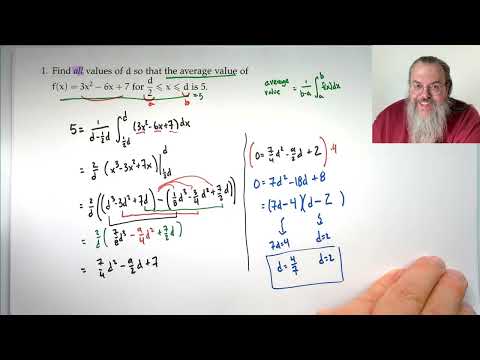
- Average-value problems can turn an interval endpoint into an unknown: for 3x² - 6x + 7 on [d/2, d], setting the average to 5 leads to d = 4/7 or d = 2.
- Algebraic rewriting can expose standard antiderivatives: (3x² + 15)/(x² + 1) becomes 3 + 12/(x² + 1), reducing integration to a linear term and an arctangent.
- For finite sums, separate constants from the index and use linearity with Σk = n(n + 1)/2 and Σ1 = n; this reduces the given expression to (3n + 5)/n².
- When a definite integral has identical bounds, its value is zero, and when its upper bound is x, the Fundamental Theorem of Calculus can find the derivative without finding an antiderivative.
- The expression √(4 - x²) describes a quarter-circle of radius 2 on [0, 2], so its integral is π and can replace a difficult antiderivative calculation.
- If F(x) = ∫ from a to x of f(t) dt, then F′ = f; consequently, F is concave down exactly where f is decreasing.
Chapters
- For f(x) = 3x² - 6x + 7 on [d/2, d], use average value = 1/(b-a) times the integral from a to b.
- Set the average equal to 5 and simplify the interval-length factor to 2/d.
- An average value can be understood as the rectangle height that gives the same area over the interval.
- An antiderivative of 3x² - 6x + 7 is x³ - 3x² + 7x.
- Substituting the endpoints and setting the result equal to 5 produces 7d² - 18d + 8 = 0.
- Factoring gives (7d - 4)(d - 2) = 0, so the possible values are d = 4/7 and d = 2.
- For the integral of (3x² + 15)/(x² + 1) from 1/√3 to 1, recognize that the denominator suggests an arctangent antiderivative.
- Rewrite the numerator as 3(x² + 1) + 12, so the integrand becomes 3 + 12/(x² + 1).
- This algebra avoids polynomial long division and separates the integral into a constant term and a standard arctangent term.
- An antiderivative of 3 + 12/(x² + 1) is 3x + 12 arctan(x).
- Use arctan(1) = π/4 and arctan(1/√3) = π/6 to evaluate the bounds.
- The definite integral simplifies to 3 + π - √3.
- For (1/n³) times the sum from k = 1 to n of 6k + 2, treat n as constant because the index k is the changing variable.
- Split the sum into 6 times the sum of k plus 2 times the sum of 1.
- Using Σk = n(n + 1)/2 and Σ1 = n gives the fully reduced result (3n + 5)/n².
- The sequence 3, 12, 21, 30, …, 84 has common difference 9 and can be written as 9k - 6 for k = 1 through 10.
- Apply linearity: the sum is 9Σk - 6Σ1 over those 10 terms.
- The sum is 435; a check pairs the first and last terms, 3 + 84 = 87, and multiplies by 10/2.
- Given ∫ from -7 to x of f(t) dt = e^(3x)f(x) - sin(5x) and f(0) = 2, the target tangent slope is f′(0).
- Differentiate both sides: the left side becomes f(x) by the Fundamental Theorem of Calculus, while the right side requires the product rule and chain rule.
- Substituting x = 0 yields 2 = f′(0) + 1, so the tangent slope is 1.
- For the sum from k = 0 to 4 of (-2x)^k + k² - 5k + 4, expand directly because there are only five terms.
- Substitute each integer k from 0 through 4, then collect the powers of x and constants.
- The simplified polynomial is 16x⁴ - 8x³ + 4x² - 2x + 1.
- For g(x) = ∫ from 3 to x of (4t² - 2t)/(t³ - 2) dt, the tangent at x = 3 requires g(3) and g′(3).
- The matching bounds make g(3) = 0 without evaluating an antiderivative.
- FTC gives g′(x) = (4x² - 2x)/(x³ - 2); evaluating at 3 gives slope 2 and tangent line y = 2x - 6.
- For the integral from 0 to 2 of (3√(4 - x²) - 2)², recognize y = √(4 - x²) as the upper half of a circle of radius 2.
- Expand the square to obtain 40 - 9x² - 12√(4 - x²).
- Separate the polynomial integral from the geometric area integral instead of seeking a cumbersome radical antiderivative.
- The integral of 40 - 9x² from 0 to 2 is 56.
- The integral of √(4 - x²) from 0 to 2 is one quarter of a radius-2 circle, with area π.
- Including the coefficient -12 gives the final result 56 - 12π.
- For velocity v(t) = ∫ from ln(t) to t² of cos(πx³) dx, acceleration is v′(t).
- Apply the variable-bounds rule: evaluate the integrand at the upper bound and multiply by 2t, then subtract its value at the lower bound times 1/t.
- At t = 1, the two contributions are -2 and -1, giving acceleration -3 m/s².
- With F(x) = ∫ from -3 to x of f(t) dt, F(4) is signed area under the graph from -3 to 4, not the graph's height at 4.
- Decompose the region into a triangle of area 2, a rectangle of area 7, and a half-circle of radius 2 with area 2π.
- The accumulated value is F(4) = 9 + 2π.
- FTC gives F′(x) = f(x), so F′(-3) is read directly from the graph as 3.
- F is concave down where F′ decreases, which here means identifying intervals where the graphed function f is decreasing.
- The decreasing intervals are (-3, 1), (1, 3), and (4, 6); the final problem set closes with a reminder to use the accumulated tools of the course.
Transcript excerpt
0:01 Now, let's do some learning, which means we're going to do problems as much as you can. Try to do the problems yourself first, but should you need some help, I'm here and I want you to learn. Let's begin with number one. Find all right so there may be more than one all the values of D. So that the average value of the function f ofx which is 3x^2 - 6 x + 7 for d /2 less than equal to x less than equal to d is 5. All right. Now what do we have? Well we know how to read these kinds of sentences right? We have this phrase the average value of
0:52 the function this interval equals five right so is five we know what that means equals five. So we just have to remind ourselves hey what's this average value thing? So here we go. So if we're looking for average value, you can almost think of it like what's the average height? Now what height do I have to have so that the area would be the same as if I were a rectangle versus a function. So the way you do it is it's one over the length of the interval. So b - a and then the total area of the integral integral a to b of f ofx dx. All right. So here we go. We'll write
1:48 down our equation. So we have that five is equal to right five equals average value and we have here's our our a and our b. So we'll mark these just so we can follow along a and b and there's our f ofx. So this will be 1 over and it'll be d minus 12 d the integral from 12 d up to d of 3x^2
This is the start of the transcript. Save this video free for the whole transcript, searchable and time-coded.
In this course
Related notes
Summary, takeaways, and chapters were generated by AI from the video's transcript and may contain errors. The video belongs to its creator, Beard Meets Calculus.