Fundamental Theorems of Calculus (Calc 1; Lecture 3-9; Fall 26)
Overview
Steve Butler connects differential and integral calculus through both parts of the Fundamental Theorem of Calculus: differentiating a cumulative integral recovers its integrand, and evaluating an antiderivative at the endpoints computes a definite integral. He develops these results with symmetry and geometric area, a Mean Value Theorem argument, chain-rule formulas for variable bounds, and a limit example whose value is 21.
Key takeaways
- For continuous f, the cumulative integral A(x) = ∫ₐˣ f(t) dt has derivative A′(x) = f(x), because its difference quotient is the average value of f over a shrinking interval.
- Definite integrals can be simplified before calculation: odd functions integrate to zero over symmetric bounds, while √(1 - x²) represents a semicircle whose area is π/2.
- For variable limits, differentiate the upper-bound contribution and subtract the lower-bound contribution: f(h(x))h′(x) - f(g(x))g′(x).
- A definite integral with fixed bounds is constant with respect to x, even if its integrand contains the symbol x; the integration variable can be renamed.
- FTC Part II computes ∫ₐᵇ f(x) dx as F(b) - F(a) for an antiderivative F, with the arbitrary constant canceling and reversed bounds changing the sign.
- The limit [1/x³]∫ₓ⁴ˣ sin(t²) dt evaluates to 21 after two applications of L’Hôpital’s Rule, using FTC Part I to differentiate the numerator.
Chapters
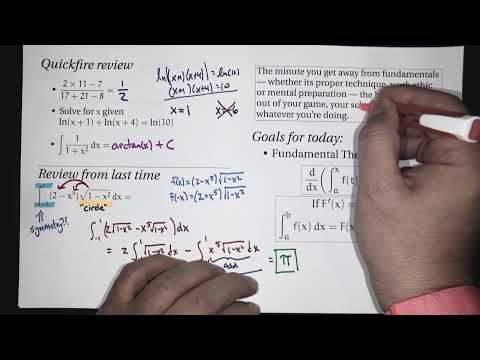
- The logarithmic equation log(x + 1) + log(x + 4) = log(10) has the valid solution x = 1; x = -6 is rejected because it makes the logarithm inputs invalid.
- The indefinite integral of 1/(1 + x²) is arctan(x) + C.
- A definite integral represents a total over an interval, often interpreted as signed area beneath a curve.
- For the integral from -1 to 1 of (2 - x⁵)√(1 - x²), split the integrand into 2√(1 - x²) and -x⁵√(1 - x²).
- The x⁵√(1 - x²) term is odd, so its integral over [-1, 1] is zero.
- The graph of √(1 - x²) is the top half of the unit circle, with area π/2; multiplying by 2 gives the result π.
- Butler frames differential calculus as measuring change and integral calculus as finding totals, then connects them by asking how a total changes.
- For continuous f, differentiating the cumulative function ∫ₐˣ f(t) dt gives f(x).
- If F is any antiderivative of f, the definite integral from a to b equals F(b) - F(a).
- A piecewise graph uses a constant segment, a line segment, and a lower semicircle centered at (5, 3) with radius 2.
- The integral from 3 to -1 is -6: the corresponding rectangle and triangle have total area 6, and reversing the bounds changes the sign.
- For the interval from 1 to 5, rectangle and triangle areas total 4, while the circular segment is a rectangle of area 6 minus a quarter-circle of area π, giving 10 - π.
- An integral with identical bounds, such as the integral from 4 to 4, equals zero.
- Butler defines a cumulative function by integrating a continuous f from a fixed starting point to x, then applies the derivative limit definition.
- Subtracting the integrals to x + h and x leaves the integral from x to x + h; dividing by h gives the average value of f on that short interval.
- The integral Mean Value Theorem identifies a point between x and x + h where that average equals f; as h approaches zero, the point approaches x.
- The result establishes that every continuous function has an antiderivative in theory, even when no familiar closed-form expression is available.
- For an upper bound h(x), the derivative of ∫ₐʰ⁽ˣ⁾ f(t) dt is f(h(x))h′(x).
- When both bounds vary, the derivative of ∫g⁽ˣ⁾ʰ⁽ˣ⁾ f(t) dt is f(h(x))h′(x) - f(g(x))g′(x).
- The minus sign for the lower bound follows from reversing its integral limits before differentiating.
- The derivative of ∫₁₀ˣ sin(t⁴)eᵗ dt is sin(x⁴)eˣ, even though finding an antiderivative of the integrand is difficult.
- The integral from 3 to 7 of x² is a constant with respect to x, so its derivative is zero.
- For ∫ₓ²²ˣ sin(t²) dt, use the upper-bound term minus the lower-bound term, applying the chain rule to both bounds.
- The limit as x approaches 0 of [1/x³]∫ₓ⁴ˣ sin(t²) dt initially has the indeterminate form 0/0.
- Applying L’Hôpital’s Rule to numerator and denominator uses FTC Part I to produce 4 sin(16x²) - sin(x²) over 3x².
- A second application gives [128x cos(16x²) - 2x cos(x²)]/(6x); canceling x and substituting 0 yields 126/6 = 21.
- If F′(x) = f(x), then ∫ₐᵇ f(x) dx = F(b) - F(a), evaluating the antiderivative at the endpoint and subtracting its value at the start.
- The derivation splits the integral at a fixed point and shows that the arbitrary constants in the antiderivative cancel.
- Only one antiderivative is needed, so the final endpoint evaluation does not require writing +C.
- The endpoint formula requires care at asymptotes; improper integrals can be handled, but not by applying the rule without checking the discontinuity.
Transcript excerpt
0:00 So let's start with our quick fire review. Yay! Okay. All right. 2 times 11 subtract seven over 17 plus 21 minus eight. We put that all together. What do we get? 1/2. Yeah. All right. Got to warm up. Solve for X. We're given log of X plus one plus log of X plus four is log of 10. So what X makes this true? Or what X's make this true? Perhaps there's more than one. Say what? >> X equals one. >> X equals one? All right. X equals one. Now we can check that, right? Uh let's
0:49 try one. 1 plus one is two. 1 plus four is five. So you're we're saying log two plus log five is log 10. Well, remember when we add that becomes multiplication. So so yeah, that's that works. Is there anything else that works? Okay. All right. Good. Now some people might be tempted to say negative six. But we're not going to yield to that temptation. No. No. Now why might somebody be tempted to say negative six? Well, they say look, log of a sum becomes log of a product. So log of X
1:37 plus one times X plus four equals log 10. And say look, I just have to have the insides match. So X plus one times X plus four equals 10. And if you start with this problem, X plus one times X plus four equal 10, you can foil on the left hand side, bring the 10 over, factor again. It out that there are two solutions, one and -6. So, wait, if this has two solutions, why did we say -6 is not a solution here? Yeah, you have to be careful. Even though when we went forward, we got to a place
This is the start of the transcript. Save this video free for the whole transcript, searchable and time-coded.
In this course
Related notes
Summary, takeaways, and chapters were generated by AI from the video's transcript and may contain errors. The video belongs to its creator, Beard Meets Calculus.