Substitution rule (definite) (Calc 1; Lecture 3-11; Fall 26)
Overview
Steve Butler reviews arithmetic, exponential-polynomial division, and the Mean Value Theorem before developing substitution as a way to simplify integrals. He shows how to choose and adjust substitutions, account for every variable, and update definite-integral bounds, including examples that evaluate to zero and pi/6 even when an antiderivative is unavailable or obscured.
Key takeaways
- A substitution must replace every occurrence of the original variable; in the integral of y³√(9 - y²), the relation y² = 9 - u is needed in addition to y dy = -½du.
- For definite integrals, convert both endpoints using the substitution: x = -2 and x = 1 both give u = 2 when u = x² + x, so the integral is zero.
- A useful substitution can be identified either from an expression nested inside another function or from a factor whose antiderivative could serve as the new variable.
- Substitution can simplify an integral even when the bounds happen to look unchanged; with u = y^(3/2), the bounds 0 and 1 remain 0 and 1, and the result is π/6.
- If a trial substitution only partly matches, rewriting the integrand can make it work; for (1 + e^t)/(1 + te^t), u = e^t + t exposes the logarithmic antiderivative.
- Consistent practice supports reliable calculus work: Butler recommends spreading study into 10-to-15-minute sessions instead of concentrating it on exam days.
Chapters
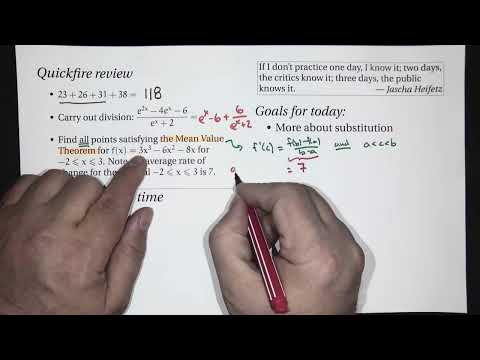
- The sum 23 + 26 + 31 + 38 is 118; grouping the digits to make tens offers a useful arithmetic check.
- Rewrite e^(2x) - 4e^x - 6 as a polynomial in e^x, then divide by e^x + 2.
- Long division gives e^x - 6 + 6/(e^x + 2), a friendlier form for later integration.
- For f(x) = 3x^3 - 6x^2 - 8x on [-2, 3], the stated average rate of change is 7.
- Set f'(c) = 7, giving 9c^2 - 12c - 15 = 0 and roots c = (2 ± √19)/3.
- Both roots lie between -2 and 3; the example also illustrates why checking algebra matters when a quadratic fails to factor as expected.
- Steve Butler connects substitution to reversing the chain rule, calling it a central technique for finding antiderivatives.
- For ∫(1 + e^t)/(1 + te^t) dt, rewriting the expression or choosing u = e^t + t produces ∫du/u.
- The result ln(e^t + t) + C is equivalent to t + ln(1 + te^t) + C.
- Jascha Heifetz's practice anecdote introduces the value of consistent work rather than cramming immediately before exams.
- Butler recommends short study sessions of 10 to 15 minutes and notes that exam-day study activity can spike by 600 to 800 percent.
- For integrals, try a plausible substitution, then rewrite or split the expression if the first attempt only partly fits.
- For ∫y³√(9 - y²) dy, choose u = 9 - y² because it is the expression inside the square root.
- Use y³ = y²·y, y² = 9 - u, and y dy = -½du so no y remains after substitution.
- Integrating and substituting back gives -3(9 - y²)^(3/2) + (1/5)(9 - y²)^(5/2) + C.
- For ∫1/√(1 + √t) dt, let u = 1 + √t, so √t = u - 1 and dt = 2(u - 1)du.
- The transformed integrand is 2u^(1/2) - 2u^(-1/2), which can be integrated with the power rule.
- Substituting back yields (4/3)(1 + √t)^(3/2) - 4√(1 + √t) + C.
- The bounds in ∫ from a to b f(x) dx refer to x-values, so changing to u requires updating those bounds.
- Updating bounds as the substitution is made avoids converting the antiderivative back to x and is often more efficient.
- Alternatively, keep the original bounds only if you return to the original variable before evaluating.
- In ∫ from -2 to 1 (2x + 1)e^((x² + x)³) dx, choose u = x² + x because its derivative is 2x + 1.
- The x-bounds -2 and 1 both map to u = 2, turning the integral into ∫ from 2 to 2 e^(u³) du.
- The definite integral is zero because its bounds are equal, even though e^(u³) has no elementary antiderivative.
- For ∫ from 0 to 1 √y/(y³ + 1) dy, use u = y^(3/2), chosen because its derivative contains √y.
- Then du = (3/2)√y dy and y³ = u², so the integral becomes (2/3)∫ from 0 to 1 1/(u² + 1) du.
- The bounds remain 0 and 1 under this substitution, and evaluating arctan gives π/6.
Transcript excerpt
0:00 So, let's start with our quickfire review. All right. So, first one, 23 + 26 + 31 + 38. You put all of these together, what do you get? >> 118. Yeah. Now, you might think, oh my goodness, they would never have a problem where they ask us to like add four numbers together, right? Well, do you remember remon sums? That's on the exam. And that means you have to be able to add numbers. So don't underestimate arithmetic, right? Make sure your arithmetic skills are in good shape. Often times I like to do things like grouping. So for example, I see the
0:47 3, 6, and 1 make a 10. 20, 20, and 30 make 70. So altogether, this makes 80. 80 + 38 makes 118. All right. Now the next one, carry out division. And you look at this problem, you might say, "What do you mean carry out division? There isn't any division in this problem." Or is there? All right. So you have e 2x - 4 e x - 6 / e to x + 2. Did anybody figure out what this was even asking for? And then even if they got that, did you figure out what the division was? Cool. Okay. So, let's talk about this
1:38 one. Um, I think here there is a moral to this one, but uh first let's just work through it. I'll grab a spare piece of paper here. So you have e 2x - 4 e x - 6 over e x + 2. Now the takeaway I want you to grab from this one because I'm I'm trying to help remind you of like plant some seeds. The takeaway I want you to to hit [snorts] here is if you see something like e to the you know k * x that's the
This is the start of the transcript. Save this video free for the whole transcript, searchable and time-coded.
In this course
Related notes
Summary, takeaways, and chapters were generated by AI from the video's transcript and may contain errors. The video belongs to its creator, Beard Meets Calculus.