More with Newton's method and introduction to Mean Value Theorem (Calc 1; Lecture 3-3; Fall 26)
 Watch on YouTube →
Overview
The lecture develops Newton’s method as a way to approximate roots by repeatedly using tangent-line intersections, then applies it to finding √2, a curve intersection, and a root of x − cos(x). It introduces Rolle’s theorem and the Mean Value Theorem, explains their relationship through a transformed function, and verifies the theorem for h(t) = 2t/(1 + t²) on [0, 1].
Key takeaways
- Newton’s method updates a guess using xₙ₊₁ = xₙ − f(xₙ)/f′(xₙ), geometrically following the tangent line to its x-intercept.
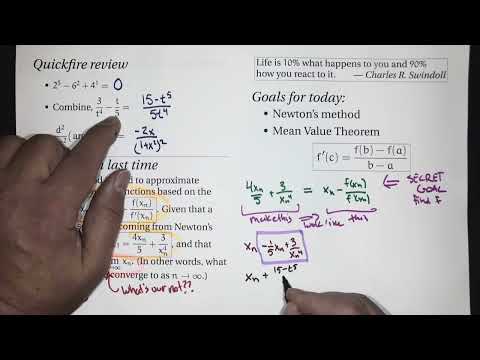
- A Newton recurrence can reveal its target root by rewriting it in the form xₙ − f(xₙ)/f′(xₙ); the recurrence 4xₙ/5 + 3/xₙ⁴ corresponds to f(x) = x⁵ − 15.
- For f(x) = x² − 2, starting Newton’s method at 1 produces 3/2 and then 17/12, an estimate of √2 accurate to about four decimal places after two updates.
- Newton’s method can turn an intersection problem into root-finding: x³ = 5 + 5x becomes x³ − 5x − 5 = 0, with two updates from x₀ = 2 producing 59/22.
- Rolle’s theorem is the equal-endpoint special case of the Mean Value Theorem: continuity and differentiability guarantee an interior derivative equal to the interval’s average rate of change.
- For h(t) = 2t/(1 + t²) on [0, 1], the Mean Value Theorem’s matching point is c = √(√5 − 2), found by setting h′(c) equal to the average slope of 1.
Chapters
- The opening review checks exponent arithmetic and combining 3t⁴ − t/5 over the common denominator 5t⁴.
- The class recalls that finding the second derivative of arctan(x) begins with its first derivative, 1/(1 + x²).
- Newton’s method seeks a function’s x-intercept by improving an initial guess through repeated tangent-line estimates.
- A recurrence’s limit represents the root the iterations approach, not necessarily its stated starting value of 11.
- The recurrence 4xₙ/5 + 3/xₙ⁴ is rewritten as xₙ − (xₙ⁵ − 15)/(5xₙ⁴).
- Matching the numerator and denominator to f(xₙ) and f′(xₙ) identifies f(x) = x⁵ − 15 and f′(x) = 5x⁴.
- The target root is x = 15^(1/5), so the recurrence is expected to converge to that value.
- The lecture distinguishes the Mean Value Theorem’s use of “mean” as average from the everyday meaning of unkind.
- Its central comparison is between average rate of change, [f(b) − f(a)]/(b − a), and instantaneous rate of change, f′(c).
- Newton’s method remains the first topic, followed by an introduction to the Mean Value Theorem.
- To find √2, choose f(x) = x² − 2, whose root is √2, and use Newton’s update xₙ₊₁ = xₙ − (xₙ² − 2)/(2xₙ).
- Starting at x₀ = 1 gives x₁ = 3/2 and x₂ = 17/12, approximately 1.4167.
- The example shows how repeated iterations quickly improve an estimate; ancient Mesopotamian calculations used related iterative ideas to approximate square roots.
- The intersection of y = x³ and y = 5 + 5x becomes the root-finding problem f(x) = x³ − 5x − 5 = 0.
- With f′(x) = 3x² − 5 and x₀ = 2, the first update is x₁ = 3.
- The second update is x₂ = 3 − 7/22 = 59/22, approximately 2.682; the in-class arithmetic is corrected to this value.
- For f(x) = x − cos(x), the derivative is 1 + sin(x), giving xₙ₊₁ = xₙ − (xₙ − cos(xₙ))/(1 + sin(xₙ)).
- Starting from x₀ = 0, computer iterations converge to the root in only a few steps.
- Repeatedly applying x ↦ cos(x) also converges to the same value, but the lecture contrasts its much slower convergence, taking about 50 iterations for comparable displayed precision.
- For a continuous function on a closed, bounded interval, the Extreme Value Theorem guarantees an absolute maximum and minimum.
- Rolle’s theorem adds equal endpoint values and differentiability, concluding that f′(c) = 0 for at least one interior point.
- If both extrema occur at the endpoints while the endpoint values match, the function must be constant on the interval; otherwise an interior extremum has derivative zero.
- The Mean Value Theorem keeps Rolle’s continuity and differentiability conditions but drops the requirement that f(a) = f(b).
- It guarantees a point c where f′(c) = [f(b) − f(a)]/(b − a), meaning a tangent line is parallel to the endpoint secant.
- A speeding example applies the result to average speed: if a car averages 75 miles per hour over an interval, its instantaneous speed must reach at least 75 miles per hour during that interval.
- The proof defines g(x) = f(x) − [f(b) − f(a)](x − a)/(b − a), which has equal endpoint values and inherits continuity and differentiability from f.
- Applying Rolle’s theorem gives g′(c) = 0, which rearranges to the Mean Value Theorem equation for f′(c).
- For h(t) = 2t/(1 + t²) on [0, 1], the average rate of change is 1; solving h′(c) = 1 yields c = √(√5 − 2), the solution inside the interval.
Transcript excerpt
0:00 We'll start as we often do. We start with our quickfire. Okay. So our first problem, if you have 2 5th subtract 6^ 2 add 4 to ^ 1, what do we get? >> Zero. >> Zero. Yes. Good. All right. And zero is a good friend of ours. Some a little bit of an algebra combine. So putting it as to one term 3 t 4th subtract t over 5 what will this become? get a common denominator.
0:53 If you can't see anything that the denominators currently have in common, it's just oh, the common denominator is the multiplying the terms together. So the common denominator would be the t 4th * 5 or 5 t 4th. So the first term you multiply by 5 over 5. That gives you your 15 upstairs. Second term t 4th over t 4th and that gives you your t 5th. And don't forget the minus. [snorts] All right. Well, an oldie but a goodie. We have to make sure we always keep track of our arc tangent. What's the second d? That's our notation. d^2 dx^2 of arc tangent of x. The second dative of arc tangent of x -2x over 1 + x^2. Good. And of course we
1:43 should keep in mind what's an intermediate step to finding the second d of arc tangent. >> Find the first der of arc tangent. And that we should just know. We love the first d of arc tangent. It's such a nice answer. 1 over 1 + x^2. And uh then you can go from there to get your second derivative. Now, at the very end of last time, we just barely had a chance to say hello to this idea of Newton's method. And so, this is it's going to be a
This is the start of the transcript. Save this video free for the whole transcript, searchable and time-coded.
Related notes
Summary, takeaways, and chapters were generated by AI from the video's transcript and may contain errors. The video belongs to its creator, Beard Meets Calculus.