University of Missouri-St. Louis CS 3130
Professor He · University of Missouri-St. Louis · 12 lectures with notes
Students in this class: ask your lecturer for the class code, and these lectures will already be in your library when you sign up.

CS3130FS26Module3AVidProc
Recursion solves complex problems by reducing them to smaller instances, with call-stack memory as the main cost.
CS3130FS26Module2C2VidProc
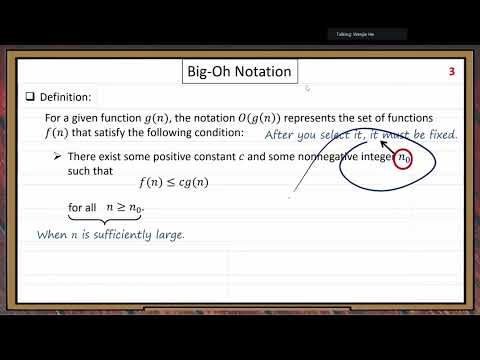
Big O, Big Omega, and Big Theta compare growth through bounds that hold for all sufficiently large input sizes.
CS3130FS26Module2C1VidProc
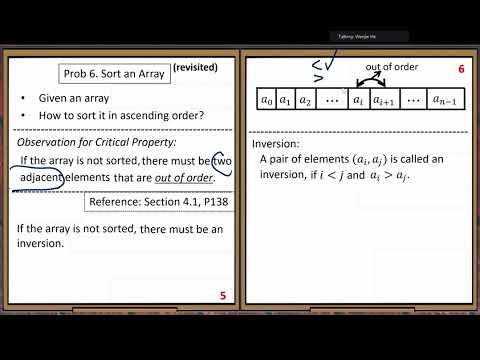
Bubble sort repeatedly removes adjacent inversions, while asymptotic notation compares algorithm growth using limits or constant bounds.
CS3130FS26Module2BVidProc
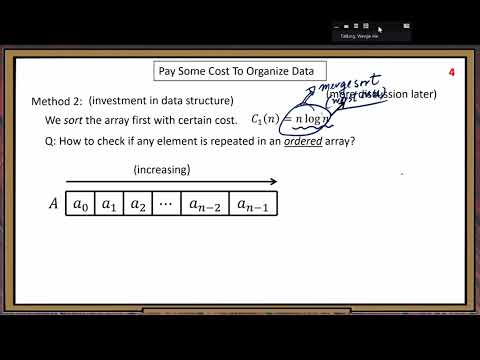
Sorting turns element uniqueness from a quadratic pairwise search into an n log n worst-case algorithm.
CS3130FS26Module2AVidProc
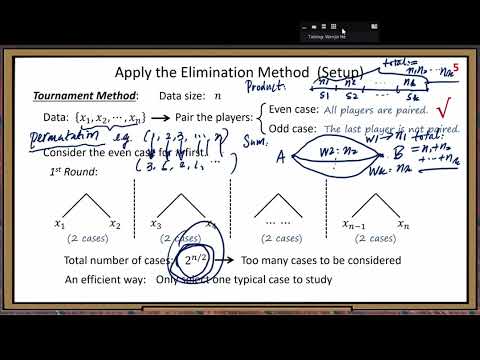
Selection sort repeatedly places the minimum, requiring n(n−1)/2 comparisons regardless of input order.
CS3130FS26Module1DVidProc
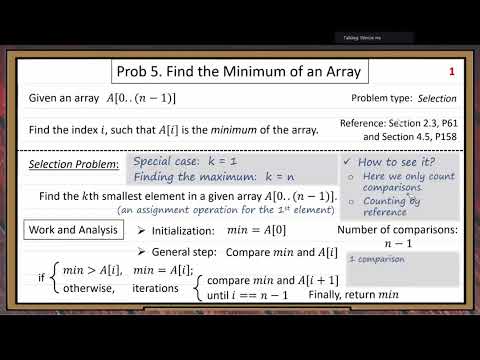
An n−1-comparison scan finds an array’s minimum optimally, as shown by a lower bound based on eliminating losing candidates.
CS3130FS26Module1CVidProc
Recognizing polynomial structure saves operations; probability-weighted analysis and overflow awareness help evaluate algorithms reliably.
CS3130FS26Module1B3VidProc
Horner’s rule and repeated squaring show how algorithm design can cut polynomial and exponentiation multiplication counts dramatically.
CS3130FS26Module1B2VidProc
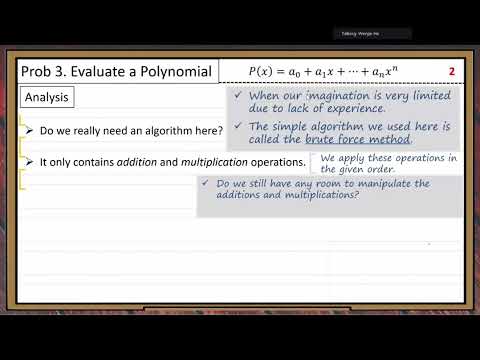
Horner’s rule evaluates a degree-n polynomial with n multiplications by factoring and reusing intermediate results.
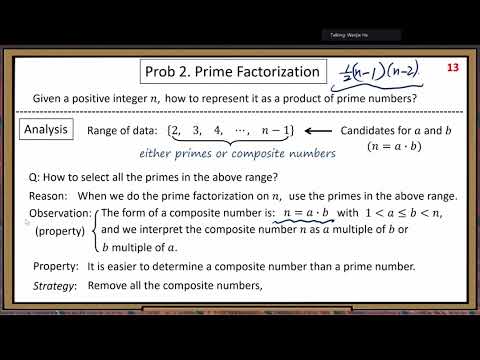
CS3130FS26Module1B1VidProc
Use complement-based sieving and square-root bounds to reduce prime-finding work, then apply operation counting to improve polynomial evaluation.
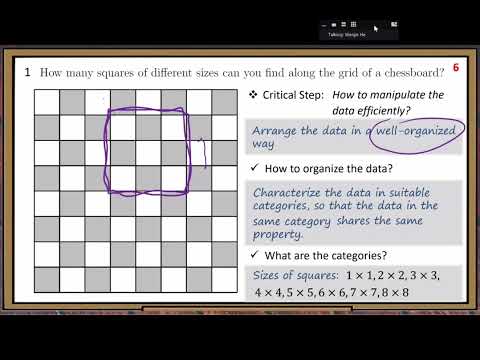
CS3130FS26Module1A2VidProc
Organizing cases, finding invariants, and shrinking search ranges turn counting and factorization problems into manageable computations.

CS3130FS26Module1A1VidProc
CS3130 combines a detailed assessment plan with a first problem-solving lesson on organizing chessboard squares by size.