CS3130FS26Module1B1VidProc
 Watch on YouTube →
Overview
The lecture develops two algorithm-design ideas through prime finding: eliminate composites with the Sieve of Eratosthenes, and reduce trial-division work using the fact that a composite number has a factor no larger than its square root. It then outlines prime factorization in canonical prime-power form and begins polynomial evaluation, showing that repeated multiplication computes x⁴ in three operations while squaring an intermediate computes it in two.
Key takeaways
- For finding primes in a range, eliminating composites is more efficient than proving each number prime because one factor pair disproves compositeness, while primality requires checking all possible factors.
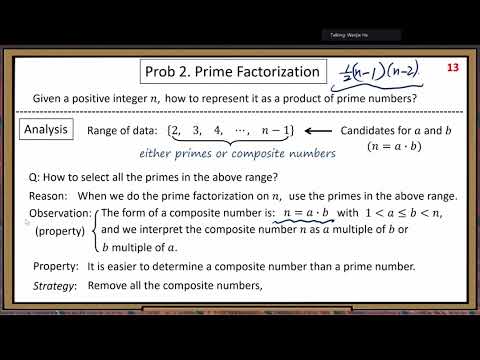
- If n = a·b with a ≤ b, then a ≤ √n; consequently, the Sieve of Eratosthenes only needs prime bases up to floor(√n), such as 2, 3, 5, and 7 for n = 100.
- Starting a sieve round at p² avoids redundant work because smaller multiples of p have already been eliminated by smaller prime factors.
- Trial division should repeatedly divide by a discovered prime: an input containing 2⁵ requires extracting the factor 2 five times before testing the next prime.
- Prime factorization has a unique standard representation when distinct prime bases are ordered increasingly and paired with positive exponents.
- Reusing intermediate results improves computation: x⁴ takes two multiplications as (x²)², compared with three under repeated multiplication.
Chapters
0:00
Why Eliminating Composites Beats Testing Every Number for Primality
- For a composite n, finding one factor pair is enough to prove compositeness; proving primality requires ruling out every possible pair.
- The lecture contrasts direct prime testing with crossing out composites, favoring the easier complementary problem.
- The Sieve of Eratosthenes finds primes indirectly: remove composites and retain the numbers that remain.
9:00
Organize Composite Numbers into Multiples of Prime Bases
- Composite numbers are grouped into categories such as multiples of 2, 3, and 5 to avoid processing candidates in a disorganized, repetitive way.
- For each prime base, the base itself remains as a prime; its larger multiples are composite.
- The lecture connects this organization strategy to categorizing mixed-size squares in an earlier chessboard problem.
13:00
Partition Rules for Managing Composite-Number Categories
- A partition of the composite-number set must cover the entire set so no composite is missed.
- Distinct subsets must not overlap, preventing redundant processing of the same number.
- Empty subsets are excluded; multiples-of-prime categories provide the intended organization.
17:00
Sieve Rounds on the Integers from 2 Through 100
- The example processes integers 2 through 100 in rounds, first crossing out multiples of 2, then multiples of 3, then 5 and 7.
- Numbers already crossed out in an earlier round, such as 6, need no further work in later rounds.
- The remaining uncrossed numbers are the primes in the range.
21:00
Use the Square-Root Bound to Stop Sieving
- For a composite n = a·b with a ≤ b, n ≥ a², so the smaller factor satisfies a ≤ √n.
- For n = 100, it is sufficient to process prime bases 2, 3, 5, and 7; no base larger than √100 = 10 is needed.
- Restricting candidate factors to primes at most floor(√n) reduces the number of rounds and the amount of work.
25:00
Sieve Implementation: Start Crossing Out at p²
- Each round selects the smallest unprocessed table entry p and treats it as prime.
- Crossing out multiples can start at p² because every smaller multiple of p already has a smaller factor and was handled earlier.
- After processing p, advance to the next uncrossed table entry and repeat until the square-root stopping condition is reached.
29:00
Trial Division Finds Prime Factors of a Number
- The lecture shifts from listing primes to factoring a given integer by testing prime divisors in increasing order.
- For each candidate p, a zero remainder from n mod p identifies p as a factor.
- After recording p, divide the current n by p and continue factoring the quotient.
33:00
Prime-Power Form and the Unique Factorization Theorem
- A factor list becomes a standardized decomposition n = p₁^e₁ · p₂^e₂ · … · pₖ^eₖ.
- The prime bases are distinct and written in ascending order; each exponent is a positive integer.
- Under this convention, the Fundamental Theorem of Arithmetic guarantees one and only one prime-power decomposition for every positive integer.
37:00
Trial-Division Pseudocode and Repeated Prime Factors
- The proposed routine maintains a factor list F and tests primes up to the square root of the original input.
- An inner while loop repeatedly divides by the same p, so inputs such as 2⁵·3⁴ contribute five 2s and four 3s to F.
- If no proper factor is found and F remains empty, the original input is prime and is added as its own factor.
43:00
Generating Candidate Primes as a Subproblem
- Trial division depends on a candidate list P containing primes no greater than √n, creating a separate prime-generation subproblem.
- One option is to generate P completely with the Sieve of Eratosthenes; another is to use consecutive integers and tolerate composite candidates.
- The lecture frames the choice as a resource tradeoff: extra candidate checks may cost less than computing and storing a fully filtered prime list.
53:00
Polynomial Evaluation as an Algorithm-Efficiency Problem
- The next topic evaluates a polynomial with coefficients stored in an array for a given value of x.
- Although the standard calculation is familiar, the central question is whether its multiplication strategy is efficient.
- The course introduces this topic early so students have more time for programming projects, including an optional prime-factorization project worth 2%.
57:00
Count Multiplications in the Straightforward Polynomial Method
- The straightforward method computes each term aₖxᵏ and sums the terms.
- For aₖxᵏ, repeated multiplication uses k multiplications to form xᵏ; the lecture checks k = 1 and k = 2 before generalizing.
- Testing simple cases and identifying a pattern is presented as a practical way to reason about a variable-sized problem.
1:02:00
Compute x⁴ with Two Multiplications Instead of Three
- The lecture asks whether the straightforward power calculation can be improved and notes that efficiency comparisons need an objective performance measure.
- For x⁴, repeated multiplication takes three multiplications: x·x·x·x.
- Reuse the intermediate x² and calculate x²·x² to obtain x⁴ in two multiplications, demonstrating room for improvement through intermediate results.
Summary, takeaways, and chapters were generated by AI from the video's transcript and may contain errors. The video belongs to its creator, DrHeUMSLTeaching.