CS3130FS26Module1DVidProc
 Watch on YouTube →
Overview
Module 1 Part D establishes that scanning an unordered array to find its minimum takes exactly n−1 comparisons: a candidate-minimum algorithm achieves that count, and an elimination argument proves no algorithm can do better. It then applies elimination thinking to finding both the minimum and maximum, setting up pairwise tournament comparisons and explaining how the 2^(n/2) possible outcomes can be represented by a typical case.
Key takeaways
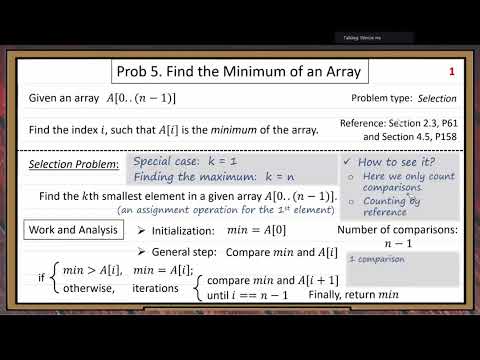
- A single-pass minimum scan makes n−1 comparisons: the first element initializes the candidate, and each of the other n−1 elements is compared once.
- The minimum algorithm is optimal because each comparison can eliminate at most one viable minimum candidate, while n−1 candidates must be eliminated.
- Transitivity lets previous comparisons establish indirect relationships, so an algorithm can infer outcomes without comparing every pair directly.
- Eliminating elements that cannot satisfy the selection criterion prevents redundant comparisons; the same reasoning applies to goals such as finding the median or second-largest element.
- Pairing n distinct elements creates n/2 first-round comparisons and 2^(n/2) possible outcome patterns; structural similarity motivates analyzing a representative pattern instead of enumerating them all.
Chapters
0:00
Selection Problems: Finding the Minimum as k = 1
- Selection problems find the kth-smallest array element; finding the minimum is the special case k = 1.
- Finding the maximum corresponds to k = n and is symmetric to finding the minimum.
- The array is assumed unordered unless the problem states otherwise.
4:04
The Candidate-Minimum Scan
- Initialize a temporary minimum candidate from the first array element.
- Process each remaining element, replacing the candidate whenever the current element is smaller.
- After scanning the array, return the minimum candidate; the method examines every element.
7:03
Counting the Minimum Algorithm’s Comparisons
- The first element becomes the initial candidate without a comparison, leaving n−1 comparisons for the remaining elements.
- Count comparisons as the basic operation; assignments are not included in this efficiency measure.
- The central question is whether any algorithm can find the minimum in fewer than n−1 comparisons.
13:00
Why Proving Optimality Requires More Than an Intuition
- Showing an algorithm is optimal requires comparing it against every possible algorithm for the same problem.
- Many competing algorithms are unknown, so a proof cannot depend on listing or inspecting them individually.
- The proposed strategy is to identify properties shared by all algorithms and use them to establish a lower bound.
18:20
Use Shared Properties to Analyze Unknown Algorithms
- Common properties allow reasoning about algorithms whose specific steps are not known.
- Comparisons are modeled as contests: for minimum-finding, the smaller element wins.
- The sports analogy has limits: unlike ordinary matches, numerical comparisons obey transitivity.
23:41
Transitivity Creates Indirect Comparisons
- If A is greater than B and B is greater than C, transitivity establishes A > C without directly comparing A and C.
- Treat this as an indirect comparison: previous results already determine the relationship between the elements.
- Recognizing indirect comparisons helps explain why an algorithm need not compare every pair directly.
27:24
Set Up the Lower-Bound Proof with a Final Winner
- The proof treats the minimum as the final winner of a sequence of comparisons.
- Assume all elements are distinct so every comparison has a clear winner and loser.
- This simplified case removes ties from the reasoning; the general problem can be addressed after the core argument.
30:03
Apply the Simplification Rule Without Losing the Original Problem
- The golden rule is to simplify a hard problem first, then return to the original version and handle the removed complications.
- With distinct elements, the minimum must beat every other element, directly or through transitive comparisons.
- The simplification supports a cleaner proof while preserving the obligation to account for ties in the general case.
34:15
Every Minimum-Finding Algorithm Must Eliminate n−1 Candidates
- An element that loses a comparison cannot be the minimum, so it is eliminated from consideration.
- A comparison can eliminate at most one previously viable candidate; redundant comparisons may eliminate none.
- Finding one final minimum requires eliminating the other n−1 elements, so at least n−1 comparisons are necessary.
37:49
The n−1 Scan Is Optimal by Matching the Lower Bound
- The candidate-minimum scan uses n−1 comparisons, matching the lower bound required by the elimination proof.
- Because no algorithm can use fewer than n−1 comparisons, the scan is optimal for finding a minimum.
- The argument applies even to unknown algorithms because it relies on properties shared by all comparison-based solutions.
47:13
Extend the Result to Finding Minimum and Maximum Together
- The next problem asks for both the maximum and minimum in one function call, rather than two separate scans.
- The discussion assumes n distinct elements to avoid tie-handling complications.
- The minimum-finding proof motivates an elimination method for discarding elements that cannot meet a target criterion.
49:27
Elimination Method: Discard Elements That Cannot Be the Answer
- Eliminate any element known not to satisfy the goal, such as finding the median or second-largest value.
- Keeping irrelevant elements can cause redundant comparisons and move an algorithm away from an efficient solution.
- Reducing the set of candidates means subsequent work operates on fewer elements and can require fewer comparisons.
56:35
Pair the Elements for a First-Round Tournament
- Group array elements into pairs so one comparison in each pair identifies a winner and a loser.
- Consider the even-n case first because every element is paired and there is no unpaired singleton.
- The first tournament round organizes the comparisons needed to build toward finding both extremes.
1:01:10
Count Pairwise Outcomes with the Product Rule
- Each of the n/2 pairs has two possible outcomes, producing 2^(n/2) combinations of winners and losers.
- Use the product rule because every pair contributes an outcome to the complete set of comparison results.
- Rather than analyze all outcomes—for example, 2^50 when n = 100—study one structurally representative case, which can stand for the others.
Summary, takeaways, and chapters were generated by AI from the video's transcript and may contain errors. The video belongs to its creator, DrHeUMSLTeaching.