CS3130FS26Module1B2VidProc
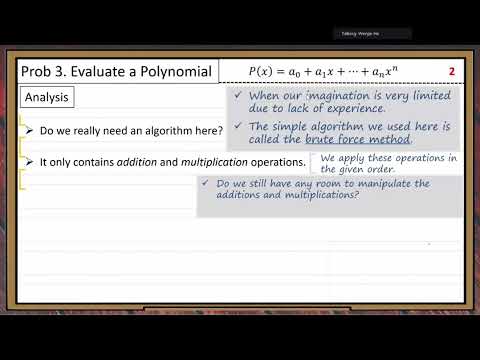 Watch on YouTube →
Overview
The lecture compares brute-force evaluation of a degree-n polynomial with Horner’s rule, using operation counts to show why reusing intermediate results and factoring common terms can reduce computation. Under the assumption that an addition costs 1 time unit and a multiplication costs 10, brute force uses n additions and n(n+1)/2 multiplications, while Horner’s rule reduces the multiplication count to n by repeatedly factoring and sharing work.
Key takeaways
- For a degree-n polynomial evaluated by brute force, the multiplication counts across terms sum to 1 + 2 + … + n = n(n+1)/2, while there are n additions.
- Under the lecture’s illustrative cost model of 1 time unit per addition and 10 per multiplication, brute-force evaluation costs n + 5n(n+1) time units.
- Horner’s rule repeatedly factors common powers of x so intermediate products are shared, reducing the multiplication count to n.
- Operation counts are more portable than measured execution time because runtime depends on hardware and implementation quality.
- A bijection between plus signs and the subscripts of following terms lets the addition count be read from the sequence 1 through n.
- Greedy factorization applies each available factoring step as fully as possible, but local optimality does not guarantee a globally optimal solution.
Chapters
0:00
Brute Force and Reusing the Result of x²
- The initial approach evaluates each polynomial term straightforwardly, without a special technique; this becomes the brute-force baseline.
- For x⁴, direct multiplication takes 3 multiplications, while calculating x² once and reusing it takes 2.
- Storing an intermediate value has low cost and can reduce repeated computation.
5:11
Problem-Solving Goal: Improve on Brute Force
- The next step is to find smart techniques that improve on the brute-force method.
- The lecture emphasizes understanding the problem and using observation and experience to identify opportunities for improvement.
- Counting additions and multiplications provides a basis for comparing approaches.
8:11
Changing Evaluation Order by Grouping x⁴
- The expression x⁴ can be grouped as (x × x) × (x × x) without changing its value.
- Both parenthesized groups produce the same x², so the second can reuse the first group’s result.
- Changing the expression’s structure changes its evaluation order and saves one multiplication.
14:19
Why Operation Counts Beat Execution-Time Comparisons
- Execution time varies with hardware, such as a supercomputer versus a low-end computer, and with differences in software implementations.
- Counting operations gives a more stable basis for comparing algorithms across computing environments.
- To combine additions and multiplications into one cost measure, the lecture assumes 1 time unit per addition and 10 per multiplication.
20:18
A CPU-Based 10-to-1 Cost Model
- The illustrative CPU model assigns 2 clock cycles to an integer addition and 20 to an integer multiplication.
- The resulting 10-to-1 ratio motivates treating one multiplication as costing 10 additions.
- The exact ratio is an assumption for analysis; the key point is that multiplication is treated as more costly.
24:44
Counting Polynomial Additions by Reference
- Each plus sign corresponds to one addition, but ellipses make direct counting difficult.
- Counting by reference pairs each plus sign with the subscript of the following polynomial term.
- Because the subscripts run from 1 through n, the polynomial has n additions.
27:47
One-to-One Correspondence as a Counting Technique
- Counting by reference uses a bijection between two finite sets to show they have the same number of elements.
- The difficult set is the polynomial’s plus signs; the easier reference set is the sequence of term subscripts 1 through n.
- The same technique can help count operations in expressions with omitted terms.
36:43
Brute-Force Multiplications and Weighted Cost
- The first term requires no multiplication; the remaining terms require 1, 2, …, n multiplications.
- Summing those counts gives n(n+1)/2 multiplications for a degree-n polynomial.
- With additions costing 1 and multiplications costing 10, the total brute-force cost is n + 5n(n+1) time units.
40:40
Use Amdahl’s Law to Target Multiplications
- The weighted-cost formula shows that multiplication accounts for much more of the brute-force computation than addition.
- Amdahl’s law motivates focusing improvement effort on the dominant, common portion of the work.
- The optimization target is therefore to reduce the number of multiplications.
46:27
Factoring the Quadratic to Share a Multiplication
- To find a useful strategy, the lecture tests a small but meaningful case: n = 2, which gives a quadratic with three terms.
- The last two terms share a factor of x, so factoring them changes the evaluation structure.
- For this quadratic, factoring reduces the multiplication count from 3 to 2.
52:47
Resource Sharing and the n = 3 Example
- Factoring is described as resource sharing: multiple terms reuse a multiplication rather than calculating it separately.
- For n = 3, factoring should cover as many terms as possible; after factoring the last three terms, another common factor remains inside the parentheses.
- Applying the remaining factorization gives a total of 3 multiplications for the n = 3 case.
55:02
Greedy Factorization: Locally Best, Not Always Globally Best
- The general strategy applies an available factoring property as much as possible at each step.
- This is a greedy algorithm: it makes a locally optimal choice, which may not produce the globally optimal solution.
- Repeated factorization reveals the nested structure needed to evaluate the polynomial efficiently.
59:10
Horner’s Rule Uses n Multiplications
- The nested, factored polynomial form is Horner’s rule, with each shared multiplication associated with a term subscript.
- Counting those multiplication points by reference gives n multiplications for a degree-n polynomial.
- Compared with brute force’s n(n+1)/2 multiplications, Horner’s rule reduces the count substantially; the lecture also previews a third algorithm and the first quiz and programming project.
Summary, takeaways, and chapters were generated by AI from the video's transcript and may contain errors. The video belongs to its creator, DrHeUMSLTeaching.