CS3130FS26Module2BVidProc
 Watch on YouTube →
Overview
The lesson compares two solutions to the element uniqueness problem: brute-force pairwise comparisons, which take Θ(n²) in the worst case, and sorting followed by adjacent checks, which take Θ(n log n) using merge sort. It then introduces growth functions as simplified efficiency measures, using dominant terms and limits to explain why n log n grows more slowly than n², and begins a careful continuous-variable argument for comparing discrete-input functions.
Key takeaways
- Brute-force element uniqueness checks n(n−1)/2 pairs in the worst case, giving Θ(n²) comparisons without any preprocessing.
- Sorting with worst-case Θ(n log n) merge sort makes duplicates adjacent, reducing the final scan to n−1 comparisons and yielding Θ(n log n) overall.
- Growth functions simplify efficiency expressions by keeping the dominant term and dropping constant multipliers; selection sort therefore has growth function n².
- The ratio n²/(n log n) reduces to n/log n and tends to infinity, proving that the quadratic method grows faster than the sorting-based method.
- L’Hôpital’s rule applies to indeterminate ratios such as 0/0 or ∞/∞; an ∞/∞ form alone does not determine whether the limit is zero, finite, or infinite.
- For integer input sizes, applying calculus requires care: the lesson extends the discrete expression to a continuous variable and begins justifying the return to the integer limit.
Chapters
0:00
Element Uniqueness: Brute Force on an Unsorted Array
- The problem is to determine whether any value occurs more than once in an unordered array of n elements.
- The brute-force method does no preprocessing and checks whether each element appears elsewhere in the array.
- Because it works directly on unsorted data, its data-organization cost is zero.
6:30
Counting the Brute-Force Comparisons
- For the first element, the worst case requires n−1 comparisons; later rounds require n−2, continuing down to 1.
- The total worst-case count is (n−1)+(n−2)+…+1 = n(n−1)/2, or Θ(n²).
- The best case is one comparison if the first pair checked has equal values; an all-distinct array is a worst-case input.
10:50
Sorting as an Investment Before Searching
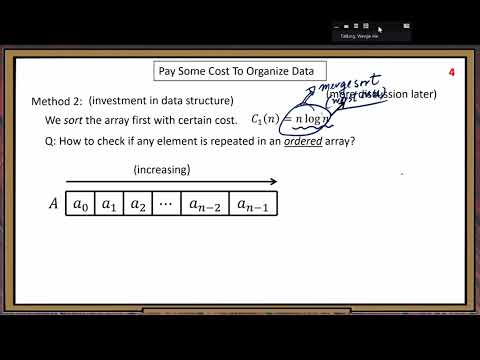
- The second method first sorts the array, treating the sorting work as an upfront investment that may reduce later comparisons.
- Merge sort is selected because it guarantees Θ(n log n) comparisons in the worst case.
- Quicksort is mentioned as another option, but its worst case is Θ(n²), despite its Θ(n log n) average case.
12:00
Why Sorted Data Makes Adjacent Checks Sufficient
- In ascending order, equal values form a contiguous block, so any duplicate values must include at least one equal adjacent pair.
- The algorithm only checks positions i and i+1, requiring n−1 comparisons after sorting.
- This reduces the comparison candidates from all global pairs, n(n−1)/2, to n−1 adjacent pairs.
19:00
Comparing the Two Element-Uniqueness Algorithms
- Brute force has a worst-case comparison count of n(n−1)/2, while the sorting method uses Θ(n log n) sorting work plus n−1 checks.
- The comparison focuses on worst-case efficiency for both methods, using merge sort for a fair guarantee.
- An algorithm with a more slowly growing efficiency function is considered faster as n becomes large.
21:00
Relating Running Time to Basic-Operation Counts
- The lesson denotes running time by T(n) and the number of basic operations by C(n).
- If one basic operation takes machine-dependent time c, then T(n) is approximately c·C(n).
- Because c is a constant for a given machine, operation counts provide a more stable basis for comparing algorithm efficiency.
23:00
Simplifying Efficiency Functions with Dominant Terms
- The first simplification removes lower-order terms and keeps the term that dominates as n grows.
- To compare growth rates, the lesson considers the ratio of a function evaluated at 2n to the same function evaluated at n.
- This ratio cancels constant multipliers, motivating a second simplification that discards multiplicative constants.
28:40
Growth Functions and the Dominance of n²
- A growth function is obtained by keeping the dominant term and then dropping its constant multiplier.
- For selection sort, the leading efficiency term is proportional to n², so its growth function is n².
- The ratio of the leading n² term to a lower-order n term tends to infinity, showing why n² dominates as input size increases.
39:00
Using Growth-Function Limits to Compare Algorithms
- Element uniqueness has growth functions n² for brute force and n log n for merge sort followed by adjacent checks.
- The comparison examines the ratio n²/(n log n), which simplifies to n/log n.
- If this ratio tends to infinity, n² grows faster, establishing the sorting-based method as asymptotically more efficient.
45:00
Logarithm Substitution Shows n Outgrows log n
- For a logarithm with base a>1, substitute u=logₐ n, so n=aᵘ and n/logₐ n becomes aᵘ/u.
- The resulting exponential-over-linear ratio tends to infinity because an exponential function outgrows a polynomial.
- This substitution provides an intuitive route to the limit before the lesson introduces a direct calculus method.
47:30
L’Hôpital’s Rule and Indeterminate Ratios
- L’Hôpital’s rule replaces a ratio of functions with the ratio of their derivatives when the limit has an indeterminate form such as 0/0 or ∞/∞.
- Examples such as (n³+1)/(n²+1), (n+1)/(n²+1), and (3n²+1)/(2n²+1) show that ∞/∞ can yield infinity, zero, or a constant.
- The lesson stresses checking the indeterminate-form condition before applying the rule.
53:00
Applying L’Hôpital’s Rule to Exponential and Logarithmic Limits
- For aᵘ/u with a>1, differentiating gives (ln a·aᵘ)/1, which tends to infinity.
- For the continuous-variable ratio x/logₐ x, differentiation gives a positive constant times x, also tending to infinity.
- The original algorithm input n is discrete, so the continuous-variable calculation is not yet a complete justification for the sequence limit.
59:00
Bridging Continuous Limits Back to Integer Input Sizes
- The lesson proposes extending n/logₐ n to the real-valued function x/logₐ x and then relating its limit back to integer n.
- It concludes that the limit remains infinity by the definition of a limit, but postpones the detailed bridge to the next class.
- Quiz 2 is posted in Module 2 with a deadline the following Tuesday.
Summary, takeaways, and chapters were generated by AI from the video's transcript and may contain errors. The video belongs to its creator, DrHeUMSLTeaching.