CS3130FS26Module2AVidProc
 Watch on YouTube →
Overview
The lecture develops a simultaneous minimum-and-maximum algorithm by using the first round of a tournament: symmetry permits analysis of one representative outcome, and winner/loser groups let each eliminate half the candidates for one of the two extrema. It then derives selection sort from repeated minimum-finding, counts its comparisons as n(n−1)/2, and explains why its best-, average-, and worst-case comparison counts are identical.
Key takeaways
- For even n, a first-round tournament finds both the maximum and minimum in 3n/2−2 comparisons: n/2 initial pair comparisons plus n/2−1 comparisons within each of the winner and loser groups.
- A representative-case argument is valid only when the alternatives are structurally symmetric; swapping elements cannot justify ignoring cases whose comparison histories differ.
- Selection sort repeatedly finds the minimum of the unplaced elements, producing a comparison total of (n−1)+(n−2)+…+1 = n(n−1)/2.
- Selection sort uses the same n(n−1)/2 comparisons on already sorted, reverse-sorted, and typical inputs, so its best-, worst-, and average-case comparison counts match.
- A sortedness precheck costs n−1 comparisons on every input; when already sorted inputs are rare, that universal overhead may outweigh the savings on those few cases.
- Elimination is useful when a proven property rules candidates out—for example, first-round losers cannot be the maximum—but reducing the candidate set is not automatically beneficial in every problem.
Chapters
0:00
Finding Both Extrema with a Partial Tournament
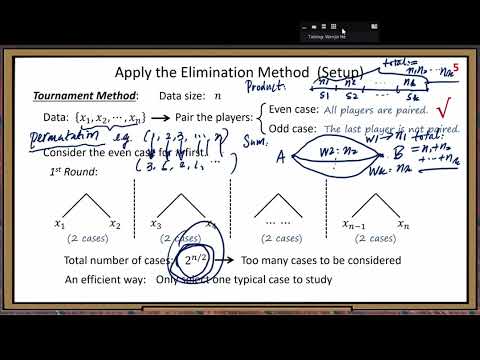
- The goal is to find both the maximum and minimum while reducing the number of comparisons.
- The method applies only the first round of tournament comparisons, then changes strategy rather than completing a full tournament.
- The analysis must account for every possible comparison outcome without enumerating every case.
3:00
Using Permutations to Justify a Representative Case
- A list of n distinct elements can be represented by a permutation describing their order or rank.
- One-to-one relabeling maps a studied outcome to other outcomes, so a representative case can stand for symmetric cases.
- Swapping elements changes the mapping without requiring a separate analysis when the cases have the same structure.
9:30
When Symmetry Does—and Does Not—Support WLOG
- The analysis can assume specific winners in the first comparisons without loss of generality only because the paired cases are symmetric.
- A comparison is not symmetric if one competitor has already defeated another element while the other has no such history.
- For nonsymmetric cases, swapping the competitors may change the situation, so both outcomes must be analyzed separately.
13:00
Diagramming First-Round Winners and Losers
- A vertical line diagram records each assumed first-round result, with the winner above the loser.
- The n elements are grouped by comparison status: winners form one group and losers another.
- Grouping elements with a shared status makes it possible to apply a common property to the entire group.
16:30
Eliminating Half the Candidates for Each Extreme
- A first-round loser cannot be the overall maximum, and a first-round winner cannot be the overall minimum.
- Eliminate the losers when finding the maximum and the winners when finding the minimum, removing half the elements from each search.
- For even n, the first round takes n/2 comparisons; finding each extreme among its remaining n/2 candidates takes n/2−1 more, totaling 3n/2−2 comparisons.
22:00
Transition from Tournament Analysis to Algorithm Efficiency
- The simultaneous-extrema calculation addresses the even-sized input case; the odd case is deferred for later discussion.
- Module 2 shifts to algorithm efficiency and brute-force methods, building on problem-solving techniques from Module 1.
- The lecture identifies search, selection, and sorting as three core problem types, with sorting introduced next.
26:30
Selection Sort Begins with Backward Reasoning
- The sorting problem is to arrange an unordered array in ascending order.
- Backward thinking starts from the required final state—a sorted array—and reasons toward the operations needed to reach it.
- The lecture assumes distinct elements initially as a simplification, with the intent that this assumption can later be removed.
34:00
The First Sorted Position Must Contain the Minimum
- In the destination array, the first position contains the minimum element of the original input.
- The useful interpretation reverses the observation: finding the input minimum tells us exactly which element belongs in position one.
- The minimum is denoted min₀, with subscripts distinguishing successive minimum elements.
38:30
Place Each Minimum In Place and Exclude It
- An element is in place when it occupies its correct position in the final sorted array.
- After placing min₀ first, find the minimum among the remaining elements and place it in the second position; repeat for later positions.
- Previously placed elements can be excluded from subsequent searches, avoiding redundant comparisons; the final remaining element needs no comparison.
47:00
Selection Sort Requires n(n−1)/2 Comparisons
- Repeatedly selecting the minimum and placing it in the next position gives the algorithm its name: selection sort.
- Finding the first minimum takes n−1 comparisons, the next takes n−2, and the sequence continues down to 1 and 0.
- Summing those counts gives n(n−1)/2 total comparisons for an array of n elements.
49:20
Best, Worst, and Average Cases for Selection Sort
- An already sorted input does not make selection sort skip its minimum-finding comparisons.
- Unlike a person who can visually recognize order, a computer must compare elements to determine which is smallest.
- The algorithm performs n(n−1)/2 comparisons in the best, worst, and average cases, so its comparison growth is quadratic.
57:30
Why a Sorted-Input Check Usually Adds Unhelpful Cost
- A preliminary sortedness test costs n−1 comparisons on every input, even if already sorted inputs are rare.
- If ordered inputs occur only about 0.001% of the time, paying that check universally may cost more than it saves overall.
- The lecture connects this tradeoff to Amdahl’s law: prioritize resources for common cases rather than spending them to optimize a tiny fraction.
1:02:36
Elimination Avoids Redundant Work, with Exceptions
- The general purpose of elimination is to remove elements that cannot affect the outcome and thereby avoid redundant computation.
- Reducing problem size often makes a problem easier, but the lecture cautions that this is a general rule with special-case exceptions.
- Best-, worst-, and average-case analysis should be applied to algorithms after their solutions and comparison behavior are established.
Summary, takeaways, and chapters were generated by AI from the video's transcript and may contain errors. The video belongs to its creator, DrHeUMSLTeaching.