CS3130FS26Module2C1VidProc
 Watch on YouTube →
Overview
The lecture develops bubble sort from the idea that every unsorted array contains an adjacent inversion: swapping adjacent out-of-order elements fixes local problems, and repeated left-to-right passes move the largest remaining value into its final position. It then compares growth functions using limits and the asymptotic notations little-o, big-Theta, and little-omega, and introduces positive constant upper and lower bounds as an alternative when a ratio limit does not exist.
Key takeaways
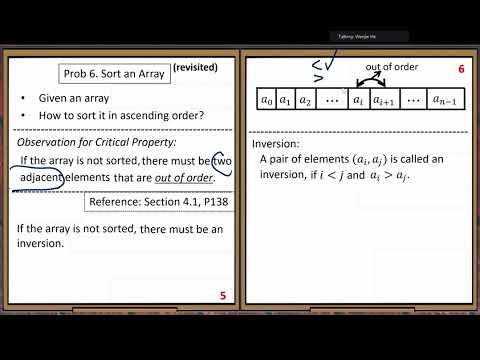
- An array with no adjacent inversion is sorted: if every neighboring pair is ascending, the entire sequence is ascending.
- In each left-to-right bubble sort pass, adjacent swaps move the largest value in the active portion to its final position, allowing later passes to skip the sorted suffix.
- A per-pass swap counter improves bubble sort’s best case: after one pass with zero swaps, the array is already sorted and further scans can stop.
- For growth comparisons, a limit of f(n)/g(n) equal to 0, a positive finite constant, or infinity indicates respectively slower growth, the same order, or faster growth.
- The ratio n²(3 + (−1)ⁿ) / ((n² + 1)(4 − (−1)ⁿ)) has no limit because it alternates between 4/3 and 2/5, illustrating why limit-based comparison is not always applicable.
- Positive constant bounds C₂g(n) ≤ f(n) ≤ C₁g(n) show that f and g have the same asymptotic order even when their ratio’s limit is unavailable.
Chapters
0:00
Sorting Through Order and Out-of-Order Pairs
- For an array of distinct values, comparing two elements yields either ascending order or an inversion.
- An ascending pair already meets the sorting requirement; a descending pair must be corrected.
- The lecture shifts from examining individual comparisons to finding a global property that can guide a sorting algorithm.
5:00
Why Every Unsorted Array Has an Adjacent Inversion
- The key property is stronger than simply saying an unsorted array contains some out-of-order pair: it contains two adjacent elements in the wrong order.
- An inversion is a pair aᵢ, aⱼ where i < j but aᵢ > aⱼ; adjacent inversions are the local cases targeted by bubble sort.
- Adjacent pairs are important because swapping a local inversion can fix it without directly addressing every globally misplaced pair.
10:00
Inversions as the Work Bubble Sort Must Remove
- A comparison detects whether its pair forms an inversion; an already ordered pair needs no change.
- Swapping the two elements of an adjacent inversion removes that local disorder.
- The algorithm’s goal is to continue detecting and correcting adjacent inversions until none remain.
16:00
Proving the Adjacent-Inversion Property by Contrapositive
- The claim has the form: if an array is not sorted, then it has an adjacent inversion.
- Its contrapositive assumes no adjacent inversion exists and reasons about every neighboring pair.
- If every adjacent pair is ascending, the values increase from the beginning to the end, so the entire array is sorted; this contradicts the original assumption.
23:00
Building Bubble Sort from Local Swaps
- The proof justifies targeting adjacent inversions: an unsorted array must have at least one.
- Bubble sort scans from left to right, comparing neighboring elements and swapping only when they are inverted.
- A single scan may not remove every inversion, so the algorithm repeats passes until the array is sorted.
28:00
Bubble Sort Passes and the Largest-Element Invariant
- During a pass, each adjacent comparison either leaves an ordered pair untouched or swaps an inversion.
- At the end of the first full pass, the largest element has moved to the array’s final position.
- Later passes exclude elements already in their final positions, shrinking the active portion of the array.
34:00
Termination and Comparison Costs in Bubble Sort
- Each complete pass places at least one more element in its final position, so a finite array eventually becomes sorted.
- Once every element is in place, the algorithm terminates; an unbounded sequence of passes would not be a valid sorting procedure.
- Comparisons are the primary operation for efficiency analysis because they occur throughout scanning, while swaps happen only when an inversion is found.
37:00
Early Stopping When a Bubble Sort Pass Makes No Swaps
- An already sorted array requires only one pass of n − 1 adjacent comparisons if the implementation can recognize that it is finished.
- A swap counter can be reset at the start of each pass and incremented whenever an inversion is swapped.
- If the counter is still zero after a complete pass, no inversion was found, so the remaining passes are unnecessary.
41:00
Comparing Growth Functions with Limits
- To compare growth functions f(n) and g(n), examine the limit of f(n)/g(n) as n approaches infinity.
- A limit of zero means f grows more slowly; a positive finite constant means the functions have the same order of growth; infinity means f grows faster.
- If the ratio limit does not exist, this comparison method cannot classify the functions, so another method is needed.
47:00
Using Continuous Limits for Discrete Growth Functions
- L’Hôpital’s rule applies to continuous variables, not directly to a discrete input such as integer n.
- The lecture uses a continuous variable x with the same expression to evaluate a difficult limit using derivatives.
- The result transfers back to integer inputs because integers are one valid sequence of values tending to infinity under the definition of a limit.
52:00
Little-o, Big-Theta, and Little-omega Notation
- f(n) ∈ o(g(n)) represents a ratio f(n)/g(n) tending to zero, so f grows more slowly than g.
- f(n) ∈ Θ(g(n)) represents the same order of growth, corresponding to a positive constant ratio in the limit comparison.
- f(n) ∈ ω(g(n)) represents a ratio tending to infinity, so f grows faster than g.
57:00
Interpreting Order of Growth for Power Functions
- For a power function nʳ, the exponent r provides a straightforward way to describe its order of growth.
- The exponent-based interpretation is an introductory shortcut for power functions, not a complete definition for every growth function.
- More complicated functions require broader comparison tools than simply reading off a power’s exponent.
58:00
Bounding Oscillating Functions When Limits Fail
- The ratio n²(3 + (−1)ⁿ) / ((n² + 1)(4 − (−1)ⁿ)) alternates between 4/3 for even n and 2/5 for odd n, so it has no limit.
- When a ratio oscillates rather than converges, compare functions using inequalities instead of relying on the limit method.
- Choose a simple comparison function g(n) and positive constants C₁ and C₂ so that C₂g(n) ≤ f(n) ≤ C₁g(n); these bounds establish the same order of growth.
Summary, takeaways, and chapters were generated by AI from the video's transcript and may contain errors. The video belongs to its creator, DrHeUMSLTeaching.