CS3130FS26Module2C2VidProc
 Watch on YouTube →
Overview
The lesson defines asymptotic growth notation through eventual constant-factor bounds: Big O is an upper bound, Big Omega is a lower bound, and Big Theta requires both. It applies these definitions and limit methods to examples including n + 2, polynomial powers, logarithms, and exponentials, showing why finite initial behavior does not determine long-run growth.
Key takeaways
- Big O membership requires fixed constants C > 0 and n₀ ≥ 0 such that f(n) ≤ Cg(n) for every integer n ≥ n₀; behavior before n₀ is irrelevant.
- Big Theta requires both an eventual upper and lower constant-factor bound, while Big Omega supplies only the lower bound.
- For n ≥ 2, n ≤ n + 2 ≤ 2n, so n + 2 is Theta of n; preserving structure similarly gives n³ ≤ (n + 2)³ ≤ 8n³.
- For every fixed d > 0 and a > 1, nᵈ = o(aⁿ), including noninteger d; the noninteger proof uses ⌈d⌉ to reduce the comparison to the integer case.
- For every d > 0, ln(n) = o(nᵈ), so even an extremely small positive power eventually outgrows the logarithm.
- A near-one exponential such as 1.00001ⁿ eventually outgrows a polynomial as large as n^1,000,000, despite potentially misleading behavior at smaller inputs.
Chapters
0:00
Big O as an Eventual Constant-Factor Upper Bound
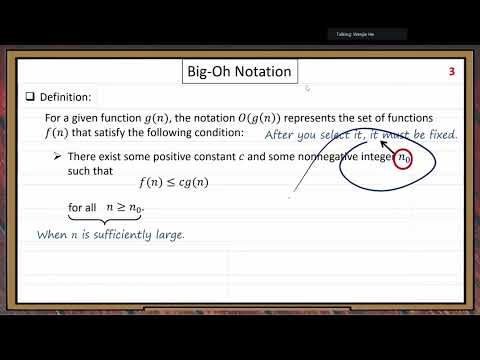
- Big O(g(n)) contains functions f(n) for which some positive constant C and nonnegative integer n₀ satisfy f(n) ≤ Cg(n) for every n ≥ n₀.
- The definition uses Cg(n) as an upper bound; it does not require a lower bound.
- C and n₀ must be fixed constants once chosen, although the definition only requires that suitable values exist.
5:00
Why Big O Ignores Inputs Below n₀
- The inequality f(n) ≤ Cg(n) only needs to hold for integer inputs n ≥ n₀; values below n₀ do not affect Big O membership.
- “Sufficiently large” means n has reached or passed the chosen threshold n₀, allowing the definition to avoid naming that threshold explicitly.
- Choosing n₀ and C together matters: moving n₀ earlier may require a larger C to keep the upper bound valid.
9:30
Graphical Meaning: Compare Growth After the Threshold
- Multiplying g(n) by C scales its graph until Cg(n) can sit above f(n) for every n ≥ n₀.
- For f(n) = n³ and g(n) = n², no fixed C can make Cn² an upper bound for n³ at all sufficiently large n.
- Asymptotic analysis emphasizes large inputs, where slow algorithms may exceed available computing resources; a better algorithm can still be slower on small inputs because of setup or preprocessing.
18:25
Big Omega and Big Theta Complete the Bound Notation
- Big Omega reverses the Big O inequality: some positive C makes Cg(n) a lower bound for f(n) for all n ≥ n₀.
- Big Theta requires two positive constants, with C₂g(n) ≤ f(n) ≤ C₁g(n) for every n ≥ n₀.
- The course focuses mainly on Big O and Big Theta, using Big Omega less often and rarely relying on little-o or little-omega notation.
- The instructor announced Homework Assignment 1 was expected the next morning, with an October 11 deadline and midterm-preparation value.
23:20
Proving n + 2 Is Theta of n
- A limit comparison gives (n + 2)/n → 1, supporting the conclusion that n + 2 and n have the same asymptotic growth.
- For the definition-based proof, n + 2 ≥ n supplies the lower bound with constant 1.
- For n ≥ 2, n + 2 ≤ 2n supplies the upper bound with constant 2, so n₀ = 2 works for both inequalities.
31:16
Why n³ Is Big Omega of n²
- For nonnegative integer input sizes n, n³ ≥ n², so n² is a lower bound for n³.
- The Big Omega proof uses constant C = 1 and threshold n₀ = 0.
- The integer-input assumption matters: for real n between 0 and 1, n³ is smaller than n².
32:44
Bounding (n + 2)³ Without Expanding It
- Keep the expression (n + 2)³ intact rather than expanding it into a polynomial; the original structure makes the bounds easier to see.
- For n ≥ 2, n ≤ n + 2 ≤ 2n; cubing gives n³ ≤ (n + 2)³ ≤ 8n³.
- These inequalities establish that (n + 2)³ is Theta of n³, with constants 1 and 8 and threshold n₀ = 2.
36:45
Using L’Hôpital’s Rule for Logarithm Versus Linear Growth
- To compare log base a of n with n, convert the discrete input n to a continuous variable x so derivatives can be used.
- For a > 1, the ratio logₐ(x)/x is an infinity-over-infinity form; L’Hôpital’s rule gives a derivative ratio with limit 0.
- The limit result implies logₐ(n) is little-o of n; the lesson cautions that L’Hôpital’s rule is invalid for non-indeterminate forms such as sin(x)/10.
44:14
Polynomial Growth Is Little-o of Exponential Growth
- For a > 1 and positive integer d, compare xᵈ with aˣ using L’Hôpital’s rule after converting n to continuous x.
- Repeated differentiation reduces the polynomial numerator; after d rounds it becomes a constant proportional to d!, while the exponential denominator still grows without bound.
- The resulting limit is 0, establishing nᵈ = o(aⁿ) for integer d; the lesson uses the golden rule to simplify the noninteger case separately.
53:20
Extending the Polynomial–Exponential Result to Noninteger Powers
- For noninteger d, use the ceiling ⌈d⌉, the next integer, to connect the problem to the already-proved integer case.
- Rewrite xᵈ/aˣ as (xᵈ/x^⌈d⌉)(x^⌈d⌉/aˣ), splitting the limit into two factors.
- The first factor tends to 0 because d < ⌈d⌉, and the second tends to 0 by the integer result; therefore nᵈ = o(aⁿ) for noninteger d as well.
58:29
Logarithms Grow More Slowly Than Roots and Positive Powers
- Writing √x as x^(1/2) makes it possible to use L’Hôpital’s rule to show log₂(n)/√n → 0.
- For every positive real d, differentiating ln(x)/xᵈ gives a ratio proportional to 1/xᵈ, which tends to 0.
- Thus ln(n) = o(nᵈ) even when d is very small; the discrete result follows by evaluating the continuous limit along integer inputs.
1:01:11
A Huge Polynomial Eventually Loses to a Near-One Exponential
- The proved result applies even to n^1,000,000 compared with 1.00001ⁿ: because the base is greater than 1, the exponential eventually grows faster.
- The base 1.00001 is only slightly above 1, but its repeated multiplication still overtakes any fixed polynomial power as n increases.
- This comparison illustrates why asymptotic results can contradict intuition based on small or moderate input sizes.
1:04:00
Even a Tiny Positive Power Eventually Outgrows a Logarithm
- The logarithm result applies to ln(n) versus n^(1/1,000,000), since the exponent is positive even though it is extremely small.
- The power function eventually grows faster than ln(n), just as ln(n) eventually grows faster than any fixed root such as the millionth root.
- The homework comparisons rely on applying these proved results directly and focusing on eventual growth rather than apparent behavior at small n.
Summary, takeaways, and chapters were generated by AI from the video's transcript and may contain errors. The video belongs to its creator, DrHeUMSLTeaching.