CS3130FS26Module3AVidProc
 Watch on YouTube →
Overview
Recursive algorithms trade additional memory and function-call overhead for simpler solutions to problems whose structure repeats at smaller sizes. The lesson develops a reusable method—define base cases, assume a smaller instance is solved, and connect it to the current instance—then applies it to factorial and the Tower of Hanoi, where three disks take seven moves and the general solution uses two recursive calls around one disk move.
Key takeaways
- A recursive solution needs directly solvable base cases and a recurrence that reduces the problem toward those cases; without both, the recursion cannot reliably produce an answer.
- Recursive calls consume stack memory, so deep call chains can cause stack overflow even when a program compiles and its logic is otherwise valid.
- Factorial follows n! = n × (n−1)! with 0! = 1; recursion demonstrates the method, but a loop avoids unnecessary call-stack overhead for this simple computation.
- For Tower of Hanoi, solving n disks means moving n−1 disks to a temporary peg, moving the largest disk once, then moving the n−1 disks to the destination: T(n) = 2T(n−1) + 1.
- The three-disk Hanoi solution takes seven moves and serves as a concrete example of how a known smaller solution can be reused twice to solve a larger instance.
Chapters
0:00
When Recursive Thinking Helps More Than Iteration
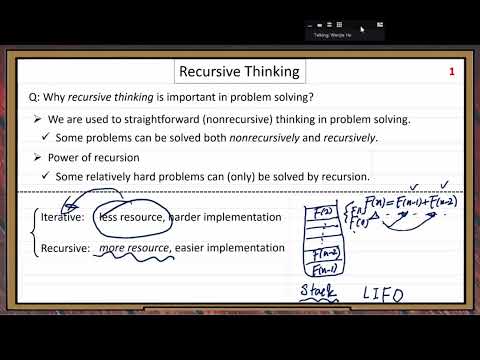
- Iterative solutions use loops such as for and while; recursive solutions solve problems through repeated function calls.
- Iteration generally uses fewer computing resources, while recursion can make harder problems substantially easier to implement.
- Many problems admit both approaches, but recursion is especially useful when a problem naturally depends on smaller versions of itself.
7:00
How a LIFO Stack Supports Recursive Function Calls
- A stack is last in, first out (LIFO): new items are pushed onto the top, and processing removes the top item first.
- Recursive execution uses stack frames to track pending calls and the information needed to resume them.
- The Fibonacci recurrence f(n) = f(n−1) + f(n−2) illustrates how recursive calls depend on smaller inputs before producing a result.
13:00
Deep Recursion, Memory Limits, and Stack Overflow
- Each active recursive call consumes stack memory, so deep call chains can exhaust a program's available stack space.
- A stack overflow is a runtime error that can terminate an otherwise compilable program when input size or recursion depth is too large.
- Reducing stored intermediate data or otherwise shortening the stack can mitigate memory pressure, though recursion still carries overhead.
18:27
Factorial as a First Example of Recursive Problem Solving
- For a non-negative integer n, factorial can be calculated iteratively with a for loop or recursively.
- The iterative factorial is the practical choice for this simple task; the recursive version is introduced to practice recursive reasoning.
- The base case 0! = 1 is essential to stop the recursion and is consistent with the factorial recurrence.
22:00
A Three-Step Framework for Recursive Thinking
- First identify sufficiently small base cases that can be solved directly.
- For the current problem size, assume the solution to a smaller instance is available—the central move in recursive reasoning.
- Derive a recurrence relation that bridges the known smaller solution to the unknown current solution.
- The same divide-and-conquer perspective leads into Module 4's focus on divide and conquer.
27:00
Deriving the Factorial Recurrence and Validating 0!
- Factorial reduces an n-operand product to the smaller problem (n−1)!, giving n! = n × (n−1)! for n > 0.
- With 0! as the base case, recursive calls can reduce n until they reach a directly defined result.
- Rearranging the recurrence gives (n−1)! = n!/n; setting n = 1 yields 0! = 1, confirming compatibility with the base case.
34:00
Why Factorial Recursion Is a Teaching Example, Not the Fastest Choice
- The recursive factorial is less efficient than a loop because it incurs function-call and stack overhead.
- For a simple factorial calculation, an iterative implementation is the sensible practical choice.
- The example's value is its reusable reasoning pattern, which can help with more complicated problems.
35:30
Tower of Hanoi Rules and the Goal of Solving n Disks
- The puzzle uses three pegs and three rules: move one disk at a time, never place a larger disk on a smaller one, and keep disks on pegs except while moving.
- A three-disk instance makes the rules and moves manageable, while the actual goal is a recursive solution for n disks.
- The constraints make planning necessary: disks cannot be set aside on a table, and smaller disks must be moved to clear the largest.
39:30
Use Small Hanoi Instances to Find the Recursive Structure
- Testing small input sizes is a problem-solving strategy also used for polynomial evaluation and other computing problems.
- One- and two-disk cases are straightforward; three disks provide a useful non-trivial case for deriving the general method.
- For three disks, treat the two-disk solution as known, then determine how to connect it to the three-disk solution.
45:00
Solving Three-Disc Hanoi in Seven Moves
- Move the top two disks from peg 1 to peg 2 using the known two-disk solution, leaving peg 3 clear for the largest disk.
- Move the largest disk from peg 1 to the destination peg 3.
- Apply the two-disk solution again to move the smaller disks from peg 2 to peg 3, completing the puzzle in seven moves.
51:00
Generalizing Hanoi with Two P(n−1) Calls
- To solve P(n), first move the top n−1 disks from the starting peg to the temporary peg.
- Move the largest disk to the destination peg, then move the n−1 disks from the temporary peg onto it.
- The dependency chain bottoms out at directly solvable cases and builds back up to P(n); the move-count recurrence is T(n) = 2T(n−1) + 1.
1:00:00
Turning the Hanoi Strategy into Recursive Pseudocode
- The procedure takes the number of disks and the peg identifiers as parameters.
- It makes one recursive call for n−1 disks, moves the largest disk, then makes a second recursive call for n−1 disks.
- The peg arguments must change carefully between calls to represent the starting, temporary, and destination pegs.
Summary, takeaways, and chapters were generated by AI from the video's transcript and may contain errors. The video belongs to its creator, DrHeUMSLTeaching.