CS3130FS26Module1A2VidProc
 Watch on YouTube →
Overview
The lesson develops problem-solving strategies through two examples: counting every square on an 8×8 chessboard and introducing prime factorization. It shows how to organize data by square size, split a 2D count into horizontal and vertical choices, use an invariant to track possibilities, and reduce computational work by identifying useful properties; the prime-number discussion applies the same reasoning to factor testing and the Sieve of Eratosthenes.
Key takeaways
- On an n×n chessboard, an s×s square has (n−s+1) possible positions along each axis, so its total count is (n−s+1)².
- For an 8×8 board, summing the counts for all sizes gives 1² + 2² + … + 8² = 204 total squares.
- The invariant s + (n−s+1) = n+1 lets a solver infer the placement count for a square size without enumerating positions; a 37×37 square on a 100×100 board has 64² placements.
- A number greater than 1 is either prime or composite, while 1 is a separate unit; testing for a factor pair distinguishes the two cases.
- A brute-force search over candidate factor pairs can require (n−2)(n−1)/2 tests, so reducing the candidate range is central to improving efficiency.
- The Sieve of Eratosthenes finds primes by repeatedly removing composite numbers, and the lesson recommends beginning with the easier case when a problem divides into cases.
Chapters
0:00
Organizing Raw Data Before Counting Chessboard Squares
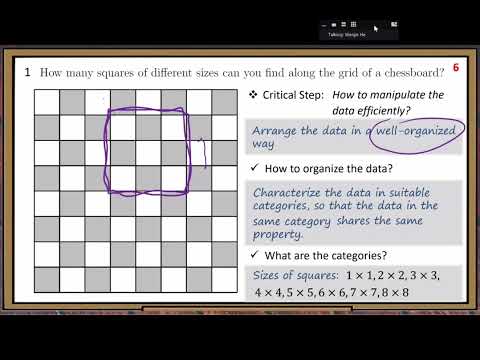
- The goal is to count every square of every possible size in the chessboard data.
- Raw data mixes squares of different sizes and locations, so it is difficult to analyze as one undifferentiated set.
- Organizing data into structured categories lets problem solvers apply shared properties to each subset.
7:00
Classifying Squares by Size and Choosing Useful Properties
- An 8×8 board has eight square-size categories, from 1×1 through 8×8.
- Squares in one category share a size, while properties such as color or area may not help with the counting goal.
- A useful property should support the task; location-specific observations are less helpful than a general counting rule.
13:00
Finding the 3×3 Count Through Side-Length Choices
- A 3×3 square has equal horizontal and vertical side lengths of three grid units.
- There are six horizontal grid segments of length three and six vertical segments of length three on an 8×8 board.
- Allowing overlapping placements is essential; multiplying 6×6 gives 36 distinct 3×3 squares.
17:00
Reducing the Square Problem from Two Dimensions to One
- Treat horizontal and vertical placement as separate one-dimensional choices rather than counting 2D squares directly.
- For any fixed square size, count its possible starting positions independently along each axis.
- The two counts combine by multiplication, making the method easy to repeat for all eight sizes.
21:00
Building the Size Table and Identifying the Invariant
- For an 8×8 board, the number of placements per dimension for an s×s square is 9−s.
- The 1×1 category has 8×8 = 64 squares; the 3×3 category has 6×6 = 36.
- The square size s and the number of placements along one dimension always sum to 9, the board width plus one.
25:00
Using the Invariant to Track Placements on a 100×100 Board
- For a 100×100 board, the invariant is 101: square side length plus available starting positions along one axis equals 101.
- A 37×37 square therefore has 101−37 = 64 possible positions per dimension, or 64² = 4,096 placements.
- The invariant makes the count quick without drawing or listing positions on a very large board.
31:00
Summing Square Counts to Get 204 Squares on an 8×8 Board
- The total is the sum of the squared placement counts: 1² + 2² + … + 8² = 204.
- For a general n×n board, the same reasoning gives 1² + 2² + … + n².
- The lesson reviews the need to recognize and use standard consecutive-integer summation formulas.
37:00
Memorizing Summation Formulas Through Mathematical Patterns
- The formula for the first n positive integers is n(n+1)/2, a result used repeatedly in the course.
- The sum of the first n cubes equals the square of the sum of the first n integers.
- Connecting formulas to memorable properties is presented as a more durable strategy than rote memorization.
41:00
Defining Prime, Composite, and Unit Numbers
- A prime is a natural number greater than 1 with exactly two positive factors: 1 and itself.
- A composite number is a natural number greater than 1 that is not prime.
- The number 1 is neither prime nor composite; it is treated separately as the unit.
45:00
Turning Prime Factorization into a Factor-Search Problem
- The objective is to represent a positive integer as a product of prime numbers.
- A composite candidate n can be identified by finding factors a and b with 1 < a ≤ b < n and ab = n.
- If no valid factor pair exists, the number is prime; the lesson notes that testing only up to √n can narrow the search.
49:00
Reducing Uncertainty by Shrinking the Candidate Range
- The lesson frames problem solving as reducing uncertainty by discovering properties that eliminate possibilities.
- For factor searches, restricting the candidate range reduces the number of multiplication tests and improves computational efficiency.
- Without a useful property, a solver must test every candidate in the original range and cannot safely skip possibilities.
54:00
Counting the Work in a Brute-Force Factor Search
- A basic search considers ordered-by-size candidate pairs with 2 ≤ a ≤ b ≤ n−1 and checks whether ab = n.
- For each a, the number of possible b values decreases; the total candidate-pair count is 1 + 2 + … + (n−2) = (n−2)(n−1)/2.
- The quadratic number of candidate pairs illustrates why reducing the search range matters.
1:01:00
Introducing the Sieve of Eratosthenes and the Easier-Case Rule
- The Sieve of Eratosthenes, an ancient Greek method, exposes primes by repeatedly removing composite numbers from a list.
- The prime-factorization discussion is left unfinished; the next lesson will explain how to carry out the composite-number removal.
- When a problem has multiple cases, the stated rule of thumb is to work on the easier case first; here, composite numbers are treated as the easier case.
Summary, takeaways, and chapters were generated by AI from the video's transcript and may contain errors. The video belongs to its creator, DrHeUMSLTeaching.