CS3130FS26Module1A1VidProc
 Watch on YouTube →
Overview
CS3130’s first class lays out the semester’s schedule, grading, assessments, attendance options, and course materials, then begins a problem-solving unit with an 8×8 chessboard square-counting problem. The course emphasizes organizing data and showing reasoning: homework has concept, basic-computation, and challenging-computation sections, while complete solution details can earn partial credit or bonuses.
Key takeaways
- Each major homework assignment has 25 four-point questions: 10 concept questions, 10 basic computation questions, and five challenging computation questions.
- Showing work is essential for credit: Part B reasoning can support partial credit, while Part C requires full details and can award up to six points for a correct improvement over the standard solution.
- The six Canvas quizzes have no time limit and remain open for a little more than a week; the two lowest scores are dropped, leaving four quizzes worth 16% total.
- The two programming projects are each worth 14% and generally last at least four weeks, giving students time to implement and experimentally compare algorithmic methods.
- The course offers three attendance paths—in-person, Zoom, and recorded-video claims through Canvas—and assigns 2% of the grade to attendance.
- The first problem-solving method is to organize the 8×8 chessboard’s squares into categories by side length before counting their possible positions.
Chapters
0:00
Semester Structure and the 28-Class Schedule
- The semester is divided into five modules; Module 1 has four parts, and the course focuses on solving computing problems.
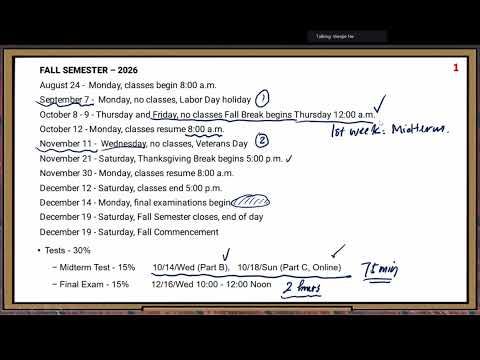
- The calendar provides 28 class sessions rather than 30 because classes are canceled for two holidays: September 7 and November 11.
- Fall break does not remove a class session; the midterm is scheduled for the first week after the break.
4:30
Midterm and Final Exam Format
- The midterm is scheduled for Wednesday, October 14, and carries 15% of the course grade.
- The 75-minute midterm includes the basic portion in class; the challenging Part C is completed online over several days.
- The final lasts two hours and includes Parts A, B, and C in class, with an additional online opportunity for Part C only.
8:39
Homework Weights and Assignment Structure
- Two major homework assignments are worth 12% each, nearly as much as the 15% midterm and final.
- Each assignment has 25 questions worth four points apiece, for a total of 100 points.
- The semester also includes six quizzes and two programming projects.
10:07
Homework Parts A and B: Concepts, Computation, and Partial Credit
- Part A contains 10 concept questions, usually multiple choice or true/false; short-answer questions may appear, but are not a fixed component.
- Part B contains 10 basic computation questions answered in short-answer form.
- For Part B, showing key formulas, steps, or reasoning can earn partial credit when the final answer is wrong; a bare guess may not.
16:23
Part C Solutions: Weak, Standard, and Strong Performance
- Part C contains five challenging computation questions and requires full solution details; a correct answer without reasoning earns only one of four points.
- A weak solution earns three points when it is correct but slightly less efficient than the standard solution—for example, using eight comparisons instead of seven.
- A standard solution earns four points, while a correct strong solution that improves on it can earn six points, including two bonus points.
25:16
Test Questions and Fairness Between Course Sections
- The tests follow the homework structure: Part A concepts, Part B basic computation, and Part C more challenging problems.
- The in-person section completes Part B during class, while Part C is offered online to provide more time and balance the online section’s testing conditions.
- Midterm questions are adapted from homework with non-trivial changes to conditions, so students must apply reasoning rather than memorize answers.
29:50
Canvas Quizzes: Six Attempts, Four Scores Count
- There are six quizzes, but the two lowest scores are dropped; the four counted quizzes are worth 4% each, totaling 16%.
- Each Canvas quiz is open for a little more than one week and has no time limit, allowing time to study and digest lecture notes.
- Auto-grading can reject short answers with extra words or formatting differences, so enter only the requested value—for example, enter “3” rather than “3 comparisons.”
35:02
Course Materials and Homework Deadlines
- The instructor follows the textbook closely, but lecture notes and posted solutions are sufficient; reading the textbook is optional.
- Each major homework assignment is open for approximately 12 days, balancing challenging questions with the semester schedule.
- Posted solutions support exam preparation, but test problems may alter homework conditions and require fresh reasoning.
38:48
Programming Projects, Attendance, and Remote Participation
- Two standard programming projects are each worth 14% and are generally open for at least four weeks.
- Projects provide hands-on comparisons of algorithmic methods through implementation and experiments; an optional project may add 2% extra credit.
- Attendance is worth 2%; students can attend in person, join through the instructor’s Zoom ID, or claim video attendance by posting to a Canvas discussion board.
47:23
Extra Credit for Course Evaluations and Early Projects
- Course-evaluation extra credit is tied to the class response rate: reaching 80% earns the full 1%, while a 75% response rate earns 0.75%.
- Early project submission can earn up to 1% extra credit, with the full amount available for submitting one week early.
- Early-credit eligibility requires all features to be complete and a project score of at least 90%; incomplete work does not qualify.
51:41
PDF Notes, Annotations, and YouTube Video Access
- Before each lecture, students receive a PDF preview of the planned notes and topics.
- After class, materials include a PowerPoint file, an annotated PDF, and an HTML file that links to the lecture video.
- Because Canvas blocks embedded and linked external YouTube videos, the files are packaged in a ZIP for local download; clicking the image link in the HTML opens the video outside Canvas.
57:58
The 8×8 Chessboard Square-Counting Problem
- The first computing problem asks how many squares of all possible sizes appear on an 8×8 chessboard.
- Counting includes 1×1, 2×2, 3×3, and larger squares in different positions; the lesson uses this example to introduce systematic problem-solving.
- The chessboard is treated as data, and the first task is to understand what information matters, including square size and location.
1:01:08
Organize Chessboard Data by Square Size
- A student proposes using a reference point and grouping squares by size; an 8×8 board has eight possible square side lengths.
- Organizing the data makes the many overlapping locations easier to count and reason about.
- The class begins categorizing the board into groups such as 1×1 squares and 2×2 squares, setting up the continuation of the counting problem.
Summary, takeaways, and chapters were generated by AI from the video's transcript and may contain errors. The video belongs to its creator, DrHeUMSLTeaching.