ME2120 - Dynamics
Overview
Ryan C. Cooper introduces ME2120’s spinning-top design project through three-dimensional rigid-body dynamics, focusing on degrees of freedom, rotational motion, and the forces that affect stability. He connects observed wobble to precession, nutation, and eccentric mass, then highlights how the top’s moments of inertia, especially I3 about its spin axis, inform design; the case submission requires a photo and a spinning video.
Key takeaways
- A top on a flat surface is modeled with five degrees of freedom when one contact constraint is applied to a six-degree-of-freedom rigid body; a gyroscope with a fixed point has three rotational degrees of freedom.
- A spinning top’s motion combines spin, precession, and nutation, so treating its axis as permanently vertical omits real rotational behavior.
- An offset center of mass creates eccentric-mass forces and wobble; balancing a top with corrective mass follows the same principle as adding weights to balance a car wheel.
- Friction at the tabletop can both dissipate energy and help return a top toward upright, while air drag also contributes to spin-down.
- For design about the top’s spin axis, the moment of inertia I3 is a key parameter in the Euler-equation description of rotational motion.
- The Case 4 deliverable is intentionally accessible: students submit a top photo and a video of its spin, without needing to provide a SolidWorks model.
Chapters
- The project goal is to design a top that spins for a long time, translating a customer request into measurable engineering choices.
- Ryan C. Cooper frames the analysis around degrees of freedom, kinematics, and forces rather than deriving a full three-dimensional differential-equation model.
- Chapter 11 on three-dimensional rigid-body dynamics provides relevant background, but students are not expected to rederive its equations.
- A pull-start gyroscope serves as a low-friction comparison for an ordinary spinning top.
- The classroom top is roughly 50 to 100 grams, while the project design has a 10-gram allowance; the example was originally intended to weigh about 5 grams.
- A coordinate system attached to the top helps describe how its axes move as it spins.
- The top’s Z-axis does not necessarily point straight up: its orientation changes as the top wobbles.
- A low-friction gyroscope can spin while tilted and trace a circular motion, rather than immediately returning upright.
- For a tabletop top, contact friction can help steady the motion and bring the top back toward upright.
- An eccentric mass occurs when the center of mass is offset from the top’s intended symmetry axis, producing a periodic force and visible wobble.
- Manufacturing steps such as machining, checking the center of mass, and adding corrective mass can reduce imbalance.
- Car wheel balancing uses the same principle: a shop spins the wheel, identifies the imbalance, and adds weights to reduce vibration at speed.
- A free rigid body has six degrees of freedom: three translations and three rotations.
- A top constrained to remain in contact with a flat table is modeled as having five degrees of freedom after one contact constraint.
- A gyroscope with a fixed point has three rotational degrees of freedom because its three translational motions are constrained.
- Spin is rotation about the top’s own axis, while precession describes the axis sweeping around another direction.
- Nutation is the bouncing or oscillating component of the axis motion, which becomes more noticeable as the top spins down.
- These three motions are coupled, so the top’s changing orientation cannot always be treated as simply vertical.
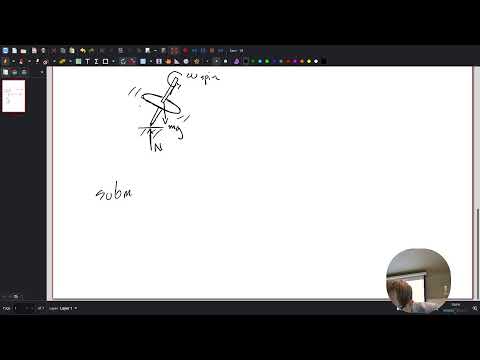
- A basic top model uses a stick and cylinder, with the contact represented either as a surface or as a fixed point.
- Gravity acts downward and the table’s normal force acts upward; the contact model determines what additional reaction forces are present.
- At a fixed gyroscope pivot, reaction forces constrain the pivot’s translation, unlike a top resting on a flat surface.
- Centrifugal force is not an external force to add to an inertial-frame free-body diagram, even though rotation is central to the top’s behavior.
- Contact friction and air drag or viscosity dissipate energy, slowing the top’s spin.
- A point-contact model has no contact radius for friction to produce a torque about that point, so the model’s assumptions matter when accounting for friction.
- The Euler equations relate applied moments to the rigid body’s moments of inertia about three axes, I1, I2, and I3.
- For a top spinning about its own Z-axis, I3 is especially important to the rotational analysis and design.
- The next design work focuses on moment-of-inertia choices; the Case 4 submission is a picture of the top and a video of it spinning, with no SolidWorks file required.
Transcript excerpt
0:20 Are you ready? help. If we had Okay, we're back starting something new.
1:20 Um doing so main goal here for our last case project is looking at spinning top design. Uh so engineers may you're always paid for numbers like what number are you doing? How are you like how did you get there? Um so the thing at least from a customer standpoint is like I want a spinning top that spins for a long time. It doesn't tell you anything about the physics involved in dealing with what what is involved in that process. So that's kind of our goal today. I'll try to stay I don't want to get too deep into like oiler angles and threedimensional like moments of inert. I mean we need 3D
2:09 moments of inertia but I'll try not to get too deep in the weeds and we can always stop and be like what are you talking about here? Um so try not to math our way through this. Try to build some engineering intuition and then you can always go back and look at math equations from there. um sound like a good plan for today. Try not to do too much because there are some really cool and it's hard not to get into it because from my perspective it's like there's all these like 3D differential equations. It's going to be grades coupled moments and motion. But I'm like all right, we need to start small. Identify what are we looking at? How do we control it? what can we actually put
2:57 into the design and a lot of that is not how do I build a perfect differential equation even though it is cool to do that and you get lots of street cred and everyone flocks to you and they're
This is the start of the transcript. Save this video free for the whole transcript, searchable and time-coded.
In this course
Related notes
Summary, takeaways, and chapters were generated by AI from the video's transcript and may contain errors. The video belongs to its creator, Professor Ryan C. Cooper.