ME2120 - Dynamics
Overview
Professor Ryan C. Cooper connects rigid-body dynamics to a class spinning-top design project, using moment of inertia, center of mass, and rotational stability to guide design choices. He compares standard shape formulas, demonstrates estimating a 3D-printed top's mass and inertia in Onshape using PLA properties, and encourages students to prototype, test, and learn from designs that do not spin as expected.
Key takeaways
- For a spinning top, moving mass farther from the rotation axis increases moment of inertia; Cooper uses I = mr² for a ring-like mass and I = mR²/2 for a thin disk to show the difference.
- A top's stability involves competing effects: spinning angular momentum helps resist tipping, while a higher center of mass increases the gravitational moment.
- Small mass imbalances can create large vibration forces at high RPM, which is why balancing matters for aircraft turbine blades as well as student-built tops.
- Onshape can support early dynamics design by reporting volume and moments of inertia, while assigning PLA at roughly 1.2 g/cm³ helps estimate mass before printing.
- CAD mass is an estimate rather than a guarantee: print infill and voids affect actual weight, and a slicer's filament-use estimate can improve the prediction.
- Testing a top that fails to spin is still valuable because it reveals how geometry and three-dimensional forces affect stability.
Chapters
- The class plans a tournament on Monday to compare how long student-designed tops spin uninterrupted.
- The initial rounds may run several tops at once, with the longest-spinning designs moved to a stand for the final competition.
- Project 4 is optional extra credit before Thanksgiving; the Wednesday session will function as open work time rather than a formal lecture.
- Cooper frames dynamics as identifying degrees of freedom, defining kinematics, and then using a free-body diagram to explain what causes motion.
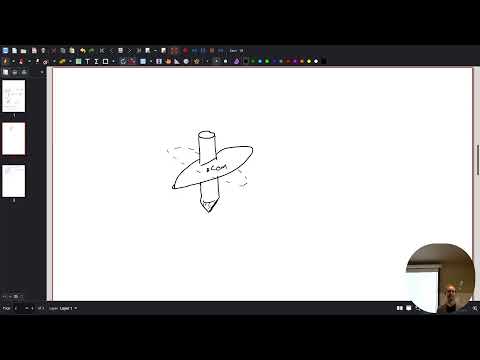
- A spinning top can spin about its design axis while also precessing and rocking, so its motion is not purely one-dimensional.
- Friction can reduce the top's nutation angle, while imperfect mass alignment can create additional wobble.
- A small mass imbalance becomes consequential at high rotational speeds, such as the thousands or tens of thousands of RPM reached by aircraft turbine blades.
- Large turbine blades can be several meters in diameter, so eccentric mass can generate substantial vibration in an aircraft.
- Center-of-mass placement also matters in aircraft fuel distribution and boats, though a sailboat's low center of mass can help it right itself.
- Gravity creates a moment that tends to tip the top over, while angular momentum from spinning helps it remain upright.
- The top's design can change its axial moment of inertia and the height of its center of mass.
- A taller center of mass increases the gravitational moment, making the top harder to stabilize at low speeds; Cooper presents this as a qualitative design tradeoff.
- Moment of inertia depends on the rotation axis and the distribution of mass relative to it, just as torque depends on a force's position and direction.
- Cooper compares examples including point masses with I = mr², a slender rod with I = mL²/12, a thin disk with I = mR²/2, and a cylindrical shell with I = mR².
- Moving mass farther from the spin axis increases rotational inertia, making a rim-heavy shape a promising starting point for a top.
- Component moments of inertia can be added or subtracted only when they are expressed about the same axis.
- A tetrahedral die shape has relatively little inertia about a chosen spin axis, so Cooper suggests using such a shape as a contact point rather than as the main mass distribution.
- A simple centered disk and shaft can spin successfully; the project does not require complicated geometry or prior CAD experience.
- Cooper sketches an axisymmetric top in Onshape and uses the software's mass and section properties to inspect volume and moments of inertia.
- For PLA, he uses a density estimate of about 1.2 g/cm³, or 0.0012 g/mm³, to estimate mass from CAD volume.
- The example design is estimated at roughly 18 g, and the CAD inertia readout shows equal X- and Y-axis values for a symmetric design.
- Moving material toward the center sharply reduces axial moment of inertia, illustrating why a wider mass distribution can improve a top's rotational inertia.
- Assigning PLA as the part material in Onshape makes the mass estimate easier to obtain than calculating density and overriding mass manually.
- A CAD estimate assumes a solid part, while a 3D print may contain voids; the slicer's filament estimate provides a practical, though still approximate, mass check.
- The tournament is a visual experiment, not a grading scale, so a top that falls over is still a useful test of how a 10 g design behaves.
- A visually unusual, dancing top can still experience forces that make it flip, even if its center of mass appears centered in a sketch.
- SolidWorks is available in engineering computer labs and can run on suitable Windows computers, while Onshape offers browser-based design and easy file sharing.
- The class will meet Monday to test the tops in the spinning competition.
Transcript excerpt
0:06 Making progress. Okay, cool. We're back. Let me mic up.
1:07 Okay, cool. We're back. Mic up. There we go. We got mic volume. I think we're in up and running. There we go. We got mic volume. Cool. mute that. There we go. All right. So, we're here on the 18th. Um or sorry, oh my god, it's the 11th
1:58 and Monday is when we're bringing our spinning tops and it's competition time. So Monday we get to show off our design work and actually look at some dynamics in motion and then we'll have a compet uh tournament style of like who has the longest spinning top. Um, I think first round will probably be pretty chaotic of like every one timer and then everyone kind of going and as we get to the fastest tops, we can kind of put them up front so everyone can see what's going on. At least that's in my head how it's going to work out. But I'll work out logistics over the weekend and coming up on Friday that way. But final competition will be like up here on the
2:48 stand. Not Beyblade style, like you don't need to attack someone else, but like spinning, just time uninterrupted. >> Yeah. Although Beyblade would be pretty cool, but that's a whole separate issue of like transferring momentum through impulses and these kind of things. It would be pretty fun to design, but a little outside the scope of our initial thought process. Cool. That's the plan. And then uh project 4 is due like before Thanksgiving. That one is extra credit. So there's not you don't have to do it if you don't want to. Um if you're interested in looking at it, uh I'll be here that Wednesday
3:37 before Thanksgiving. But you can also
This is the start of the transcript. Save this video free for the whole transcript, searchable and time-coded.
In this course
Related notes
Summary, takeaways, and chapters were generated by AI from the video's transcript and may contain errors. The video belongs to its creator, Professor Ryan C. Cooper.