ME2120-002
Overview
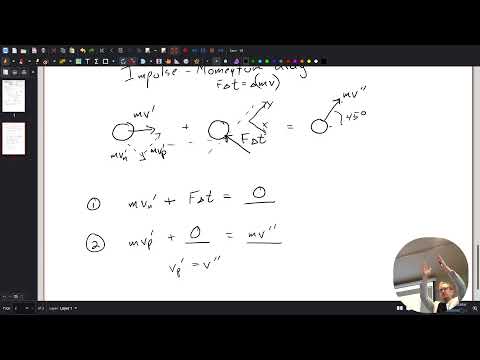
Ryan C. Cooper develops a ball-bearing sorting case problem: balls leave a table at 2 m/s and fall 0.2 m, reaching a bucket 0.4 m away in about 0.2 seconds; a second group must leave at about 1 m/s to land in a bucket 0.2 m away. The class distinguishes ideal rolling friction from rolling resistance, then models a speed bump as an impact whose impulse removes the velocity component normal to its surface, reducing the ball's speed while retaining its component parallel to the slope.
Key takeaways
- For a ball bearing leaving a table 0.2 m above the landing surface, the fall time is about 0.2 seconds; at 2 m/s it travels roughly 0.4 m horizontally.
- With equal fall times, halving the horizontal range from 0.4 m to 0.2 m requires reducing the horizontal speed from 2 m/s to about 1 m/s.
- Ideal static friction at the stationary contact point does no work during rolling without slipping, while rolling resistance represents real energy loss and should be assessed separately.
- A ball bearing rolling on steel has a very small illustrative rolling-resistance coefficient, about 0.001, supporting its omission in this short-range calculation.
- A bump's height does not by itself cause a lasting energy loss in an ideal conservative up-and-down path; an impact model can reduce speed by removing the velocity component normal to the bump.
- The impulse-momentum method is useful for short, high-force contacts: the bump's normal impulse changes momentum, while gravity's impulse is negligible over the brief collision.
Chapters
- Ryan C. Cooper introduces the final case problem: a manufacturing line sends rolling ball bearings across a table toward two buckets.
- One group should travel 40 cm to bucket one; the other should hit a speed bump and travel 20 cm to bucket two.
- The design question is whether a mechanical speed bump can reduce the balls' speed enough to halve their travel distance.
- Cooper checks the design against conservation of energy and basic cause-and-effect reasoning.
- Removing mechanical energy is feasible: brakes and speed bumps can dissipate energy, increasing entropy rather than creating energy.
- The class proceeds on the assumption that a bump can slow the ball bearings.
- A ball bearing rolling without slipping has zero relative velocity at its contact point with a stationary table.
- Cooper uses a car example: tire-road friction provides the forward force that accelerates a powered vehicle.
- He distinguishes that useful static friction from rolling resistance, which can cause a rolling object to lose speed.
- For a rotating ball, the free-body diagram must track where forces act, because their locations determine the moments they create.
- On a flat table, gravity and the normal force do no work because the ball has no vertical displacement.
- In ideal rolling without slipping, the contact point is instantaneously stationary, so static friction does no work on the ball.
- Cooper explains that real rolling losses are modeled with a rolling-resistance coefficient, not the ordinary sliding-friction coefficient.
- Illustrative values include about 0.3 for soft rubber tires on sand and about 0.001 for a ball bearing rolling on steel.
- Because the ball-bearing resistance is small for this case, the class treats it as negligible and keeps the exit speed at 2 m/s.
- After leaving the table, the ball is modeled with gravity as its only significant force; air drag is ignored over the short flight.
- From a height of 0.2 m, the vertical motion gives a fall time of roughly 0.2 seconds.
- At 2 m/s horizontally, the ball travels about 0.4 m during that fall, matching the first bucket's 40 cm distance.
- Both ball bearings fall from the same 0.2 m height, so their flight time is approximately the same, about 0.2 seconds.
- To cover 0.2 m rather than 0.4 m in that time, the second ball needs a horizontal speed near 1 m/s.
- This gives the speed bump a target: reduce the initial 2 m/s speed to approximately 1 m/s.
- Raising a ball increases gravitational potential energy, but descending the bump returns that energy in an ideal conservative model.
- For a ball bearing that stays in contact and has no suspension, bump height alone does not explain a permanent reduction in speed.
- Cooper identifies the abrupt interaction with the bump, and the resulting impulse, as the mechanism to analyze for speed loss.
- The impulse-momentum relation is force integrated over a short time, expressed as force times time equals change in momentum.
- The bump's contact force is modeled as a large force acting over a brief interval; gravity and rolling resistance contribute negligible impulse over that interval.
- The example treats the bump's normal impulse as changing the ball's momentum in the direction perpendicular to the contact surface.
- Cooper resolves the incoming and outgoing velocities into components normal and parallel to the bump surface, using a 45-degree slope as an example.
- In the simplified impact model, the normal outgoing velocity is zero while the parallel component is retained, so a steeper bump removes more speed.
- The model initially assumes continuous contact; calculating a negative contact force would show that the ball loses contact and requires a more detailed flight analysis.
- Cooper assigns students to examine the case problem independently on Friday, with an in-person comparison planned for Monday.
Transcript excerpt
0:15 Yeah, new SNL. This class >> [snorts] >> Okay, welcome back. It's a beautiful day outside, so thank you for being here. Thanks for taking some time to do some engineering work. This is our last case problem. We'll do one more project. And then we'll have then we'll have some
1:03 time to think about like how this class affects your life. Like where where does this come up in your life? Career, hobbies, anything like that. So, we'll spend a couple of days doing that. Cool. So, this last case problem is combination of like some energy methods, some impulse momentum methods, looking at speed bump design. design we have manufacturing process that ends where these ball bearings are rolling across a table. We want half of them to not slow down and go straight into bucket number one right at distance one. The other half we want them to hit our speed bump, slow down, and then fall into bucket
1:50 two, which is half the distance. So, one is 40 cm away, the other one is 20 cm away. First step is just is this even possible? Can you design like a mechanical speed bump that slows something down to bring it half the distance? Is it possible? It's kind of like this is this one's like a gut feeling check. Like is there anything is it violating conservation of energy? Are we adding energy without doing work? No, we're taking away energy. Taking away energy is always easy. Like getting something to slow down, no problem. Brakes, speed bumps, we can
2:38 do that. Is it violating like any kind of weird time travel things of like the ball needs to be in the basket before it actually travels to the basket. Like something where logically it just doesn't even make
This is the start of the transcript. Save this video free for the whole transcript, searchable and time-coded.
In this course
Related notes
Summary, takeaways, and chapters were generated by AI from the video's transcript and may contain errors. The video belongs to its creator, Professor Ryan C. Cooper.