ME2120 - 001
Overview
Ryan C. Cooper develops a speed-bump design problem for engineering dynamics: a steel ball bearing moving at 2 m/s must be redirected so it lands 20 cm away instead of 40 cm away. Projectile motion shows the ball needs to leave the bump at 1 m/s, while the force analysis distinguishes ideal rolling friction from rolling resistance and motivates using impulse and momentum to design a sharp speed change.
Key takeaways
- A ball launched horizontally from 20 cm above the floor is airborne for about 0.2 seconds, so reducing its horizontal speed from 2 m/s to 1 m/s halves its range from roughly 40 cm to 20 cm.
- Static friction in ideal rolling without slipping does no work at the contact point; rolling resistance is the separate mechanism used to represent energy loss.
- A smooth bump that returns a ball to its starting height does not reduce its final speed through gravity alone, because gravity is conservative.
- Rolling resistance depends on the rolling object and surface: Cooper cites about 0.001 for hardened steel bearings on steel, versus 0.3 for a car in sand.
- The impulse-momentum relation, force integrated over time equals change in momentum, provides a way to analyze how an abrupt bump could produce the required velocity reduction.
Chapters
- The case problem models a manufacturing line that sends half its objects to a 40 cm landing point and half to a 20 cm point.
- The design goal is to use a speed bump to slow a rolling object enough to reach the nearer bucket.
- Cooper frames the analysis around force, energy, momentum, and the constraints of physical motion.
- The baseline ball bearing rolls across a flat table at 2 m/s, with gravity and the table's normal force acting through their contact or mass locations.
- Cooper emphasizes starting dynamics problems by identifying applied forces and checking whether their net force produces acceleration.
- A friction force drawn against the ball would imply sliding and deceleration, so the model must distinguish sliding from rolling.
- For rolling without slipping, the contact point is instantaneously at rest relative to the table, so static friction does no work there.
- An ideal ball can maintain constant translational and rotational kinetic energy while rolling on a rigid, level surface.
- When the ball rolls at constant speed on the flat table, no horizontal force is needed to change its motion.
- Rolling resistance, rather than ideal static friction, represents losses that slow a rolling object and can be modeled using a resistance factor times the normal force.
- Cooper gives approximate rolling-resistance values of 0.001 for hardened steel bearings on steel and 0.3 for a car traveling through sand.
- The flat-track baseline treats rolling resistance as negligible, leaving the ball's horizontal speed at approximately 2 m/s.
- At the table edge, the ball leaves horizontally from a height of 20 cm with no initial vertical velocity.
- Gravity sets the flight time independently of horizontal speed; falling 0.2 m takes approximately 0.2 seconds.
- At 2 m/s, the ball travels about 40 cm horizontally during that fall, matching the farther bucket.
- Cooper consults a rolling-resistance table and contrasts steel bearings on steel, near 0.001, with the much larger value for a car on sand.
- The comparison supports ignoring rolling resistance for the short, hard-surface track rather than treating ordinary static friction as an energy loss.
- The ideal calculation therefore remains close to the observed engineering target of a 40 cm range.
- Both trajectories fall through the same 20 cm height, so their flight times are the same.
- Horizontal distance is proportional to horizontal exit speed over that fixed flight time.
- Halving the range from 40 cm to 20 cm requires reducing the exit speed from 2 m/s to 1 m/s.
- Cooper's design method starts with the desired outcome, the 1 m/s exit speed, and works backward to the mechanism that must produce it.
- A smooth bump that raises the ball and returns it to its original height cannot halve its speed by gravity alone, because gravitational energy is recovered on the descent.
- The speed change must involve effects beyond a reversible change in height, such as losses or a sharp interaction.
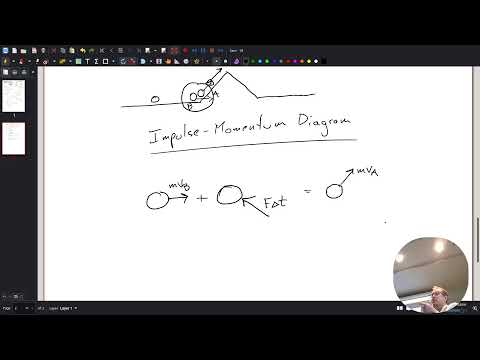
- A gradual curve changes the ball's direction continuously, while a steep, abrupt profile can create a much larger change in motion.
- Cooper compares a smooth hill with a pyramid-like bump and uses a curb as a familiar example of a sharp obstacle that can nearly stop a rolling object.
- The ball-bearing design must account for the impact-like forces generated by the abrupt change in path.
- Impulse is force applied over time, and its units are newton-seconds; it equals the change in momentum, Δ(mv).
- A large force acting over a short interval can sharply change the ball's velocity, unlike the continuously changing forces on a smooth curve.
- Cooper assigns the impulse-momentum diagram as the tool for developing the bump design, with students to compare their designs in the next class.
Transcript excerpt
0:31 Okay, it is a beautiful day outside. Thank you for taking some time to be here. Try some engineering dynamics together. Um this is our last case problem. Um, we're general, the general idea is like a speed bump design. So rather than designing it for like a car that's kind of bouncing forward, backward, and up and down, we're just looking at like a manufacturing process that ends. Half we want half of the objects to go full speed and land in bucket one. And then the other half we want them to hit a speed bump and land in bucket two. So we're we're kind of splitting up how these things move across end our like
1:20 manufacturing process. So that that's the goal. We can put any speed bump we want in there. Make it as big as curvy or whatever we want. But the main thing is like we need it to slow down to the point where it goes about half the distance. I think yeah about h 20. Yeah. 20 cm versus 40 cm. How does that sound intuitively? How does that sound? Does it feel possible that you can slow something down with a speed bump? We're not violating any like laws of physics, right? Like we're not saying we want it to travel back in time and then land in box number two. So either entropy is not incre either
2:10 entropy stays the same or it uh increases energy seems like it's going to be conserved. We probably figure out momentum, make sure that that's conserved. We should be in a good spot. Sound good? This is our Yeah. Last case problem. And then we'll do next week we'll take a look at project four and that'll be the last assigned project as well. And then
This is the start of the transcript. Save this video free for the whole transcript, searchable and time-coded.
In this course
Related notes
Summary, takeaways, and chapters were generated by AI from the video's transcript and may contain errors. The video belongs to its creator, Professor Ryan C. Cooper.