ME2120-002
 Watch on YouTube →
Overview
Professor Ryan C. Cooper analyzes a speed-bump design using impulse-momentum diagrams, showing how a ramp removes the velocity component normal to its surface while preserving the tangential component. The class compares 60° and 45° ramp designs, then derives a curvature constraint, approximately r ≥ v²/g, to keep a rolling object in contact with the rounded bump at the expected maximum speed.
Key takeaways
- In the idealized impact model, a ramp removes the velocity component normal to its surface and preserves the tangential component, so ramp angle directly controls speed loss.
- A 2 m/s object striking a 60° ramp retains 2 cos 60° = 1 m/s along the ramp; a second symmetric 60° impact can reduce that to 0.5 m/s.
- A 45° approach ramp retains 2 cos 45° ≈ 1.41 m/s from an incoming speed of 2 m/s.
- For a rounded bump, the approximate no-separation condition is r ≥ v²/g, evaluated using the maximum speed expected at the curve.
- A negative calculated normal force is physically unavailable for an ordinary surface, so it signals that the object will lose contact and may become airborne.
Chapters
- Cooper frames case problem four as a cycle of understanding how a design works, testing it, and modifying it.
- The design target is to reduce an object moving at 2 m/s to 1 m/s.
- The prior impulse-momentum result is that velocity parallel to the bump remains, while the normal component is removed.
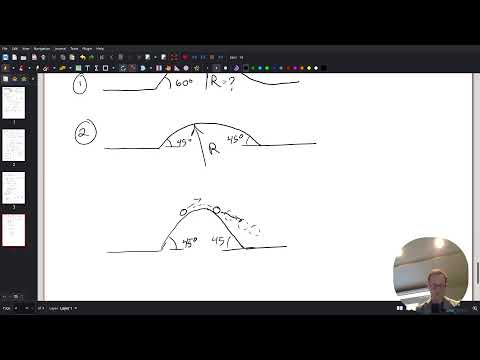
- For a 60° incline, the ramp supplies impulse normal to its surface to eliminate the incoming normal momentum.
- The parallel component is 2 cos 60°, or 1 m/s, so an idealized impact reduces the speed from 2 m/s to 1 m/s.
- The impulse magnitude grows with both the incoming speed and the ramp angle.
- The object reaches the descending 60° face at 1 m/s and receives another impulse that removes its new normal velocity component.
- Resolving the velocity into components gives a final tangential speed of 1 cos 60°, or 0.5 m/s.
- The symmetric two-face design therefore cuts speed at both impacts, rather than preserving the 1 m/s target through the exit.
- A 45° approach ramp retains 2 cos 45°, approximately 1.41 m/s, along its surface after the idealized impact.
- A sharp pyramid-like bump can act as a launch ramp, making airborne motion a concern rather than a controlled speed reduction.
- Rounding the bump can help maintain contact, but its shape must be considered alongside the ramp angle.
- The class considers an 18 mm, roughly three-quarter-inch ball bearing rolling over the bump.
- The effective path and transition geometry depend on where the ball contacts the surface, so object diameter matters.
- Possible profiles include two 45° ramp sections joined by a smooth transition, a variable-radius curve, or a parabola.
- The ball's free-body diagram includes gravity and the surface's normal force; friction matters for rolling but is initially set aside.
- Intrinsic coordinates describe the curved path, with centripetal acceleration represented by v²/r.
- Combining the normal-force balance with centripetal acceleration turns the contact question into a design constraint.
- At the top of a small-angle curve, gravity is approximately mg toward the center of curvature, while the surface normal acts oppositely.
- If the required normal force becomes negative, the surface would have to pull the ball like a suction cup, which an ordinary ramp cannot do.
- A normal force of zero marks the threshold of losing contact; a positive normal force is needed to remain on the bump.
- The approximate top-of-bump condition is n ≈ mg - mv²/r.
- Requiring n ≥ 0 gives g ≥ v²/r, or a minimum curvature radius r ≥ v²/g.
- Designers should apply the constraint using the maximum speed expected over the bump, not just a lower nominal speed.
- The critical case depends on both the curve's radius and the object's speed as it travels over the crest.
- An object may stay in contact on the approach but begin drifting away on the descending side as its path no longer follows the surface.
- A sufficiently large radius, checked against the expected maximum speed, helps avoid a ramp-like launch.
- For a 45° approach, the retained tangential speed from 2 m/s is 2/√2, approximately 1.41 m/s.
- For a 60° approach, the corresponding retained speed is 2 cos 60°, or 1 m/s; the impact impulse removes the normal component.
- Cooper closes by noting that the class has a radius-design equation and will continue project four in the next session.
Transcript excerpt
1:00 Okay. Welcome back. We are working on case problem four, designing a speed bump. So, figuring out how does it work so we can optimize it, get it to do what we want it to do. That's our general MO as engineers. Ask how does it work and then as soon as you know how it works, you start modifying it until it's either broken or you can sell it. Those are your two main engineering options. 90% of what we do ends up breaking, but that's all right. It's still fun. No? If you're not breaking 90% then you're just not trying enough. You need to try more. You could simulate it, but your
1:48 simulation should absolutely be breaking. You should be pushing the limits on your simulations. I guess that's what I mean. When you're simulating at least 90% of what you try should be breaking. But you break stuff, you fix it, you learn along the way. All right. We left off with a cliffhanger of impulse momentum diagrams. And we were figuring out that whatever whatever velocity was parallel to our speed bump, that would maintain. We would keep it and then we'd lose everything that was perpendicular to the speed bump. So, I wanted to check in and figure out where people are at.
2:37 Either what you thought about it or if you took that to the next step of trying to figure out what the design is. Our main goal is that we're moving 2 m per second. We want our speed bump to drop us to 1 m per second. All right. So, I'm going to check in, see where people are at. I forgot the mic today. Yeah.
3:45 Yeah. All right.
8:12 So, one idea and this is a great way to just try things of just
This is the start of the transcript. Save this video free for the whole transcript, searchable and time-coded.
Related notes
Summary, takeaways, and chapters were generated by AI from the video's transcript and may contain errors. The video belongs to its creator, Professor Ryan C. Cooper.