EVEG 4156: Waste & Sanitation - Composting
Overview
Samuel Snow explains how large-scale composting turns wastewater sludge into biosolids, focusing on pathogen treatment, moisture control, aeration, and regulatory limits. He compares Class A and Class B treatment targets, describes static-pile and in-vessel systems, and assesses the practical challenges of applying composting and urine separation in household latrines.
Key takeaways
- The lecture gives two Class A composting routes: aerated static piles held at 55°C for at least 3 days, or windrows held at 55°C for 15 days with 5 turns.
- A 50 to 60 percent moisture range supports biosolids composting; too little moisture slows microbial activity, while excess water restricts oxygen and promotes anaerobic conditions.
- Bulking agents such as sawdust, rice husks, or coconut husks improve wet sludge structure and help maintain airflow through compost piles.
- Metal concentration limits and lifetime land-application caps are needed because wastewater-derived metals can accumulate in soils over repeated biosolids applications.
- Class A treatment reduces pathogen risk but does not guarantee total pathogen removal, so crop and public-contact restrictions may still apply.
- Household latrine composting must account for labor and hygiene: a technically plausible design can fail in practice if it requires people to regularly turn unpleasant, potentially infectious material.
Chapters
- Samuel Snow frames composting as a way to recycle sludge and other solids, then asks which processes can also work at household scale.
- A possible centralized business model would collect pit-latrine waste by truck and process it into methane and fertilizer.
- Odor, incomplete mixing, surviving pathogens, allergen-producing fungi, and inconsistent operation are challenges at both small and large scales.
- Class A receives more stringent pathogen treatment and permits broader uses, including some public-contact applications, though crops such as lettuce and spinach remain restricted.
- The lecture gives a Class A aerated static-pile target of 55°C for at least 3 days, or a windrow target of 55°C for 15 days with 5 turns.
- The stated Class B targets are 40°C for 5 days and 55°C for at least 4 hours, with limits on public contact.
- Heat and exposure time work together to inactivate microbes, much like disinfectant concentration and contact time.
- Municipal sludge can contain metals from flushed materials, wastewater inputs, and substances the human body excretes into sewage.
- Because metals can accumulate in biosolids and soil, regulations set concentration thresholds and lifetime application limits for each plot.
- Land-use controls aim to prevent harmful long-term contamination while recognizing that soils naturally contain metals such as nickel.
- Wastewater sludge often needs dewatering, while food scraps may need added moisture and mixing to create a suitable compost feedstock.
- Bulking agents such as sawdust, shredded corn husks, rice husks, and coconut husks improve structure and help keep wet material from turning anaerobic.
- The target temperature is generally 55°C to 65°C, followed by a stabilization period that lets the material cool and undergo further microbial processing.
- Bulking material may sometimes be recovered and reused, depending on the process.
- The lecture identifies 12 to 15 percent moisture as a rough minimum for microbial activity and says moisture below 40 percent can slow growth.
- A 50 to 60 percent moisture range is presented as optimal for biosolids composting.
- Excess water makes the pile muddy, restricts oxygen transfer, and encourages anaerobic conditions rather than the desired aerobic process.
- The sugar example illustrates how water availability affects microbial growth: dry sugar resists spoilage, while liquid foods such as milk support microbial activity.
- Static-pile systems start with a prepared mixture stacked over aeration infrastructure, with air drawn through the pile by a pump.
- A breathable cover helps limit rain entry, while drains collect excess liquid from rainfall and biological reactions.
- Air drawn from the pile can be routed through a filter-like screen to help manage odor.
- Once the pile reaches 55°C, the stated Class A static-pile process holds that temperature for at least 3 days; microbial heat supplies the energy.
- An in-vessel system can add solids near the top and remove processed solids near the bottom, with residence time set to meet the treatment target.
- Continuous air injection can provide oxygen without turning, as long as the mixture is porous enough for air to pass through.
- Alternative designs use moving augers or conveyor-like mechanisms to turn and transfer the material.
- The central operating goal remains an aerobic process that achieves the required temperature for the required duration.
- Separating urine can recover a nutrient-rich stream for direct fertilizer use and reduce moisture in the fecal solids that need composting.
- A soak pit or collection medium such as rice husks can absorb urine, though odor and handling remain concerns.
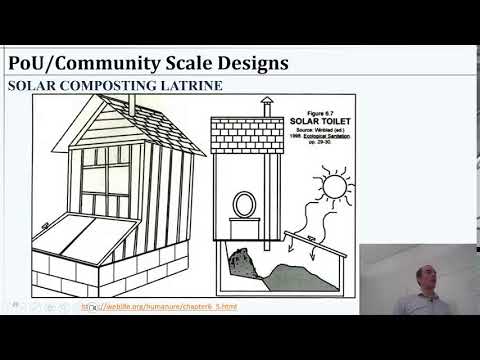
- A latrine design that requires people to shovel and turn fecal material may be impractical because of labor, hygiene risks, and unpleasant conditions.
- Solar-heated latrines and rotating compartments could simplify handling, but a carousel design without mixing may become anaerobic and smell.
- The term biosolids generally refers to solids that have already been processed, while unprocessed material is called sludge or solids.
- Snow cautions that 55°C treatment does not guarantee every pathogen is dead; cyst-forming organisms such as Cryptosporidium and Giardia may survive, so use restrictions remain important.
- The class is set to watch an older biogas-production video and visit the lab to count bacteria, but the transcript ends before those activities occur.
- Snow says research-paper introduction feedback is still in progress and aims to provide it before the end of the week.
Transcript excerpt
0:05 All right, good morning. How you guys doing? Um today we're going to continue our conversation about um biosolids, composting, um kind of solid waste handling for um for the purpose of recycling, how to deal with um sludge or solids streams. I'm really taking a look at sort of the technological front. How do we do it at a large scale so we can think about what it would take to do it in a point of use. Um I do have a few slides on point of use composting latrine type type scenarios, but to be honest, I think there's there's perhaps some room for improvement and
0:53 room also to to notice that some of the processes really are better at scale. Um that that could mean that in some scenarios uh there might be a business model to collect solid waste from communities as a source um a feed for a methane production uh system. Right, so I can imagine it's plausible that if you had a bioreactor that could produce methane and you could afford to take a truck to different pit latrines and extract the waste, um do the service do that as a service, perhaps even getting paid for it, and then produce methane and and um fertilizer out of the
1:40 the result, um maybe there's a business model there, right? So, it might not be uh huge margins, but I can imagine that something like that maybe um maybe plausible. Um okay, so we're I'm to take a look at a bit of that uh including a a video on biogas production that's like super old but kind of um kind of cool or interesting in its own right. Um What what did video editing look like 20 years ago? We'll get >> [laughter]
This is the start of the transcript. Save this video free for the whole transcript, searchable and time-coded.
In this course
Related notes
Summary, takeaways, and chapters were generated by AI from the video's transcript and may contain errors. The video belongs to its creator, Samuel Snow.