EVEG 4156: EndNote How-to + Water Indicators & Measurements
Overview
Samuel Snow demonstrates how EndNote works with Microsoft Word and LSU’s Scopus access to collect references, insert citations, and update bibliographies, while emphasizing that citation style must match punctuation and attribution rules. He then outlines two community water-treatment projects, electrochlorination and cyanide removal, using real water-quality data to frame practical questions about treatment performance, cost, operations, and safety.
Key takeaways
- EndNote’s main advantage is that it synchronizes in-text citations and bibliographies in Word, so moving claims or changing citation styles does not require manually renumbering references.
- Scopus provides a repeatable route from literature search to an EndNote-compatible citation export, while publisher pages and the LSU library catalog can fill gaps for articles and books.
- Citation management does not replace editorial judgment: authors still need to check citation placement, punctuation, and attribution for the selected style.
- Electrochlorination design depends on actual water chemistry and pumping patterns: Amigos water has only 10 to 11 mg/L chloride, while an electrolyzer may require 30 to 40 mg/L, and mineral-rich water can create precipitation problems.
- Cyanide treatment must address metal-bound cyanide as well as free cyanide; chlorine may not remove the bound fraction, making total-cyanide performance and safe residuals important design criteria.
- A treatment option for a rural system must be evaluated beyond removal efficiency, including costs, operator training, waste handling, variable flows, weather, heat, and power interruptions.
Chapters
- Samuel Snow recommends EndNote, available free through LSU TigerWare, for organizing references in research and group-project reports.
- EndNote inserts citations at the Word cursor and automatically builds and updates the bibliography.
- When citation formatting needs final manual edits, EndNote can convert a document’s citations to plain text.
- LSU Library provides access to Scopus, which searches scientific literature and lets users sort results by date or citation count.
- Scopus exports citation records in formats including EndNote and RIS, with options to include abstracts and keywords.
- Journal publisher pages such as ScienceDirect and ACS also offer citation exports, though Scopus can be easier to use consistently.
- For books that do not export easily from Scopus, search the LSU Libraries catalog using book details or an ISBN and look for an export route.
- EndNote can also create records manually for books, journal articles, and other reference types.
- EndNote can locate and store full-text PDFs, but Snow notes that he generally finds its PDF features less convenient than managing references.
- EndNote can switch among styles such as Environmental Science & Technology, APA, and numbered citations, then reformat citations and references.
- Citation placement affects sentence punctuation: author-date citations and numbered citations must follow the conventions of the chosen style.
- Technical claims based on other people’s research need references; omitting attribution can constitute plagiarism, while genuinely obvious facts may not need citations.
- Snow asks students who have not completed the short moral-foundations reflection to submit it before the semester ends; completed work supports participation credit.
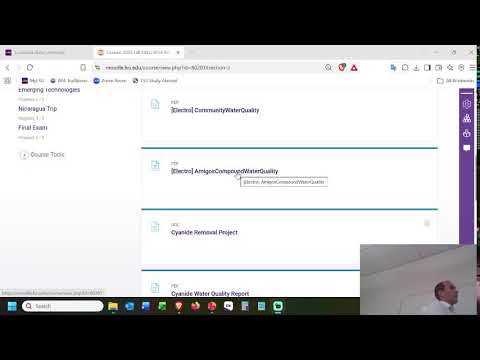
- Moodle now contains group assignments for electrochlorination and cyanide removal, with four students in the former group and three in the latter.
- The projects are intended to produce practical findings for communities, and students may investigate useful questions beyond the initially specified tasks.
- The electrochlorination group will assess an operating Amigos system and compare its performance with sodium hypochlorite, or bleach.
- A second task evaluates rural-community use, including salt costs, electricity demand, electrode replacement, and a long-term life-cycle perspective.
- Snow estimates an electrode unit at about $3,000 and explains that treatment design must account for intermittent pumping, including an assumed six hours of tank filling per day.
- Treatment location matters: oxidized minerals may precipitate in storage tanks, so students should consider whether treatment occurs before or after storage.
- Metal-bound weak-acid-dissociable cyanide is difficult to treat with chlorine; chlorine may remove free cyanide while leaving toxic complexes.
- Students should compare treatment options for total cyanide, including operator training, maintenance, sludge or solids disposal, and backup plans.
- The analysis should assess resilience to flooding, drought, temperatures around 100 degrees, and short power outages.
- A new borehole is the default alternative, but drilling alone can cost about $15,000 and may fail to produce suitable water.
- Snow posts water-quality reports from Nicaragua, noting that students may need to translate Spanish labels and that concentrations are generally reported in milligrams per liter.
- The Amigos water contains about 10 to 11 mg/L chloride, below the electrolyzer’s stated minimum of roughly 30 to 40 mg/L, so salt must be added.
- A rural example has about 120 mg/L chloride, near the Amigos system’s stated target of 110 mg/L, but its calcium-carbonate hardness of 375 indicates a risk of mineral precipitation.
- Detectable iron may consume chlorine and contribute to electrode or system problems, increasing treatment demand and the need to manage deposits.
- A posted rural-water report shows cyanide at about 68 mg/L, far above the cited maximum admissible level of 0.05 mg/L.
- Snow says the sample came from a real water system where people may still be drinking the water if no intervention has occurred.
- Groundwater chloride is generally expected to remain fairly stable, but routine testing can detect changing contaminants such as cyanide.
- A reusable Excel calculation sheet could document project assumptions and let communities or future teams adjust inputs for a new water source.
- The next lecture will cover indicators used to assess chemical and microbial quality in drinking water and conventional indicators used for wastewater treatment standards.
- Snow plans to compare field assessment methods with laboratory analysis, including when samples must be sent out for tests such as cyanide or lead.
Transcript excerpt
0:03 All right, I'm going to go ahead and uh get started. So, good morning. I know the few people are still making their way in. Good morning. Um there's a a couple of uh announcements or or things I'd like to to share, but in case some people are still trickling in, what I'm going to do is I'm going to go ahead and start with the end note kind of a training seminar sort of a portion. These are from the slides last time. We didn't quite get to them. So, I'm going to start here. It'll be recorded for anybody that's uh misses the first few minutes and then I'll do some announcements in about 10 15 minutes. So, end note and um I should have reminded you to bring a laptop if you wanted um or you can uh go back and
0:52 work through this with me kind of afterwards or next time we talk about kind of writing stuff feel free to ask questions. But um EndNote is software that I find very convenient. Um, there it is occasionally some a bit finicky, but I think all the reference citation software can be that way. It's available on Tiger Wear for free, which is why I'm recommending it to you. I've used it since I was um probably in your shoes, maybe just starting grad school, maybe just before. Um, and it's been a huge help because it manages your your references. It gives you a way to store your references and
1:40 insert them into Microsoft Word um, very conveniently. So, I'm going to walk you through a bit of that um, as a tool for really both your uh, research projects in particular, but also the group projects as you navigate putting together some sort of a report. So, you
This is the start of the transcript. Save this video free for the whole transcript, searchable and time-coded.
In this course
Related notes
Summary, takeaways, and chapters were generated by AI from the video's transcript and may contain errors. The video belongs to its creator, Samuel Snow.