EVEG 4156: Latrines & Biosolids
Overview
Samuel Snow connects basic pit latrines to biosolids reuse, contrasting a simple waste-containment pit with Eawag’s high-tech Autarky toilet, which separates and dries urine, treats gray water for flushing, and incinerates blackwater to produce ash fertilizer. He explains why pathogen control, culturally informed hygiene, and carefully managed aerobic composting matter, then weighs fertilizer and soil benefits against odor, exposure risks, and inconsistent product quality.
Key takeaways
- The Autarky toilet demonstrates a resource-recovery chain: separate and dry urine, biologically treat and disinfect gray water for flushing, and incinerate blackwater to produce fertilizer-bearing ash.
- Biosolids reuse must control exposure at multiple stages, including handling, processing, and crop application; pathogen reduction alone does not address every contamination risk.
- Aerobic composting depends on balancing moisture and airflow: saturated material blocks oxygen, while overly dry material slows microbial activity.
- Composting heat can support pathogen reduction, but uncontrolled heat from biological decomposition can create a fire hazard inside organic piles.
- Nitrogen and phosphorus make biosolids valuable as fertilizer, but excess nutrient application can contribute to eutrophication, so nutrient balance and local soil needs matter.
- Biosolids can improve soil structure and water behavior, but odors, worker exposure, and batch-to-batch nutrient variability can limit safe and consistent use.
Chapters
- The class begins with short project presentations and peer feedback before continuing the latrine lecture.
- A basic pit latrine confines human waste while liquid leaches into the ground and solids remain in the pit.
- Ventilation pipes, fly screens, latches, and toilet seats can improve a latrine without changing its basic design.
- The Autarky system separates urine at the toilet and dries it to recover nutrients with comparatively little processing.
- Gray water receives biological treatment and disinfection so it can be reused for flushing.
- Blackwater is incinerated, leaving ash that can be processed into fertilizer; urine capture need not be perfect for the system to function.
- The energy- and equipment-intensive system illustrates a high-tech option rather than a practical toilet for every household.
- Handling fecal matter requires sanitation during processing as well as safeguards when treated material is applied to crops.
- Dedicated tools, such as a shovel reserved for biosolids, and user education can reduce cross-contamination with food-growing activities.
- Snow frames cultural taboos around waste as potential behavioral protections, so reuse programs should account for local beliefs rather than assume acceptance.
- Safe use requires pathogen reduction and attention to contaminants that may persist or accumulate when biosolids are repeatedly applied to land.
- Biosolids can recycle nitrogen and phosphorus, nutrients that are costly to replace with manufactured fertilizer.
- The lecture connects nutrient balance to the Redfield ratio, citing an approximate 115:15:1 carbon:nitrogen:phosphorus ratio for algae.
- Plants obtain much of their carbon from the atmosphere, while excess nitrogen or phosphorus entering waterways can contribute to eutrophication.
- Anaerobic digestion can convert organic carbon into methane for energy, although biogas recovery may be difficult at small, point-of-use scales.
- Biosolids composting is defined as aerobic, thermophilic decomposition that produces relatively stable, humus-like material.
- Moisture must be balanced: waterlogged piles restrict airflow, while overly dry material limits bacterial growth.
- Turning a pile or blowing air through it maintains oxygen; pH, temperature, oxygen, and the microbial community also shape decomposition.
- Biological heat can help kill pathogens but can become a fire hazard if an organic pile overheats.
- Feedstock balance matters: corn husks alone provide mostly carbon, while concentrated manure may need additional carbon-rich material.
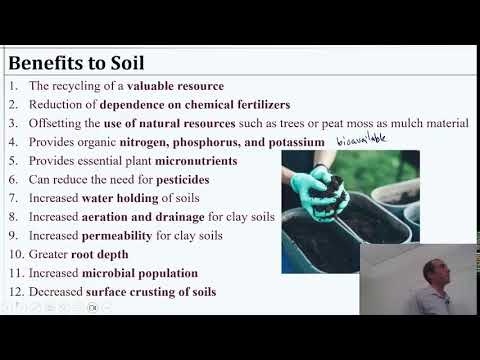
- Compost can add nutrients and micronutrients while improving soil texture, drainage, water retention, root growth, and microbial activity.
- Organic material can reduce surface crusting and make dense clay soils more permeable when incorporated appropriately.
- Human-waste compost can produce strong odors, and pathogens may survive or spread if treatment is inadequate.
- Fungal spores or allergens can expose workers during application, especially when material is sprayed.
- Compost batches may differ in nutrient content, complicating consistent fertilizer use at larger scales.
Transcript excerpt
0:03 All right, good morning. So, we are going to have presentations, quick ones, um kind of practice, introduce how things are going with your project so far. Um doesn't have to be super formal, but I know you guys prepared slides, which I appreciate. Um I didn't plan any formal way to give you feedback, and but I will give you some feedback, and you can give each other some feedback, like, "Hey, I like this. Hey, maybe have you thought of that?" Um could be could be with presentation style, or even with just the content. Like, hopefully, you have enough content to be interesting to be like, "Hey, have you thought about this? Or what what's the deal with that?" Um so, that's my hope is to give you give you all some uh some feedback like
0:51 that. Um to give you plenty of time for that, I'm going to do just like a a halfway lecture here. Um so, we'll probably get part way through these slides, and then um pick back up next time with them. So, we're going to talk about uh continue talking about latrines, but now take the angle of the biosolids. So, last time we we spoke about what what is kind of the the simplest way to to treat our uh human waste uh with no nothing more fancy than a little structure, right? And that would be a latrine. Uh and you can improve it if you ventilate it um with a little bit of thought, maybe add a few um gadgets and things, like a a door with a doorknob, and maybe or a
1:39 latch, uh maybe a a pipe to ventilate, screen to keep the flies out. Uh something like a toilet seat. Um things like that would be would be great
This is the start of the transcript. Save this video free for the whole transcript, searchable and time-coded.
In this course
Related notes
Summary, takeaways, and chapters were generated by AI from the video's transcript and may contain errors. The video belongs to its creator, Samuel Snow.