EVEG 4156: Water Quality Indicators and Measurements
Overview
Samuel Snow explains how field measurements can identify water-quality problems when laboratory testing is costly, slow, or impractical. He covers probe-based measurements and portable colorimetry, then explains why microbial safety is assessed through indicator organisms such as coliforms, including culture methods, serial dilution calculations, and a portable filtration-and-incubation kit.
Key takeaways
- Conductivity is a fast field indicator of dissolved ionic material, but it is not a direct measurement of total dissolved solids.
- Colorimetry converts analyte-dependent light absorption into a concentration estimate using a blank and the Beer-Lambert relationship.
- Microbial water safety is difficult to establish by screening for every pathogen, so routine assessments use indicators such as total and thermotolerant coliforms.
- For the worked culture example, 137 colonies from 0.5 mL after six tenfold dilutions correspond to 2.74 × 10⁸ CFU/mL in the original sample.
- Sterile technique and blank controls are essential in field microbiology because contamination from equipment or handling can produce misleading colonies.
- NaCl is not a substitute for bleach: sodium hypochlorite produces disinfecting free-chlorine species, including HOCl.
Chapters
- Shipping samples to a laboratory can be expensive and delayed, and samples may degrade without suitable preservation or refrigeration.
- Field tools help assess chemical and microbial water quality during site visits for drinking-water and wastewater investigations.
- A pH probe or inexpensive indicator strips provide a quick baseline measurement because pH affects water chemistry.
- Conductivity is a practical proxy for dissolved ionic material, while total dissolved solids can be measured directly by evaporating water and weighing the residue.
- Many probes convert a physical or chemical response into an electrical signal that can be recorded digitally.
- Dissolved oxygen and temperature can change after collection, so they should be measured at the site or immediately after sampling.
- Biological activity can alter nitrate or phosphate results; refrigeration and prompt analysis can help preserve samples.
- Light-sensitive analytes may require light protection, and collection procedures depend on the specific analysis.
- Multiparameter probes can log measurements and associate them with GPS locations for mapping water-quality changes across a lake or among wells.
- Some probes remain deployed for continuous monitoring, recording data at set intervals and storing or transmitting readings.
- Low power demand makes battery-operated logging useful for remote monitoring.
- A thermocouple infers temperature from how temperature changes electrical behavior in coupled metal elements.
- A pH probe compares a hydrogen-ion-sensitive glass surface with a reference solution, commonly near pH 7, and reads the resulting voltage difference.
- pH electrodes must remain hydrated in a suitable storage solution so their reference condition does not deteriorate.
- Conductivity probes pass electricity between electrodes; more dissolved ions generally make current flow more easily.
- Colorimetric analysis measures how much light a sample absorbs, using a blank to establish the baseline before measuring the reacted sample.
- Transmittance is transmitted light divided by incident light, and absorbance is calculated as the negative logarithm of transmittance.
- The Beer-Lambert relationship links absorbance to analyte concentration, molar absorptivity, and optical path length; standard cuvettes commonly have a 1-centimeter path.
- The same light-absorption principle applies to water-treatment processes such as assessing how much UV light reaches water.
- Portable colorimeters use LEDs and light detectors to quantify color changes without bulky benchtop instruments or lamps that need warm-up time.
- A cuvette shield blocks ambient light so the device can measure the sample consistently in the field.
- Field colorimetry can provide rapid screening or monitoring data before selected samples are sent to a laboratory for more precise analysis.
- Reagent packets, drops, or sealed glass ampules trigger the color-producing reaction; some analyses first convert the analyte into a measurable form.
- Sample handling may require cooling, sealing with minimal headspace, light protection, or acidification, depending on volatility and biological activity.
- Ammonia, NH3, can volatilize, whereas charged ammonium, NH4+, is less likely to escape from solution.
- Existing sample color or incompatible water chemistry can interfere with colorimetric results, and some tests work in freshwater but not saltwater.
- Water can contain many harmless bacteria, viruses, and other organisms, so detecting microbial DNA does not by itself establish a health risk.
- Testing individually for every pathogen would require pathogen-specific assays and substantial time and expense.
- Coliforms and related organisms serve as indicators of possible fecal contamination, while pH or conductivity changes can also signal a need for further investigation.
- A total-coliform culture places a measured water sample on growth media and incubates it around 37°C so bacterial colonies become visible.
- Each visible colony represents a colony-forming unit, or CFU; counts are reported relative to the sample volume, often per 100 mL.
- Drinking-water guidance commonly targets zero coliforms per 100 mL, though indicator counts do not prove that the organisms present are pathogens.
- A thermotolerant coliform test at about 44°C narrows the indicator group but is still not a direct test for every pathogen.
- Incubation near 44°C selects for organisms able to grow under hotter conditions than the approximately 37°C total-coliform test.
- Media can distinguish metabolic responses by colony appearance; the lecture describes colored colonies as a way to separate tolerant from non-tolerant groups.
- More targeted tests, including E. coli media, can improve specificity, but indicator organisms remain proxies for pathogen risk.
- Serial dilution reduces a concentrated sample in repeated steps; six tenfold dilutions produce an overall dilution of 10⁶.
- Plates with too many colonies become indistinguishable, while very low counts are unreliable; roughly 20 to 200 colonies is a useful counting range.
- Dilution planning helps ensure at least one plate yields a count that can be interpreted.
- The example counts 137 colonies after spreading 0.5 mL of a sample diluted tenfold six times.
- The diluted sample contains 274 CFU/mL because 137 colonies in 0.5 mL are multiplied by two.
- Multiplying by the 10⁶ dilution factor gives an original concentration of 2.74 × 10⁸ CFU/mL.
- For relatively clean water, filtration concentrates bacteria from a larger volume rather than diluting the sample.
- Water testing often uses 100 mL; filtering more volume can help detect sparse organisms, while a dirty sample may need dilution or a smaller filtered volume.
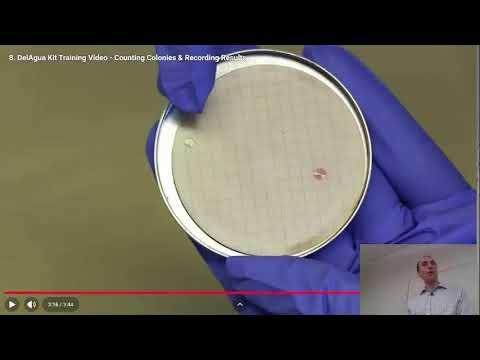
- The lecture introduces a portable DelAgua kit with small plates and a battery-powered incubator for field culture work.
- The field procedure maintains sterility so microbes from fingers, equipment, or previous samples do not distort the water sample's result.
- A hand-operated vacuum draws water through a membrane filter, trapping bacteria; the filter is then placed on a nutrient pad that wicks moisture through to the organisms.
- A compact incubator can run from a car battery, allowing plates to grow at the required temperature away from a laboratory.
- A media blank and a deionized-water blank check whether contamination is present in the reagents or procedure before sample counts are trusted.
- Very low colony counts carry substantial sampling uncertainty, especially when only one or two colonies are observed; counts should be interpreted with sample volume in mind.
- Municipal drinking-water systems perform repeated microbial tests, and chlorine residuals can help suppress bacterial recovery in distribution systems.
- Sodium chloride, NaCl, is table salt and does not provide the same disinfection as sodium hypochlorite, NaOCl, the active ingredient in bleach.
- Free chlorine species, including hypochlorous acid, HOCl, provide disinfection; the lecture notes that electrolysis can generate these species.
Transcript excerpt
0:07 All right. Good morning. How are you guys doing? All right. Okay. Today we're going to talk about how we how we measure or find water quality um problems. So, we've talked so far, of course, about uh some of the core ethics and some considerations about when and why, what to think about if we do some sort of intervention. And then we began talking about, okay, what is our water source? Is it contaminated? What does that mean for the water? Um, today I'd like to talk a little bit about how we know if it's contaminated or how to what tools do we have to use if we're going to the field and taking
0:57 some the measurements. So, of course, you could always go and take some sample and ship it off to a lab. Uh, but there are a few potential issues there, including well, might cost a lot. that might uh the sample might go bad or you have to have the right protocols in place to keep it safe um to keep it preserved. Perhaps you don't have access to refrigeration conveniently um or shipping or a decent laboratory nearby. Um so I'm going to talk about a few tools we might use in the field. Talk about some of the technologies and uh that'll kind of we'll be uh coming back to the same the same place where we started in terms of talking about both drinking and
1:45 wastewater. How do we measure? How do we look at the chemical microbial um and then these for the drinking water and then the potentially if we're looking at wastewater contamination, what are the tools we have for those? And that mean Yeah. Okay. Okay. So, we'll start with the the chemical characterizations. the uh there's a few that are quite
This is the start of the transcript. Save this video free for the whole transcript, searchable and time-coded.
In this course
Related notes
Summary, takeaways, and chapters were generated by AI from the video's transcript and may contain errors. The video belongs to its creator, Samuel Snow.