EVEG 4156: Defining Development
Overview
Samuel Snow frames development as more than infrastructure or income: it should improve health, dignity, agency, and people’s ability to choose how they spend their time, without taking freedoms or resources from others. The class connects that framework to global health and environmental engineering, using examples such as water storage, latrines, efficient cookstoves, and community-led appropriate technology; Snow also outlines a 4 to 6-page research paper and group projects tied to Nicaragua.
Key takeaways
- Development should increase quality of life, human dignity, and agency, not be measured only by infrastructure or income.
- Snow’s time-saved framing of prosperity helps explain how running water, electricity, and labor-saving appliances can expand people’s choices, but it does not fully capture social relationships or fulfillment.
- A water intervention can provide cleaner water while disrupting a community’s third space, so project design should account for social practices as well as technical performance.
- Appropriate technology is more likely to be sustainable when local communities shape its design and implementation around economic, social, environmental, and cultural conditions.
- Global health includes prevention through handwashing, sanitation, clean water, and efficient cookstoves, not just medical treatment after illness.
- Development is ethically constrained: a proposed benefit is not genuinely good if it depends on coercion, exploitation, or removing another person’s rights.
Chapters
- Samuel Snow says the Moodle course page and syllabus are live, with Tuesday’s slides and sections for course materials.
- The first class included introductions, and Snow’s PhD student is present.
- Snow is still organizing the semester project instructions and plans to post updates on Moodle.
- Snow expects two or three groups to give end-of-semester presentations, likely on projects connected to Amigos for Christ in Nicaragua.
- Individual research papers are intended to build writing skills while letting students investigate an environmental technology topic.
- Snow is open to topics such as indoor air quality and cookstoves in developing contexts, even when they extend slightly beyond lecture material.
- Students can propose their own topic or choose from specific ideas Snow will provide.
- Possible investigations include arsenic in India or Bangladesh and water and sanitation responses after a disaster such as a flash flood.
- Snow recommends considering a specific location because it helps reveal how culture and local conditions shape engineering solutions.
- The planned paper sequence includes a topic presentation, a thesis paragraph, a draft, and a final paper near the end of the semester.
- The previous assignment targeted about 4 to 6 pages, proper citations, a minimum number of sources, and scientific-report style; Snow plans to revise the instructions.
- Potential themes include policy, culture, religion, technology, infrastructure, geography, economics, history, and ethics, with papers expected to integrate several.
- Past topic examples include groundwater-quality prediction, ion exchange or removal, alternatives to septic tanks, and advanced pit latrines.
- The class starts defining development through quality of life, then connects it to roads, jobs, education, and access to hospitals.
- Roads and paths can save time, improve productivity, and make school and medical care reachable.
- Snow broadens development beyond convenience to include basic rights and human dignity.
- Students consider whether the goal is simply to make life better and what concrete changes would count as meaningful progress.
- Students identify sustainability and community capacity to continue improvements as conditions for lasting development.
- Infrastructure and essential needs discussed include energy and electricity, food, sanitation, water, and shelter.
- Snow describes a third space as somewhere beyond home and work where people can socialize or pursue enjoyable activities.
- A centralized water system can unintentionally remove a communal water-gathering space, showing why interventions should preserve valuable social practices.
- The class treats a good action as one intended to benefit others, while recognizing that moral judgments can differ.
- Giving someone a chocolate bar by taking it from another person is not a clear good, because the benefit comes at someone else’s expense.
- Snow uses taxation for shared water infrastructure to illustrate that societies may accept limits on individual resources under agreed rules.
- Development interventions should pursue a net benefit without violating other people’s rights or liberties.
- Snow distinguishes prosperity from merely having basic needs met, emphasizing the agency to decide how to live and use one’s time.
- Running water, electricity, dishwashers, washing machines, and air conditioning are discussed as technologies that reduce routine labor.
- The Rational Optimist is cited as the source of the idea that prosperity can be understood through time saved.
- Snow notes limits to this definition: social connection and personal fulfillment matter, and labor that saves one person time can exploit another, as in slavery.
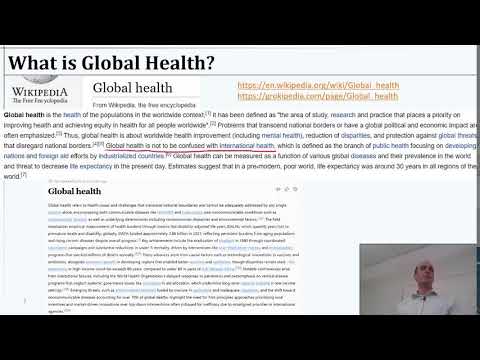
- Students define global health in terms of broad health improvement and fair access to care.
- Snow expands the idea beyond physician visits to prevention, sanitation, hygiene, vaccination access, and health education.
- Water and wastewater treatment are linked to global health because clean water and sanitation prevent disease.
- A household device such as an automated vacuum illustrates that technology only improves welfare when it actually saves time in its users’ circumstances.
- Snow introduces a course book whose foreword is written by Jimmy Carter.
- Students read the one-page foreword before Snow reads it aloud for discussion.
- The passage connects global health to peace, democracy, human rights, environmental quality, and the alleviation of suffering.
- The foreword describes a child in Mali learning handwashing to prevent diarrheal disease and communities building water storage in Honduras.
- It cites villagers pouring latrine slabs in Timor-Leste and women constructing efficient cookstoves in Asia.
- Efficient cookstoves can reduce indoor air pollution while using scarce tree resources more effectively.
- Carter presents water, sanitation, hygiene, and shelter as human-rights concerns, not merely engineering or development tasks.
- The foreword argues that engineering includes poverty and disease eradication as well as planning, design, and construction.
- Appropriate technology should be developed with ongoing local input and fit each community’s economic, social, environmental, and cultural conditions.
- Community-led implementation is presented as more likely to foster healthy communities and reduce gender inequality.
- The Carter Center principle described in the passage is that people can improve their lives when they have skills, knowledge, and access to resources.
- Students question the foreword’s claim that improved global health will connect people in peace and equality.
- Snow notes that poor health, famine, and resource scarcity can contribute to conflict, but the path from health improvements to peace is indirect.
- The class asks what world peace means across households, cities, gangs, and countries, and whether that goal is realistically definable.
- Discussion distinguishes equal access and opportunity from forcing everyone into identical outcomes.
- Snow compares definitions that distinguish global health from international health, the latter described as public health focused on developing nations and foreign aid.
- He returns to how interventions can build prosperity sustainably without taking resources or rights from others.
- Students planning the Nicaragua trip are asked to submit passport scans and flight information that week.
- The trip is scheduled for October 24 to 31, with visa and travel logistics still to be discussed.
Transcript excerpt
0:04 All right. Good morning. How are you guys? I uh almost was almost late this morning. Just the traffic. It was like actually not so bad the past couple of days, but uh [laughter] today ouch. Um okay. Well, I hope you hope you're all doing all right. Um, I got the Moodle page up and running last night and then this morning as I was going to show you that, I realized it hadn't been published to you you yet. So, here it is um as of two minutes ago, but it's here. Uh, the syllabus is up up um and then we have sections for different portions of the course. So, take a look here. The slides from
0:51 Tuesday are here. Um, I emailed them to you. Um, will also note that um my uh my PhD student is is here. So we we did introductions last time. Maybe you can just say hi [laughter] and maybe actually maybe everybody just with your names small class. So thank you. And let's just go quickly around the names. Thank you. Thank you. Um, okay. So, we
1:44 are we are going to be launching into kind of the the core content of the course in uh in some ways. Um I I'm still doing a little bit of organization for uh the group projects. I'm going to talk also with the um guys at uh Amigos for Christ about what projects uh they see as important and I'm going to then clarify. Okay, here's exactly the uh the tasks we can do for our semester projects. Uh these the semester project itself I will put up the instructions here. Essentially what we will do with that is these will be presentation uh focused but we might also provide a small report. These will be group
This is the start of the transcript. Save this video free for the whole transcript, searchable and time-coded.
In this course
Related notes
Summary, takeaways, and chapters were generated by AI from the video's transcript and may contain errors. The video belongs to its creator, Samuel Snow.