EVEG 4156: SODIS & PAMs
Overview
Samuel Snow explains SODIS, or solar disinfection, as a low-cost point-of-use treatment that uses sunlight, bottle heating, and UV exposure, but whose performance depends heavily on clean water, strong direct sun, and long exposure. He then examines photoactive materials, including C60 fullerenes and titanium dioxide, which harness light to create reactive oxygen species, and details why short-lived radicals, dissolved organic matter, and material-retention challenges complicate practical deployment.
Key takeaways
- SODIS is inexpensive and easy to communicate, but practical performance is commonly closer to one to three log reductions than the five-log reductions possible under clean, controlled laboratory conditions.
- Ground-level sunlight lacks UVC because the atmosphere absorbs it; the remaining sunlight overlaps only weakly with DNA's strongest absorption near 260 to 265 nm.
- C60 fullerene can rapidly inactivate MS2 when concentrations and light conditions are suitable, potentially because positively charged fullerene aggregates attract negatively charged viruses.
- Organic matter is a major treatment variable: 5 mg/L humic acid nearly eliminated observed fullerene-mediated viral inactivation in one experiment.
- Titanium dioxide photocatalysis can inactivate E. coli, but studies may require catalyst doses up to grams per liter, and short-lived reactive species limit how far treatment effects extend from the catalyst surface.
- A practical photoactive reactor must simultaneously manage light transmission, catalyst retention, surface contact, radical quenching, and variable water chemistry.
Chapters
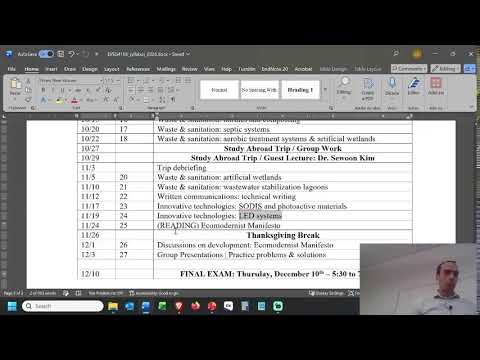
- Draft papers are due Thursday, with feedback planned in about a week to support final-paper revisions.
- The upcoming lectures cover SODIS, photoactive materials, and UV LEDs; a Tuesday class during Thanksgiving week is replaced by reading the Ecomodernist Manifesto.
- The roughly 10 to 15 page manifesto introduces the Anthropocene idea that Earth is increasingly shaped by human activity.
- SODIS uses sunlight to disinfect water, commonly by placing water in clear PET bottles, a widely available plastic that transmits some UV.
- Effective treatment combines light exposure and heat, with at least six hours of direct sunlight suggested under favorable conditions.
- Only a small portion of sunlight reaching the ground contributes directly to disinfection, so exposure is far less potent than germicidal UV lamps.
- Snow uses a 2017 solar-eclipse measurement to illustrate how sunlight intensity varies by wavelength and how the atmosphere filters the spectrum.
- UV-C, normally effective for germicidal treatment, is absorbed by the atmosphere before reaching the ground.
- Ground-level sunlight contains some UV-B and UV-A, but only a narrow part of the available spectrum overlaps with useful DNA absorption.
- The lecture classifies UVA as roughly 320 to 400 nm, UVB as 280 to 320 nm, and UVC as wavelengths below 280 nm.
- DNA absorbs most strongly around 260 to 265 nm, where UV can create cross-links that prevent replication and require repair.
- Low-pressure mercury lamps emit strongly at 254 nm, near DNA's germicidal absorption peak, unlike sunlight at Earth's surface.
- Turbidity can scatter or block light and shield microbes, while cloud cover, rain, bottle material, temperature, and latitude also affect treatment.
- Laboratory best-case results after six hours include up to five-log bacterial reductions; practical performance is more often around one to three logs.
- Some viruses show roughly three to four log reductions, while resistant protozoa such as Cryptosporidium and amoebae may require longer exposure or remain poorly controlled.
- A solar concentrator study used a 25-liter reactor and reported roughly 20 to 50 percent Cryptosporidium inactivation after six to eight hours, with results varying by turbidity.
- Microbial inactivation depends on both temperature and exposure time: at 105°C, one example organism showed substantial survival after 10 seconds but about 99.99 percent reduction after 40 seconds.
- Pasteurization, sous vide cooking, and slow cooking illustrate how lower temperatures can still control pathogens when maintained for longer periods.
- Autoclaves commonly use 121°C for 15 to 20 minutes to sterilize samples under pressure, far exceeding the temperatures SODIS typically reaches.
- SODIS can use nearly free, common PET bottles and is simple to explain, but darker or thicker plastics and aluminum cans do not transmit useful UV.
- Its drawbacks include variable disinfection, weak performance against some protozoa, warm treated water, labor demands, and possible microbial repair after treatment.
- A photosensitizer absorbs light and transfers energy to oxygen, producing singlet oxygen that can damage viruses and other targets.
- C60 fullerene is a soccer-ball-shaped, 60-carbon molecule that can photosensitize oxygen using UVA and visible light, but it does not readily dissolve in water.
- Edible dyes such as Rose Bengal and methylene blue can also generate singlet oxygen, though dye degradation raises questions about byproducts and health risks.
- Unlike photosensitization, photocatalysis involves light-driven electron transfer that separates an electron from a positively charged hole.
- Photocatalysts such as titanium dioxide can generate hydroxyl radicals and superoxide, which oxidize microbes and some water contaminants.
- Hydroxyl radicals are highly reactive but short-lived, creating a mass-transfer limitation because they may react before reaching a distant target.
- Potential applications include self-disinfecting surfaces, drinking-water treatment, wastewater treatment, and advanced oxidation of pesticides or pharmaceuticals.
- Complete oxidation of organic compounds aims to convert their carbon into carbon dioxide, with products such as water and nitrogen-containing compounds also possible.
- Partial oxidation may transform a contaminant into less toxic byproducts, but those intermediate products require evaluation.
- Experiments tested C60 fullerene concentrations with visible light and UVA against MS2 viruses; 10 nanomolar fullerene produced little effect.
- Increasing fullerene concentration increased inactivation, and at 1 micromolar the effect was so rapid that sampling every 20 seconds was needed.
- Cationic groups on fullerene aggregates may attract negatively charged viruses, bringing them close to localized singlet-oxygen production.
- First-order disinfection kinetics link disinfectant concentration and contact time to log reduction, expressed through a CT relationship.
- Rose Bengal and methylene blue produced similar estimated CT values, while fullerene appeared much more efficient when singlet oxygen was measured in the same way.
- Snow suggests the difference may reflect localized high concentrations around fullerene colloids that a bulk chemical measurement does not capture.
- Adding 0.1 mg/L of organic carbon as humic acid slowed viral reduction to about three logs in half an hour; at 5 mg/L, little inactivation occurred.
- Organic matter may coat fullerene particles or occupy their positively charged surfaces, preventing negatively charged viruses from approaching.
- This interference illustrates how natural organic matter can undermine promising lab-scale photoactive disinfection.
- A titanium dioxide study showed E. coli inactivation, but used concentrations up to grams per liter, much higher than the fullerene concentrations discussed earlier.
- Bacterial cell membranes can provide initial protection, so photocatalytic inactivation may take time even when the process is effective.
- A critical review of photocatalytic water treatment asks why decades of research have produced few widespread applications, prompting closer study of practical barriers.
- Practical systems must provide usable visible or UVA light while managing interference from natural or dissolved organic matter.
- Hydroxyl radicals may diffuse only a few nanometers, though estimates range up to a few hundred nanometers; singlet oxygen lasts several microseconds, compared with nanoseconds for hydroxyl radicals.
- A reactor must retain photoactive material without allowing people to ingest it, while still transmitting light and providing adequate contact area.
- Experiments with titanium dioxide, light, and a hydroxyl-radical probe showed that organic matter can quench reactions, with effects depending on pH and material type.
- Some organic matter hindered the probe reaction, while small amounts in certain cases appeared to improve it by helping the probe approach the catalyst surface.
- The lecture closes by previewing further discussion of photoactive materials and UV LEDs, and reminding students about the Thursday draft-paper deadline and the post-Thanksgiving manifesto discussion.
Transcript excerpt
0:10 All right. Good morning. How you guys doing? Doing all right. Okay. So, just a quick uh quick look at our remaining schedule for for the semester. We are closing in fast. Your draft papers are due Thursday, which means I will have uh maybe a week or so to get them back to you so that you can have a have that feedback to prepare your final papers. So I will try to be quick about that. Um the today we're going to talk about solar disinfection and photoactive materials for disinfection.
0:59 Um so we're slightly behind on that. That means Thursday we'll um take a look at UV LEDs and what kind of advancements we can have on them. Um I think we will delay the um the toilets or perhaps say that we've talked about them already. So what I'm planning to do I think see I guess we did this right? we did. I think that's how it played out.
1:52 Anyway, um so today, solar disinfection, photoactive materials, that's been a research topic for me for pretty much all of my grad school and beyond. or this is what kind of what I started and what I did in grad school. So this one's near and dear to to me. I'll talk your head off about it if if I let myself or if you let me. Um so we we kind of may maybe that will bleed into Thursday a little bit too. Um and then LEDs following that UVs kind of parallel to that. Um expand on it further. Tuesday next week. I know a lot of people want to travel or are traveling and it's Thanksgiving week. So, instead of regular class, I'm asking
2:41 you to um take time to read the uh
This is the start of the transcript. Save this video free for the whole transcript, searchable and time-coded.
In this course
Related notes
Summary, takeaways, and chapters were generated by AI from the video's transcript and may contain errors. The video belongs to its creator, Samuel Snow.