EVEG 4156: Ethics of Intervention | DW Supply & Contamination
Overview
Ethical intervention should be evidence-based, cost-aware, and led by the communities it is meant to help: good intentions can cause harm when outsiders impose solutions without local knowledge, consent, or sustainable ownership. The lecture applies that framework to water and sanitation, covering fecal-oral disease prevention, centralized versus point-of-use treatment, U.S. drinking-water standards, and filtration tradeoffs from roughly 10-micrometer media filters to reverse osmosis.
Key takeaways
- Effective intervention requires community consent and local ownership; unsolicited advice, culturally mismatched communication, or externally imposed systems can undermine both dignity and long-term operation.
- Engineers should verify problems with data and field observations, then monitor whether an intervention actually reduces harm rather than relying on good intentions alone.
- Fecal-oral transmission is a central water-safety threat, so treatment must combine appropriate source protection, particle removal, disinfection, and clean storage.
- Centralized treatment is not always feasible: point-of-use systems must provide comparable protection despite limited pipes, electricity, and wastewater infrastructure.
- Filtration becomes more expensive as pore sizes shrink: media filtration can target particles near 10 micrometers, while bacteria removal may require 0.1 to 0.2 micrometer membranes and desalination requires reverse osmosis.
- Water safety depends on usability as well as health standards: chlorine taste can lead communities to reject treatment, while local contaminants such as arsenic, mining-related cyanide or mercury, nitrate, and fluoride require region-specific responses.
Chapters
- Students should prepare research-project thesis statements by October 1 for a short classroom presentation and peer feedback.
- The research-paper rubric, topic list, assignment portals, ACS reference guide, and writing resources are available on Moodle.
- The planned final presentations are during the week before finals, provisionally on Tuesday, with Thursday as a possible alternative.
- Two groups will study treatment options for cyanide, possibly arsenic, and an electric chlorinator for Amigos.
- The group presentations should run about 20 to 30 minutes, with each student presenting several slides and the group preparing a shareable project summary.
- The chlorinator analysis should compare chlorine levels across the system and account for salt and electricity costs versus conventional chlorine.
- The cyanide analysis should compare viable treatment approaches, treatment levels, operating costs, and options such as a borehole.
- Engineering ethics centers on improving and protecting people’s lives, including through the water people drink and the infrastructure they rely on.
- Jonathan Haidt’s The Righteous Mind introduces moral foundations including care, fairness, liberty, loyalty, authority, and sanctity.
- Recognizing that people prioritize different moral foundations can help engineers understand community values without assuming one political or moral outlook fits everyone.
- Environmental protection can be grounded in human well-being, including people’s interest in experiencing and preserving nature.
- The lecture cautions that aid can fail when planners overlook corruption, local conditions, or whether infrastructure such as bathrooms has running water and can be maintained.
- The Karpman drama triangle describes toxic relational roles as victim, victimizer, and rescuer; the rescuer role can also appear in international aid.
- Providing food without supporting local food security can create dependency and worsen hardship when aid ends.
- Interventions should respect rights and avoid defining equity as making everyone identical or taking away from some people to benefit others.
- Maps showing projected malaria changes from 2000 to 2015 illustrate how health data can identify places where conditions are worsening.
- Field observation can reveal constraints missed by desk research, such as soil that is too clay-rich for septic-system infiltration.
- Technical evaluations, public-health studies, community concerns, and news reports can all help establish that a problem exists.
- The World Health Organization’s Global Health Observatory offers aggregated data, including water, sanitation, and hygiene indicators.
- The lecture asks whether engineers should maximize good at all costs, weighing care and fairness against costs imposed on other people.
- A five-mile-per-hour speed limit might reduce car accidents but could impose a cost people would reject as disproportionate.
- Desalinating seawater could provide clean water, but its expense makes it impractical as a universal solution.
- Reducing CO2 emissions can prevent climate-related harm, but constraining energy access may undermine infrastructure and resilience in developing communities.
- Unsolicited advice can feel patronizing; asking a community what help it wants supports dignity and makes advice more welcome.
- Water-safety education must account for language and cultural differences, including gestures whose meanings vary across communities.
- The “Got Milk?” campaign illustrates translation risk: its Latin American advertising was rendered with a phrase meaning “Are you lactating?”
- Sustainable projects require ownership and leadership from within the community, as well as communication and ongoing management.
- The trolley problem contrasts pulling a lever to kill one person while saving five with allowing five deaths, highlighting action-versus-inaction arguments.
- Helping a drowning person may be courageous, but rescue can also endanger the would-be helper and requires practical judgment.
- The drowning-person dilemma raises a parallel question about obligations to people facing starvation in impoverished countries.
- Ethical decisions about aid should consider multiple moral foundations, the opportunity to help, and the costs of intervention.
- A fundamental water and sanitation goal is to interrupt fecal-oral transmission, in which pathogens from human or animal waste reach drinking water.
- Wastewater treatment and drinking-water disinfection provide barriers, but wildlife can still introduce fecal contamination into surface waters.
- Pathogens from another organism’s gut can cause diarrheal disease and other infections when they enter the human body through water or food.
- A protected source and suitable treatment are essential even when obvious chemical toxins are not present.
- Deep groundwater can receive natural filtration over long travel times, reducing many surface-water pathogens, though metals and other contaminants remain possible.
- A U.S. graph of typhoid-fever deaths from 1900 to 1960 shows a decline during the period when chlorination and other public-health improvements expanded.
- Typhoid is fecal-orally transmitted, and a vaccine may be recommended before travel to countries where the disease is endemic.
- Choosing among surface water, groundwater, and other sources affects the treatment barriers a system needs.
- Developed systems commonly collect water, treat it centrally, distribute it through pipes, and collect wastewater for centralized treatment.
- Point-of-use treatment becomes important where electrical grids and pipe networks are unavailable or too expensive.
- A hand-dug well 30 to 40 feet deep may provide water but still require treatment; household sanitation may depend on a pit latrine or septic system.
- Decentralized systems must preserve the health protections that centralized treatment and distribution systems provide.
- U.S. primary drinking-water standards are enforceable limits for contaminants that can harm health, including pathogens, chemicals, and radionuclides.
- Preventing fecal-oral transmission addresses most waterborne pathogens, though Legionella can grow in distribution plumbing without a fecal source.
- Public-water standards do not guarantee that every private well is safe; private-well contamination may not receive the same regulatory oversight.
- The U.S. and World Health Organization guidelines can serve as reference points for countries adapting standards to local conditions.
- Secondary standards address aesthetic qualities such as taste, odor, temperature, color, and hardness, rather than enforceable health limits.
- Chlorine taste can discourage people from drinking treated water; activated-carbon filters such as Brita can reduce that taste.
- Hardness mainly reflects calcium and magnesium, while iron and other minerals can consume chlorine or complicate treatment.
- Water pH may matter for chlorination and other processes even when it is not itself a direct health concern.
- Water treatment may require particle removal before disinfection because particles can shield microbes from disinfectants.
- Point-of-use systems need clean storage as well as treatment; uncovered buckets can be contaminated by animals, birds, or the surrounding environment.
- Health concerns vary by region, including arsenic, cyanide and mercury near gold mining, naturally high nitrate, and excessive fluoride.
- Chlorine dosage must account for local acceptance: communities in Nicaragua may reject chlorinated water or reduce dosing because of its taste.
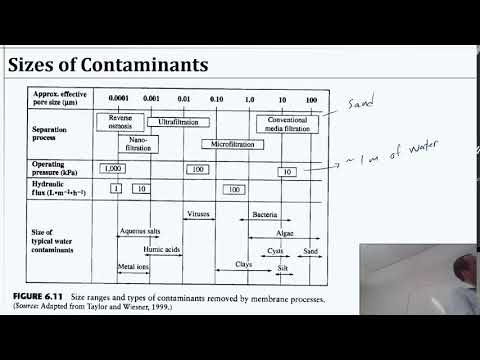
- Media filters can remove particles around 10 micrometers with roughly 10 kilopascals of pressure, approximately one meter of water head.
- Microfiltration with pores around 0.1 to 0.2 micrometers can remove bacteria such as E. coli at about 100 kilopascals, or roughly 10 meters of water head.
- Finer filtration can capture viruses, while chemical removal and deionization require nanofiltration or reverse osmosis for desalination.
- As filtration targets smaller contaminants, operating pressure rises and hydraulic flux falls, increasing the cost per volume treated and limiting desalination’s practicality.
Transcript excerpt
0:07 All right, good morning. All right, so I've got a couple of updates for you. Um, I meant to post the uh instructions for the presentations yesterday. Today we'll talk about it and I will show you. I posted it just right now before class. Um the assignment for the group project presentations will look like this. Um this is actually instructions for your presentation grades in general. So one one piece will be to discuss your thesis with the class, give each other some feedback. Show you what I have in mind for that in a moment. Um and then the next big thing would be the group project itself. The
0:56 aim here is to help essentially help amigos with two problems. One would be cyanide and we might add arsenic to it. Um but cyanide in particular, what would be the most viable treatment option given the circumstances and a review of what that would entail. uh some calculations to to say okay what what might we expect for cost operation um and some things like that. The other would be the electric chlorinator and related calculations terms of cost. How does it compare to regular chlorine? So we'll get we'll get back to that and I still need to flesh out those details to give you a more specific prompt. So I'm I'm still working on that. But the uh
1:45 group presentation expectations, I expect each of you will split into two groups for the for these projects. and for each each person to present a few slides. Um something like 20 to 30 minutes total for the um for the presentation and also prepare a uh a project summary that we can print or or send to Amigos as like, hey, here's here's kind of what
This is the start of the transcript. Save this video free for the whole transcript, searchable and time-coded.
In this course
Related notes
Summary, takeaways, and chapters were generated by AI from the video's transcript and may contain errors. The video belongs to its creator, Samuel Snow.