EVEG 4156: Septic Systems
 Watch on YouTube →
Overview
Samuel Snow explains how septic systems extend pit-latrine sanitation to handle greater water flows by settling and digesting solids in a tank, then dispersing effluent through a soil leach field. He connects system reliability to residence time, soil percolation, protection from roots and non-biodegradable waste, and practical constraints in Nicaragua, including clay soils, seasonal high water tables, and the cost of infrastructure.
Key takeaways
- A septic tank's most important function is retaining settleable solids so they do not clog the leach field; soil treatment cannot compensate for a field blocked by particles.
- Tank settling capacity depends on usable clear-water volume and flow: as sludge and scum accumulate, residence time falls because theta equals volume divided by flow rate.
- Percolation testing must account for saturated soil conditions; fissures in dry clay can create deceptively fast drainage and produce an unreliable estimate of field capacity.
- Deep-rooted trees, non-biodegradable wipes, and harsh chemicals threaten different parts of a septic system by clogging distribution pipes or disrupting tank microbes.
- Nicaraguan septic designs illustrate a practical trade-off: permeable soils and low flows can make a single perforated pipe effective, but clay soils and seasonal high groundwater can make conventional systems unsuitable.
- Septic tanks reduce pathogens but do not disinfect wastewater; pathogen die-off and competition in soil provide additional treatment, so separation from wells and surface waters remains important.
Chapters
- The following Tuesday has no class because of a field trip; Dr. Seyoung Kim is scheduled to give a Thursday guest lecture on point-of-use water treatment, including membranes and adsorption.
- Samuel Snow asks students to review draft-introduction feedback and use Microsoft Word files for future submissions so he can add comments and track changes.
- The draft grade is provisional: final evaluation emphasizes improvement, and the next half-draft is due November 12.
- A pour-flush toilet adds water to sanitation, helping a water seal keep odors and flies out.
- A bucket of water can flush a toilet manually, allowing waste to be conveyed several feet away from the latrine instead of dropping directly into a pit.
- A simple pour-flush pit may handle occasional bucket flushes, but showers and other continuous wastewater flows require more capacity and safer soil discharge.
- Two pits with a diversion chamber could alternate use while one pit drains, but switching introduces mechanical complexity and a risk of failure.
- Unlike a pit filled mainly with solids, a higher-flow pit may fill with liquid and need time to drain before reuse.
- As water flow increases, designers must account for leachate travel and the distance to drinking-water sources.
- An Arborloo relocates the latrine after use and plants a tree on the former site to make use of nutrients and stabilize the soil.
- Samuel Snow defines a septic system as anaerobic treatment followed by designed discharge into soil, commonly through a septic tank and leach field.
- Louisiana and some Nicaraguan communities face high groundwater or clay-rich soils; aerated treatment units can discharge at the surface but require power and raise pathogen-safety concerns.
- A septic tank provides time for settleable particles to sink and anaerobic microbes to digest and solubilize some organic matter.
- Inlet and outlet arrangements, screens, and submerged pipes help prevent solids and floating scum from escaping with the effluent.
- The tank's essential job is to keep particles from clogging the soil absorption field, which is costly and difficult to replace.
- Septic tanks do not disinfect wastewater; pathogens decline as effluent travels through soil, where they encounter competing microbes, predators, and die-off conditions.
- Snow cites about 100 meters as a typical U.S. separation guideline between a septic system and a drinking-water source.
- A leach field near a creek, pond, or river can contribute nutrients and oxygen demand, although tank digestion and soil processes reduce some of the impact.
- A conventional layout uses gravity to move wastewater from the home through a septic tank and into a leach field; pumped mound systems are possible but require power.
- Perforated pipes surrounded by gravel or sand distribute effluent, while deep-rooted trees and large shrubs can invade and clog the pipes.
- Strong drain cleaners can harm tank microbes, and so-called flushable wipes can persist in the tank or obstruct field pipes.
- Snow notes that some Nicaraguan homes use trash cans for toilet paper because plumbing may not handle it, changing how much material accumulates in the tank.
- Tank sizing depends on household size, water use, sludge accumulation, and the time needed for particles to settle.
- Residence time follows theta equals volume divided by flow rate; as sludge reduces usable volume, water has less time to settle before leaving.
- Snow gives 270 gallons as a minimum tank size for a three-to-four-person household under a cited U.S. design assumption intended to allow about 10 years before pumping.
- The lecture discusses roughly 45 gallons per person per day as a design basis and notes that an Amigo's target may be about 100 gallons per person per day.
- A percolation test measures how quickly water moves through soil to estimate the field area required for a given wastewater flow.
- The procedure uses a dug test pit, pre-wetting to saturate nearby soil, a second fill, and timed measurements of water-level decline, often expressed in minutes per inch.
- Dry-season cracks in clay can make water drain rapidly through fissures even when the soil itself is poorly permeable, producing a misleading result.
- Better infiltration generally means less field area is needed, while poor infiltration requires more land or a different treatment approach.
- Many communities in Nicaragua have permeable volcanic soils and low wastewater flows, allowing a simple tank connected to one perforated infiltration pipe to work in many cases.
- Some households have clay-rich soil or wet-season water tables that rise too high for conventional septic systems, making conditions vary sharply between nearby homes.
- More field area and testing can improve reliability but increase labor and material costs, creating difficult community-level investment decisions.
- Snow warns that an infiltration pit is less reliable long-term than a septic tank because particles can accumulate in the soil and progressively stop infiltration.
- Snow gives an estimated pathogen reduction of 20 to 75 percent in the tank, while emphasizing that this does not make the effluent safe by itself.
- Anaerobic treatment converts some biological oxygen demand and organic carbon into methane and carbon dioxide; tanks need venting to manage gas.
- Large pH changes, temperature shocks, freezing, or toxic chemicals can harm the microbial community, while excessive mixing can carry particles toward the outlet.
- Hydrogen sulfide can corrode metal, so concrete is a common tank material; sludge removal needs depend on accumulation and local maintenance access.
- Organic polymers and cellular material are broken down through hydrolysis and fermentation into alcohols and carboxylic acids.
- Further microbial steps produce acetate, hydrogen, and carbon dioxide; acetogens and methanogens use these intermediates.
- Snow notes that much of the organic carbon becomes carbon dioxide, with a smaller share converted into methane.
- A solids mass balance compares incoming solids with microbial decay and biosolids generation to estimate net accumulation.
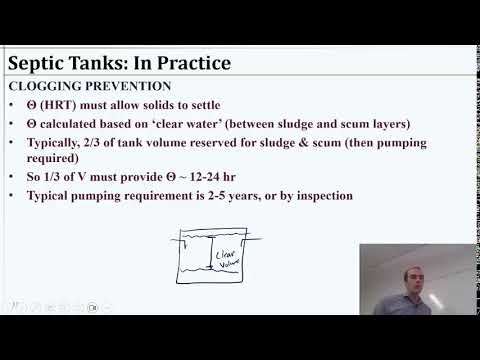
- Designers reserve tank volume for sludge and scum; Snow describes about two-thirds of the tank as unavailable for clear-water settling, leaving the remaining volume to provide roughly 12 to 24 hours of retention.
- Typical pumping guidance is every two to five years or based on inspection, but Snow notes that some Nicaraguan systems may go more than 10 years without maintenance because pump-truck services may be limited.
- Two empirical sludge estimates are presented: 47 times time in years raised to the 0.675 power, and 13.39 times years plus 50, both estimating gallons per person.
- Suggested further reading includes the EPA homeowner guide, an LSU library resource, and an article on septic-system modeling.
- Snow plans to share photos from Nicaragua in a later class and closes by reminding students that Thursday has a guest lecture and Tuesday has no class.
Transcript excerpt
0:04 All right, good morning. We're just going to get get going. Um, I know at least one person's out for an appointment uh, this morning. So, small class. All right. Uh, couple quick announcements. First of all, next week, of course, um, is the uh, the field trip. So, there will be no class Tuesday. On Thursday, I've arranged for Dr. Seyoung Kim, he's a one of the newer faculty in our department, to give a guest lecture. Um, and I just simply invited him to talk about the intersection of his work with the
0:51 potential applications for point of use water treatment kind of stuff. So, it should be interesting, should be kind of low-key. Uh, see his flavor. He tends to work with, um, membrane processes and also, I I think some some polymer chemistry for uh, membranes and other applications. So, should be maybe membranes, maybe adsorption, maybe something uh, along those lines. Um, so, for those of you not on the trip, I encourage you to go there. Um, uh, and be here hopefully on time. I'll send a uh, reminder. I think that he would appreciate that. Um, I'll also warn him that there will be at most five of five of you here. Um, but I I would appreciate that.
1:39 Uh, the other announcement, um, I wanted to to mention is the talk for a minute about the draft intros. I've gotten those back to you. You should have, um, that feedback files on Moodle now with grades. Uh what what you need to do is uh look at the feedback file in Moodle. That will have a breakdown of the supposed grade that I gave you and I'll uh explain that in a moment. And also don't worry too much about the
2:27 grade um assigned for that.
This is the start of the transcript. Save this video free for the whole transcript, searchable and time-coded.
Related notes
Summary, takeaways, and chapters were generated by AI from the video's transcript and may contain errors. The video belongs to its creator, Samuel Snow.