EVEG 4156: Technical Writing Workshop
Overview
Samuel Snow’s EVEG 4156 workshop explains how to build a clear technical argument by distinguishing source claims from a writer’s own analysis, synthesizing research rather than merely summarizing it, and citing borrowed ideas accurately. The class also covers practical revision techniques, including avoiding patchwriting, choosing active voice when it clarifies agency, resolving vague pronouns, limiting idioms, and using resources such as CXC materials on Moodle and the American Chemical Society style guide.
Key takeaways
- A research paper must distinguish source-derived claims from the writer’s own reasoning, then connect both into a defensible argument.
- Synthesis adds value beyond summary: combining findings from multiple studies lets the writer make an inference that no single source states.
- Patchwriting is not an acceptable paraphrase when it retains a source’s sentence structure and phrasing with only minor edits; quote exact wording or restate the idea independently.
- Citations should support identifiable factual claims, and one citation can cover related sentences when the attribution remains clear; repeating it is preferable to leaving ambiguity.
- Active voice often clarifies who performed an action and reduces wordiness, while passive voice is useful when the actor is unknown or deliberately not emphasized.
- Clear antecedents and precise wording reduce the effort required to follow technical prose, especially for readers who may lose their place in dense material.
Chapters
- Samuel Snow frames the class as a workshop for revising sentences and addressing feedback on students’ draft papers.
- Even when AI can produce a plausible essay, the writer’s ideas, opinions, research, and directions determine the argument.
- The assignment develops the familiar structure of a claim supported by evidence, from a paragraph to a research paper.
- Snow introduces a graduate-writing resource from the CXC Communications Across the Curriculum program, available through Moodle.
- The worksheet asks writers to mark information drawn from sources and distinguish it from their own ideas and analysis.
- Its prompts help writers identify who is making each claim and develop their own position in a research community.
- Phrases such as “a common view in the field” and “researchers have long assumed” establish what others argue while setting up a response.
- Writers can qualify claims, disagree with a source, or agree with part of an argument while identifying what remains uncertain.
- The worksheet’s CARS approach moves from establishing a research territory to identifying a niche and occupying it with the writer’s claim.
- Neutral reporting verbs include “reports” and “notes,” while “demonstrates,” “contends,” and “suggests” convey more specific actions.
- Snow recommends replacing weak verbs such as “says,” “talks about,” and “looks at” with verbs that describe a source’s contribution.
- Citations can be integrated through a signal phrase, such as an author reporting a finding, or placed after a full sentence that summarizes or quotes a source.
- Snow argues that a technical-paper conclusion should synthesize findings rather than repeat the paper’s earlier points.
- A summary reports that study A found X and study B found Y; a synthesis connects those findings to draw a new inference.
- Paragraph-ending synthesis can link topics, such as regional geography and culture, to lead into their effects on water-treatment infrastructure.
- Patchwriting occurs when a writer retains a source’s phrasing and sentence structure while deleting words or substituting a few synonyms.
- Snow distinguishes patchwriting from a properly attributed direct quotation and a genuine paraphrase written in the student’s own words.
- If a source’s exact wording is essential, quote it; otherwise, restate the idea independently and cite the source.
- Snow explains that plagiarism can result from missing citations, even when the omission was accidental rather than intentional.
- The cited student-code definition includes unacknowledged use of another person’s words, structure, ideas, or data.
- Drafts missing references are part of the revision process, but the same omissions in a final submission would be a problem.
- Widely known facts, such as Earth’s standard gravitational acceleration of about 9.81 meters per second squared, may not need a citation; research-derived claims generally do.
- Snow analyzes a sample claim that poor management of industrial, agricultural, and sewage waste has become a regional health concern, noting that its multiple factual claims may need multiple sources.
- A broad opening statement about access to clean drinking water may need less support than a specific claim that it is a critical challenge, though citing it is acceptable.
- The claim that photocatalytic technologies may help water treatment if hurdles are overcome reads partly as the writer’s assessment, so the factual basis and the writer’s inference should be made explicit.
- A citation can support a sequence of sentences when they continue the same source-derived idea, but readers must be able to tell which claims it covers.
- Snow uses a water-shortage example involving Oaxaca, Mexico, to show how a second sentence can explain the geography behind a cited claim.
- When attribution is uncertain, repeating a citation is acceptable and safer than leaving a source-based claim unsupported.
- Snow explains that submitted PDFs were converted to Word documents so he could add revision comments.
- Students can reply to a comment in a draft to ask what a note such as “ref” means, or delete comments after addressing them.
- Comments and questions can help clarify a draft, but should not remain in a final submission.
- In “I lift the water bottle,” the subject performs the action; in “the water bottle was lifted by me,” the subject receives it.
- Passive constructions commonly use a form of “to be,” as in “was chased” or “is being lifted,” and shift attention from the actor to the recipient.
- Snow recommends favoring active voice when it makes technical explanations more direct, while recognizing that passive voice can be useful when the actor is unknown or unimportant.
- The examples “monkeys adore bananas” and “bananas are adored by monkeys” show how passive voice can make otherwise simple sentences awkward.
- Changing passive wording to active voice often forces writers to identify who performed an action and can reduce unnecessary words.
- Passive voice may be appropriate when the actor is not the focus, as in reporting that experiments were performed with bacteria.
- Snow notes that the Oaxaca example’s “has recently shined a light” phrasing was not a clear passive construction, illustrating the need to diagnose the actual sentence structure.
- Pronouns such as “these,” “it,” and “that” need clear antecedents; specifying “these compounds” is clearer than leaving “these” unexplained.
- In an example about organophosphate and organochlorine contaminants, naming the compounds directly helps readers identify what is associated with health effects.
- Technical writing should avoid vague conversational expressions and idioms such as “a lot,” whose intended quantity may not be precise.
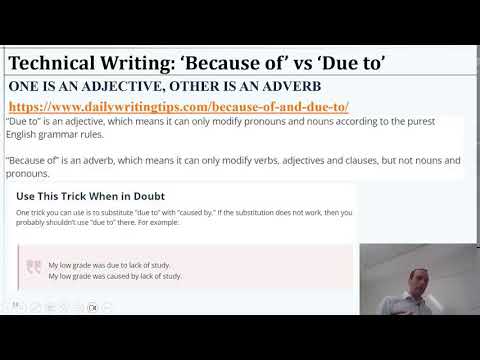
- Snow points students to Moodle resources on participial phrases, conjunctive adverbs, and the distinction between “because of” and “due to.”
- An opening participial phrase such as “glazed with barbecue sauce” takes a comma; a conjunctive adverb such as “accordingly” can connect independent clauses after a semicolon.
- The American Chemical Society style guide is offered as a technical-writing reference, alongside resources on active and passive voice.
- Snow recommends reviewing sentence diagrams to identify subjects, verbs, and objects, and closes by previewing wastewater stabilization for the next class.
Transcript excerpt
0:04 All right. Good morning. How are you guys doing? Feeling all right? How do you feel about the the paper so far? Feedback? Have you looked at the feedback I gave you? Feeling all right about it? Was any of it confusing or like what what does that mean? Why did he write that? kind of kind of understood what I was referring to. Okay. So, today mostly I want to take a a workshop type of an approach. Um, I've got slides to look through and resources to look at, but really if if you want to spend a little time like just talking about a a particular sentence that you've got and you're trying to rewrite or something, I'd be happy to do that
0:51 the board or on the virtual board or or whatever. So, um, if you do think of something or something, uh, comes up, please, please feel free to and this will help everybody, right? Everybody will appreciate being like, "Oh, yeah, let me think about that. Let me how can I reword or rework that and and why?" So, really today, I just want to talk about technical writing. um give you some tips, uh explain a few resources, and kind of go over some common mistakes I see. Um, and uh, one thing to to think about as we step into a world of computers doing essentially writing
1:40 um, alongside or perhaps um, by our direction. One thing that you'll you'll recognize, no matter how sophisticated a computer gets at at doing this type of work, it's your thoughts that really are going to matter. Um, and it's your ability to perhaps tell a computer what to express or what what ideas to put together and formulate that's really going to make a
This is the start of the transcript. Save this video free for the whole transcript, searchable and time-coded.
In this course
Related notes
Summary, takeaways, and chapters were generated by AI from the video's transcript and may contain errors. The video belongs to its creator, Samuel Snow.