EVEG 4156: WW Stabilization Lagoons
Overview
Samuel Snow explains wastewater stabilization lagoons as low-energy, land-intensive systems that use sunlight, algae, bacteria, wind, and sometimes mechanical aeration to remove organic matter. The lecture compares anaerobic, facultative, aerated, and duckweed-based lagoons, then connects their design and performance to oxygen and carbon cycling, sulfide risk, hydraulic detention time, maintenance, and climate.
Key takeaways
- Facultative lagoons depend on vertical separation: wind and photosynthesis support an oxygenated surface, while light-limited sludge zones remain anaerobic and digest settled organics.
- A lagoon’s treatment capacity depends on more than pond size: sunlight, temperature, wind-driven oxygen transfer, organic loading, and hydraulic detention time all affect performance.
- Sludge accumulation directly reduces treatment volume and residence time; maintenance is needed by the time sludge occupies roughly one-third of the lagoon.
- Sulfide near 6 milligrams per liter can kill nearly all algae, cutting off a major oxygen source and potentially triggering a decline in treatment performance.
- Long detention times can improve solids and pathogen removal, but lagoons should not be treated as reliable disinfection: a two-log bacterial reduction can still leave disease-causing concentrations.
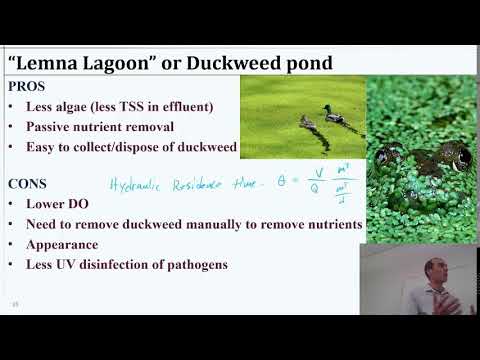
- Duckweed lagoons can capture nutrients in harvestable biomass and reduce algal solids, but shading lowers dissolved oxygen and UV exposure, so an aerobic or disinfection step may still be needed.
Chapters
- Samuel Snow introduces wastewater stabilization lagoons as the semester’s last typical lecture before more specialized topics.
- For the research-paper draft, students should submit enough material for useful feedback and begin using EndNote or a similar citation manager.
- Snow says the final paper is expected to be four to six pages, but a complete, evidence-based argument matters more than an exact page count.
- Lagoons can provide relatively simple, low-energy treatment where communities have enough land, sunlight, and warm temperatures.
- Clay-rich soils can help form an impermeable basin, although a clay and plastic liner may be needed to prevent seepage.
- Heavy rain can cause overflow, cold conditions can slow or freeze treatment, and weak aeration can lead to odors.
- Microbial populations can be disrupted by temperature or pH shocks, so lagoons are less robust than fully controlled treatment processes.
- Anaerobic ponds are deeper and support oxygen-depleted conditions that digest sludge and can handle relatively high organic loading.
- Anaerobic effluent may still contain sulfides and oxygen-demanding material, so it commonly needs a facultative or aerobic treatment step afterward.
- Facultative ponds combine an oxygenated surface with an anaerobic bottom; Snow gives about eight feet as an example of a possible maximum depth.
- Aerated lagoons use equipment such as fountains to add oxygen, increasing energy and equipment needs.
- Facultative ponds behave roughly like continuously stirred tank reactors because wind and inflow produce some mixing.
- Long, winding pond arrangements can approximate plug flow, with less mixing from the inlet end to the outlet end.
- A treatment train can sequence anaerobic, facultative, and aerated zones to match the wastewater and desired treatment.
- Snow shows examples of lagoon layouts in Louisiana and Texas, emphasizing that land shape and treatment goals influence the configuration.
- A lagoon system serving Chinandega, Nicaragua, treats city wastewater in ponds that appear to operate in parallel before discharge to a nearby river.
- At a pig farm in Nicaragua, manure and washwater pass through two lagoons; the second basin appears greener, consistent with more algae growth.
- A deep, unlined infiltration pit follows the lagoons, but sediment and clogging are likely to limit its long-term effectiveness.
- Wet-season overflow and accumulated sludge reduce usable lagoon volume and hydraulic detention time, undermining treatment.
- Photosynthesis adds oxygen during daylight while consuming carbon dioxide and incorporating nutrients into algal and cyanobacterial cells.
- At night, respiration consumes oxygen and produces carbon dioxide, so oxygen availability varies over a daily cycle.
- Murky water and settled solids limit sunlight at depth, creating reducing, anaerobic conditions where organic matter and sulfur compounds are transformed.
- Wind mixes mainly the surface, but strong mixing can disrupt vertical zones; low wind, cloudy weather, or winter conditions can leave more of the water column oxygen-depleted.
- Photosynthetic algae and cyanobacteria supply oxygen that aerobic bacteria use to decompose wastewater organics.
- Bacterial decomposition releases carbon dioxide, ammonia, and phosphate that can support further algal growth.
- The coupled processes form a nutrient and gas cycle, although both algae and bacteria also require nutrients for their own growth.
- Photosynthesis uses light energy to convert carbon dioxide, water, and nitrogen sources into cellular organic matter while releasing oxygen.
- Carbon dioxide generally accumulates overnight when photosynthesis stops, then declines after sunrise as algae consume it.
- Removing dissolved carbon dioxide reduces carbonic-acid influence and raises pH; Snow illustrates a case with pH around 8 to 8.6.
- A more extreme example reaches approximately pH 9.4 to 10.2 when carbon dioxide becomes very low.
- Carbonate buffering moderates pH changes, but large daily swings can still challenge microorganisms.
- Solar energy varies with latitude and month, making high-latitude winter operation especially challenging for photosynthesis-dependent treatment.
- Photosynthetic efficiency depends on detention time, daily illumination, wastewater loading, and temperature.
- Oxygen transfer from the atmosphere depends on water temperature, wind, aeration equipment, oxygen saturation, depth, and physical mixing.
- Designers can use theoretical equilibrium calculations or empirical relationships based on observed wind and oxygen-transfer conditions.
- Anaerobic decomposition can produce hydrogen sulfide and bisulfide, compounds associated with the rotten-egg odor of stagnant wastewater.
- With sufficient oxygen, sulfide can be oxidized through elemental sulfur toward sulfate.
- Snow notes that sulfide near 6 milligrams per liter can kill almost all algae, interrupting oxygen production and worsening lagoon performance.
- Typical sulfide levels may range from near zero during daylight to 1 to 2 milligrams per liter at night, with cold, low-light periods increasing accumulation risk.
- The pond can be viewed as an aerobic surface, an intermediate anoxic zone, and a more strictly anaerobic sludge layer.
- Aerobic processes occur near the surface, while methane and carbon dioxide can form in deeper anaerobic areas.
- Algae and cyanobacteria are key photosynthetic organisms; bacteria perform aerobic, facultative, and anaerobic transformations.
- Plants can also be incorporated into lagoon treatment, providing a different route for nutrient uptake and biomass production.
- Basic loading calculations multiply wastewater strength by flow rate to estimate the organic matter, commonly expressed as BOD, entering each day.
- High-strength wastewater may require an anaerobic lagoon followed by a facultative pond, or a larger pond to reduce loading per unit volume.
- Typical hydraulic detention times are about 20 to 50 days for anaerobic ponds and 20 to 180 days for facultative ponds.
- Lagoons can remove solids and some pathogens, but even a two-log reduction in pathogenic bacteria may leave enough organisms to cause illness.
- Bright green water generally indicates abundant suspended green algae and favorable lagoon conditions.
- Dull green or yellowish water may indicate undesirable blue-green or filamentous algae; gray or black water suggests anaerobic conditions.
- Tan, brown, or red coloration can indicate soil entering the pond, while black patches may signal sludge or other problems.
- Routine work includes screening debris, removing scum, inspecting flow, repairing embankments, and removing sludge every year or every two to five years, or when sludge occupies about one-third of the pond.
- Lemna lagoons use floating duckweed to photosynthesize, take up nutrients, and produce harvestable plant biomass.
- Plastic grids can keep duckweed from being blown into one corner; harvested plants may be landfilled or potentially composted.
- A Louisiana example uses about 90 days of hydraulic retention, with a fountain-assisted aerobic zone at the far end.
- Duckweed reduces algal solids in the effluent but shades the water, lowering dissolved oxygen and natural UV exposure; plants also require manual or automated harvesting.
- Hydraulic retention time is basin volume divided by flow rate; a 90-day average does not mean every water parcel stays exactly 90 days, especially in a mixed reactor.
Transcript excerpt
0:04 All right, good morning and sorry for being late. Uh think perhaps a few others might uh might also apologize if they show up. [laughter] Um so welcome. We'll uh we'll get going. I'll give a a lecture. So thank you for being here. [laughter] Um, I I guess if if I showed up and nobody showed up, then maybe I would just point everybody to to last year's last time's all my lecture, but Okay. So, all right. Just getting going. I was I >> Well, I literally just started talking because I was >> I think >> Okay, it wasn't wasn't just me then. I
0:51 was running late, so I was I was feeling bad and then like walked in like four four minutes after 9 or something and my alarm's like, "Uh, did I miss something?" [laughter] So, okay. So, we'll we'll get going. Um, today we're going to talk about wastewater stabilization lagoons. uh in in a way this is our last um what I'll say typical lecture for the uh semester. After this it'll be a little more topical. Um I guess these are all topics but more like special topics. So, kind of rearranged a little bit of this, but um today is
1:40 wastewater stabilization lagoons. What are those about? Um, and after that we're going to do some more like research type of topics, maybe some more discussions, and there's room for if if anybody had any particular interest um we could we could go into that. Um, and perhaps I maybe I ought to prepare some slides on um the uh electrolyer type of system. >> I have a question. >> Yeah. for that. How much do you want us to start like how much?
2:30 >> Okay, so good question and I'll uh I'll
This is the start of the transcript. Save this video free for the whole transcript, searchable and time-coded.
In this course
Related notes
Summary, takeaways, and chapters were generated by AI from the video's transcript and may contain errors. The video belongs to its creator, Samuel Snow.