EVEG 4156: Aerobic Treatment & Engineered Wetlands
Overview
Aerobic treatment units (ATUs) use powered aeration to improve wastewater before surface discharge, but their dependence on electricity, mechanical upkeep, and periodic sludge removal can make them difficult to maintain. Engineered wetlands offer an alternative: free-water-surface systems and subsurface gravel reed beds use plants and microbial processes for treatment, with design choices affecting oxygen, clogging, habitat, and pathogen removal; examples include a roughly 1,000-person community system in Montpellier and Mandeville’s discharge across 1,700 acres of wetland.
Key takeaways
- ATUs can target carbonaceous BOD below 25 mg/L and TSS near 30 mg/L, but their aerators, air intakes, pumps, and optional chlorine tablets require ongoing maintenance.
- Household wastewater flow is intermittent: a daily total of 400 to 1,500 gallons may arrive mainly during about six hours, making treatment conditions unlike a steady-flow system.
- Free-water-surface wetlands create distinct low-oxygen vegetated zones and better-oxygenated open water, while subsurface reed beds use gravel and drainage to bring air into underground flow paths.
- Wetlands provide meaningful but incomplete treatment: examples report roughly 93% BOD removal, while 90% to 99% pathogen reduction still leaves residual risk.
- Mandeville’s natural-wetland discharge receives effluent from a lagoon system at an average of about 2.3 million gallons per day across 1,700 acres, but its actual nutrient-removal performance is contested.
- A wetland liner of at least 30 mil protects groundwater and prevents groundwater inflow from unexpectedly increasing the volume the system must treat.
Chapters
- Anaerobic septic systems digest solids and do not require air pumping, but sulfide production can cause strong odors.
- The technical-writing workshop is planned for Tuesday, and the opinion-article rough draft deadline is moved to November 19.
- Anaerobic breakdown converts organic carbon largely to methane and carbon dioxide, while aerobic treatment produces carbon dioxide and water.
- An ATU adds oxygen so aerobic bacteria can treat wastewater before surface discharge, which is less suitable for odorous anaerobic effluent.
- A typical ATU draws surface air through an aerator and bubbles it into a continuously mixed treatment chamber.
- Baffles can keep bubbles out of the outlet area so solids settle before effluent leaves the unit.
- In a gravity-fed layout, the outlet sits below the inlet; some systems discharge to a ditch or spray treated water onto lawns.
- Louisiana rules require ATUs to be capable of disinfection, but do not require that they disinfect; chlorine can also harm organisms in the receiving ditch.
- Some layouts use a primary chamber for scum and sludge, an aerated chamber for biological treatment, and a settling stage before discharge.
- Pumps can move wastewater between chambers or to an outlet at a different elevation, but they add mechanical complexity.
- A septic system may also need a pump when its absorption field is uphill from the tank, making toilet use vulnerable to power outages.
- A US household may generate 400 to 1,500 gallons per day, with much of that flow arriving during roughly six hours rather than evenly across 24 hours.
- Typical targets include carbonaceous BOD below 25 mg/L and total suspended solids near 30 mg/L; disinfection aims to reduce fecal coliforms, often by 99% or more.
- Aerator wear and blocked air intakes reduce oxygen delivery; ATU solids may need pumping every 3 to 5 years, compared with about 5 to 7 years for septic tanks.
- Calcium hypochlorite tablets may need regular replacement, while separating greywater from toilet waste can reduce the load on a poorly draining septic system.
- A working ATU discharge was contrasted with cloudy, whitish-gray effluent associated with a unit whose aerator may have stopped functioning.
- A research case examined whether ATU discharges contribute human fecal contamination to nearby rivers.
- Proper aeration can support aquatic life, but weak maintenance can allow treatment performance to deteriorate.
- Engineered wetlands can provide an alternative when surface discharge is needed but a powered ATU is impractical.
- The core goals are waste stabilization, containment, pathogen removal, and odor control, potentially at a small-community scale.
- Wetland designs include free-water-surface (FWS) systems and subsurface-flow systems, both of which require attention to climate, flow, treatment targets, and groundwater separation.
- Microbes can oxidize organic carbon with oxygen, convert ammonia to nitrate through nitrification, and remove nitrogen through denitrification to N2 gas.
- An FWS wetland directs surface water through shallow vegetated zones, an open-water zone, and further vegetation before discharge.
- Photosynthesis can add oxygen during daylight, while algae respiration and wastewater breakdown can consume oxygen, especially at night or in shaded areas.
- Cattails and other marsh-adapted plants tolerate oxygen-poor, waterlogged root zones that would damage many garden plants.
- Open water permits sunlight and air exchange; floating plants must not cover it completely, and sandy or sandy-loam beds support water movement and roots.
- Subsurface-flow wetlands, also called reed beds, move wastewater through gravel below the surface while plants root into the media.
- Water is typically maintained below the gravel surface; draining and alternating beds can draw air deeper into the gravel.
- Gravel provides flow paths and microbial surface area, but accumulated particles can clog the bed and require maintenance.
- Keeping flow underground can help control odors compared with an open-water system.
- A French community system serving roughly 1,000 people screened large debris before sending wastewater into lined gravel beds planted with reeds.
- PVC pipes provided air pathways into the beds, especially when they drained; a sprinkler also appeared to return wastewater to the bed surface for additional aeration.
- The site tested added treatment steps including filtration, electro-oxidation, gravity membranes, and UV to assess pathogen control and possible agricultural reuse.
- Most effluent bypassed the experimental advanced-treatment line and flowed toward a nearby prairie and creek.
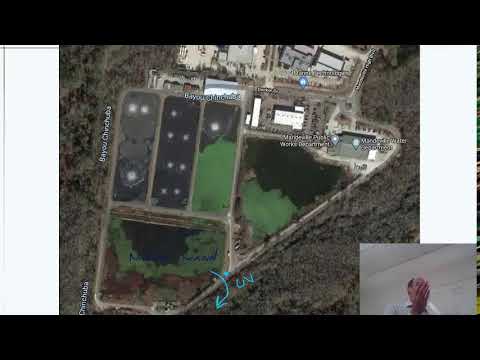
- Mandeville’s treatment plant uses three stabilization lagoons and UV dosing before discharging into neighboring wetlands as tertiary treatment.
- The permit allows up to 4 million gallons per day, average flow is about 2.3 million gallons per day, and discharge is distributed across roughly 1,700 acres.
- The wetland discharge is intended to remove additional nutrients before water reaches Lake Pontchartrain, partly to limit harmful algal blooms.
- The system’s design and effectiveness are disputed, so natural wetlands should not be assumed to provide reliable treatment without evaluation.
- A liner of at least 30 mil, about 0.762 mm, helps protect groundwater and prevents unwanted groundwater inflow from increasing treatment volume.
- FWS systems can support wildlife and enhanced nitrification but may breed mosquitoes; subsurface beds reduce surface-water contact but can clog and may provide less nitrification.
- Gravel quality and transport can make subsurface beds costly, while FWS beds need suitable soil and sufficient elevation for discharge.
- FWS basins are often 5 to 10 times longer than they are wide, with shallow zones only centimeters deep and deeper zones approaching 1 meter; gravel beds may be roughly 0.25 to 1 meter deep.
- Wetlands can remove pathogens through decay, competition, sunlight, and predation by organisms such as amoebae, but a 90% to 99% reduction still leaves pathogens.
- Reported examples show about 93% BOD removal for FWS wetlands; both FWS and subsurface systems remove suspended solids and nutrients, but neither necessarily removes all phosphorus.
- Suitable FWS plants include bulrush, cattail, papyrus, and common arrowhead; reed beds use compatible reeds, grasses, rushes, and sedges.
- Plant selection must match whether roots grow in open wetland soil or gravel with submerged and aerated zones.
- Septic systems, ATUs, and wetlands are generally designed as standalone treatment options, although pairing ATU discharge with a planned wetland may add treatment.
- Waste-hauling practices described for Ghana may remove both liquid and sludge from pits, producing high-strength wastewater that creates challenges for receiving treatment plants.
- Discharging concentrated wastewater to the ocean can damage local ecology; nutrient loading also contributes to oxygen depletion, as illustrated by the Mississippi River dead zone.
- Households with ATUs pay for equipment and upkeep, while sewer customers commonly fund treatment through recurring charges on water bills.
Transcript excerpt
0:05 All right. Good morning. So, today we're going to continue talking about [clears throat] the aerobic treatment option. So, like I like I said last time after our kind of trip debrief, I reminded us about the concept of the septic system and ultimately that that the septic tank and the biological process are inherently anaerobic. And that's important for a few reasons. You can get pretty good treatment aerobic or anaerobic and anaerobic of course does not require the pumping of air through anything. It's
0:54 a little simpler in that sense and it also does a pretty good job digesting solids so that slows down the accumulation of sludge in a tank that's just sitting there on the ground. So, there's several advantages there. Disadvantages would be essentially that it's pretty stinky. So, if and when you do have to pump out the solids or if you were to do an anaerobic system or let let a what was supposed to be aerobic become anaerobic, then you are forming a lot of sulfides, things like that that tend to smell rather bad. So, today we're going to look at kind of the alternative to anaerobic and see what are the simplest ways we
1:41 could do that. I will also note that so Tuesday Tuesday next week are I'll I'll plan to give a lecture on technical writing and kind of do a workshop. So, so bring your laptops Tuesday if interested, It be helpful. I'm going to go through some materials we have on Moodle. Uh take a look at that and So there's lots of resources um and I'm just going to give whatever tips I can to help you improve that process of taking your ideas
2:29 and essentially drawing your own ideas out of what you're reading from the
This is the start of the transcript. Save this video free for the whole transcript, searchable and time-coded.
In this course
Related notes
Summary, takeaways, and chapters were generated by AI from the video's transcript and may contain errors. The video belongs to its creator, Samuel Snow.