EDF9850_Lecture4_Part3
 Watch on YouTube →
Overview
Lesa Hoffman explains multilevel models as partitioning outcome variation into level-one residuals and level-two random effects, then combining them in a model-implied covariance matrix V; random slopes add predictor-dependent variance and covariance, so cluster-mean centering matters. She connects that structure to maximum-likelihood estimation, compares ML with REML and boundary tests for random-effect variances, and explains why predicted cluster effects shrink toward the overall mean.
Key takeaways
- A random intercept creates constant within-cluster covariance, while a random slope makes both individual variances and pairwise covariances depend on predictor values.
- The marginal covariance matrix V is built from random-effect structure ZGZ-transpose plus residual structure R; its block-diagonal form encodes independence between clusters.
- Cluster-mean centering a level-one predictor with a random slope prevents the model from imposing the same predictor-dependent variance pattern across within- and between-cluster variation.
- For fixed-effect comparisons, use ML rather than REML likelihood criteria; REML-based comparisons are not valid when the fixed effects differ.
- Because random-effect variances cannot be negative, a one-variance likelihood-ratio test can use a 2.71 critical value at the 5% level instead of the ordinary chi-square value 3.84.
- Predicted random effects are shrunken BLUPs, with stronger shrinkage for extreme clusters and clusters containing fewer observations; they should not be treated as observed cluster scores.
Chapters
0:00
How Random Intercepts and Slopes Partition Multilevel Variance
- A two-level model separates person-level residual variance from cluster-level random-intercept variance.
- A random slope reallocates some level-one residual variation to level two because clusters can have different within-cluster predictor slopes.
- Random effects at the same level may covary, but Hoffman notes that covariance across levels would violate the model structure.
- A cross-level interaction explains random-slope variance when the level-one predictor already has a random slope; without one, it explains residual variance.
5:00
Matrix Notation and the Random-Intercept Covariance Pattern
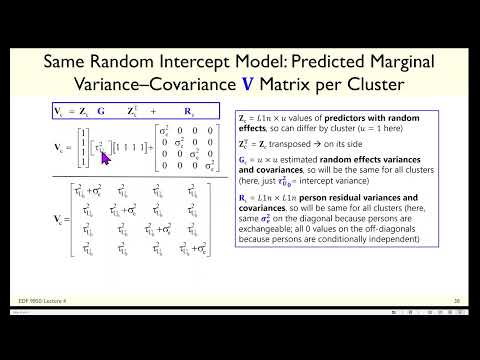
- For each cluster, the outcome vector is represented using fixed-effect predictors X, random-effect predictors Z, random effects, and level-one residuals.
- The G matrix contains random-effect variances and covariances, while R contains level-one residual variances and covariances.
- With only a random intercept, each person has the same model-implied variance, and people in the same cluster share covariance from the random intercept.
- After conditioning on the random intercept, people within a cluster are assumed independent in this model.
9:00
Random Slopes Build Predictor-Dependent Variance into V
- The marginal covariance matrix V combines ZGZ-transpose with the level-one residual matrix R.
- A random slope makes individual variance depend on the predictor value, including a squared-predictor term and its covariance with the intercept.
- Random linear slopes produce a U-shaped variance pattern across the predictor, while covariance between two people depends on both of their predictor values.
- Cluster-mean centering isolates within-cluster variation and avoids imposing the same variance pattern across both within- and between-cluster predictor values.
- The full V matrix is block diagonal across independent clusters; clusters may have different sizes, and a three-level model is needed to represent dependence between clusters in the same school.
15:00
Maximum Likelihood Uses the Multivariate Normal Likelihood
- For conditionally normal outcomes, maximum likelihood iteratively searches for variance components; fixed effects can be computed once those components determine V.
- Each cluster contributes a multivariate outcome, with the residual vector compared against model predictions and weighted using V and its inverse.
- The determinant and inverse of V enter the likelihood, so V must be positive definite and invalid variance or correlation estimates can cause estimation problems.
- Standard errors reflect estimate uncertainty, while minus two log likelihood, AIC, and BIC support relative model comparisons.
- Convergence occurs when successive parameter updates no longer change the likelihood enough; software such as R's lme4 and other packages can differ in tolerances and results.
24:00
ML, REML, Model Fit, and Boundary Tests for Variances
- REML adjusts for uncertainty in estimating fixed effects, while ML maximizes the likelihood of the data; REML variance estimates can reduce downward bias, especially with few clusters or complex models.
- Do not compare models with different fixed effects using REML likelihood-ratio tests, AIC, or BIC; use regular ML for those comparisons or Wald tests for fixed-effect terms.
- Minus two log likelihood and information criteria are relative-fit measures, with smaller values preferred; standard multilevel output does not provide absolute fit by default.
- Random-effect variances sit on a zero boundary, so likelihood-ratio tests may require mixture chi-square reference distributions: the one-variance 5% cutoff is 2.71 rather than 3.84.
- For a random slope variance plus its intercept covariance, the cited 5% mixture cutoff is 5.14 rather than the ordinary two-degree-of-freedom cutoff of 5.99.
31:00
Why Predicted Cluster Effects Shrink Toward the Mean
- The variance of directly calculated cluster means is largest; the model-estimated cluster variance is smaller, and the variance of predicted random effects, or BLUPs, is smallest.
- BLUPs shrink extreme cluster estimates toward the overall center, especially when a cluster has few people and its estimate is less reliable.
- Predicted random effects blend cluster-specific information with the overall model, with the balance depending on remaining variation around the slopes.
- Random effects are latent variables rather than observed single scores, so Hoffman recommends estimating their variance directly instead of treating predicted U values as definitive cluster scores.
34:00
Diagnosing Singular Fits and Choosing ML or REML
- Messages such as singular or non-positive definite indicate problems with the random-effects covariance structure, often a variance near zero or a correlation near plus or minus one.
- A random-slope variance near zero suggests that the slope may not be needed; rescaling predictors can also help when extremely small units create tiny variance estimates.
- ML and REML both evaluate cluster-level multivariate outcomes, but REML maximizes residual likelihood and cannot compare models with different fixed effects.
- REML requires normal residuals at each level and is unavailable for generalized multilevel models; generalized models or multilevel structural equation models may require ML or Bayesian estimation.
Summary, takeaways, and chapters were generated by AI from the video's transcript and may contain errors. The video belongs to its creator, Lesa Hoffman.