EDF9850_Lecture3_Part1
Overview
Lesa Hoffman explains why a level-one predictor in a multilevel model can combine within-cluster and between-cluster relationships into a misleading “smooshed” slope. She recommends cluster-mean centering the predictor and entering both its within-cluster deviation and cluster mean, which separates the two effects; a school-language example shows 53% of level-two variance and 35% of level-one variance explained, with between and within slopes of 3.66 and 2.42.
Key takeaways
- When a level-one predictor has both within-cluster and between-cluster variation, entering it only once can conflate two different relationships into a single weighted slope.
- Cluster-mean centering separates the effects by subtracting each cluster’s mean from individual predictor values, then entering that mean as a distinct level-two predictor.
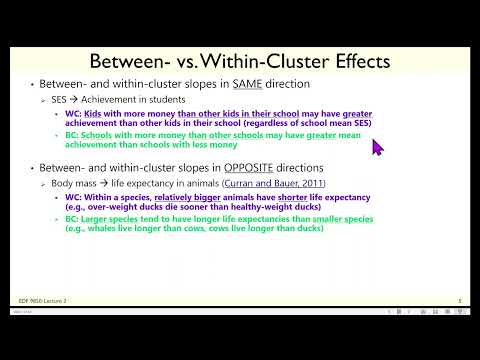
- The within slope compares a person with others in the same cluster, while the between slope compares cluster averages with other clusters; their directions can even be opposite.
- The contextual effect is the between slope minus the within slope, representing the additional contribution of the cluster mean after accounting for the person-level predictor.
- In Hoffman’s student verbal ability example, the model explains about 53% of school-level outcome variance and 35% of student-level residual variance, with slopes of 3.66 between schools and 2.42 within schools.
Chapters
- For students nested in schools, the level-one residual variance captures differences among students within a school, while the level-two random-intercept variance captures differences among school means.
- ICC1 is the proportion of total outcome variance attributable to between-cluster differences; it ranges from 0, with no cluster dependence, to 1, with identical outcomes within each cluster.
- School characteristics such as rural or urban status can predict between-school differences and should reduce the random-intercept variance when relevant.
- A person-level predictor such as student socioeconomic status can vary both among students in the same school and across school averages.
- The predictor’s ICC indicates whether it has within-school variation, between-school variation, or both; values between 0 and 1 mean both levels may need separate slopes.
- A conventional model that enters the level-one predictor alone assigns one coefficient to variation at both levels, risking model misspecification.
- Interpret within-cluster effects relative to other people in the same cluster, and between-cluster effects relative to other clusters.
- Student socioeconomic status could predict achievement both within schools and between schools, but those slopes need not have the same size or direction.
- Examples of opposite-level patterns include body size and lifespan, typing speed and accuracy, and exercise and heart rate: relationships within a species or person can differ from relationships between species or people.
- Because predictor and outcome variability differ by level, unstandardized within and between slopes can also differ in scale.
- Entering one unsplit level-one predictor produces a weighted combination of its within-cluster and between-cluster slopes, which Hoffman calls a “smooshed” or conflated effect.
- The combined estimate is usually closer to the within-cluster slope because there are generally many more people than clusters, leaving the between-cluster estimate more vulnerable to distortion.
- Fewer clusters and a lower predictor ICC make it harder to recover the between-cluster relationship because less between-cluster signal is available.
- Separating the effects addresses the endogeneity concern associated with a level-one predictor correlating with a level-two random intercept, without automatically requiring a fixed-effects model.
- A within-cluster slope asks whether people with higher predictor values than others in their cluster also have higher or lower outcomes; it can reduce level-one residual variance.
- A between-cluster slope asks whether clusters with higher average predictor values than other clusters also have higher or lower mean outcomes; it can reduce level-two random-intercept variance.
- The contextual slope is between minus within and tests whether the two effects differ; substantively, it estimates the added contribution of the cluster mean after controlling for the individual-level predictor.
- A school-context example asks whether a student’s predicted outcome would change if that student were placed in a school with a different average socioeconomic status.
- Hoffman contrasts cluster-mean centering, grand-mean centering with the cluster mean added, and latent centering in multivariate multilevel or multilevel SEM models.
- For cluster-mean centering, calculate each person’s deviation as their original predictor minus their cluster’s mean; zero then means the person is at their own cluster average.
- Add the cluster mean as a separate level-two predictor, optionally centering it at a constant such as the sample mean so zero represents an average cluster.
- The within-cluster deviation has only within-cluster variation and estimates the within slope; the cluster mean has only between-cluster variation and estimates the between slope.
- Hoffman illustrates three hypothetical schools with mean reading scores of 4, 5, and 6 to distinguish school-level reading effects from student-level effects.
- A positive between-school reading-to-math relationship can coexist with a zero within-school relationship, so school averages predict one another even when individual differences do not.
- The reverse pattern is also possible: students who read better than their schoolmates may score better in math even when schools’ average reading and math scores are unrelated.
- Hoffman demonstrates cluster-mean centering with student verbal ability predicting language scores across schools, retaining homework and mixed-grade school predictors from the earlier model.
- The within-school verbal predictor is each student’s score relative to their school mean; the school-mean verbal predictor is centered at 10, making an average school the reference.
- The example uses R multilevel-model output with REML and a linear contrast calculated as between minus within to estimate the contextual effect.
- The model explains about 53% of the empty model’s school-mean variance and 35% of its student-level residual variance; the estimated between slope is 3.66, the within slope is 2.42, and the contextual difference is about 1.2.
- A cluster-mean-centered predictor estimates whether someone with a higher value than others in their cluster also has a higher outcome than those cluster-mates.
- The cluster mean estimates whether clusters with higher average predictor values than other clusters have higher predicted outcomes; it can be included even when the person-level predictor is omitted.
- Hoffman recommends including both components for clearer interpretation and directs students to complete Formative Assessment 2 in Canvas before the next class.
Transcript excerpt
0:01 Hello folks and welcome back to my home office. I'm here today to record the first part of lecture three all about level one predictors. This is honestly one of the hardest topics that I ever have to teach and it's also something that still to this day is not particularly well understood. So I want to walk through this as carefully as I can. We will do it as many times as needed to make it sink in. So the first part of this then will focus on a little bit of review defining kinds of effects that level one predictors can have and then the first half will focus on cluster mean centering. The second half will focus on an alternative approach of grand mean centering and a third approach that I will only have time to wave my hands at that's formed within the field of multi-level structural
0:48 equation modeling latent centering. So away we go. So for clustered data, thus far we have talked about empty means models and adding level two predictors to them. So just as a review, the purpose of using multi-level models is to quantify and predict all of the different sources of sampling variation in your outcome with predictors that correspond to that same dimension of sampling. So in the context of people nested in clusters, we have level one that describes why people from the same cluster differ from each other. That is captured with this e level one residual that has variance of sigma squared sub e in the notation that I'm
1:35 using. And at level two, we have this beta placeholder or backpack or latent variable because it contains other parameters that then describes how each cluster gets its own mean at level two. And the way that is partitioned is the
This is the start of the transcript. Save this video free for the whole transcript, searchable and time-coded.
In this course
Related notes
Summary, takeaways, and chapters were generated by AI from the video's transcript and may contain errors. The video belongs to its creator, Lesa Hoffman.