EDF9850_Lecture1_Part2
Overview
Lesa Hoffman introduces the terminology and variance-focused logic of multilevel modeling, distinguishing general from generalized models and single-level from mixed-effects models for multiple sampling dimensions. She explains how random intercepts and slopes represent dependency, why modeling variance improves fixed-effect tests, and when multilevel models offer advantages over cluster indicators or repeated-measures ANOVA.
Key takeaways
- General models assume conditionally normal residuals, whereas generalized models support categorical, count, and skewed continuous outcomes.
- A person-level measure such as free-lunch eligibility can contain both student-level variation and school-level variation in the proportion eligible, so its within- and between-school effects must be distinguished.
- A two-level empty model divides outcome variance into cluster random-intercept variance and person-level residual variance without yet explaining either source with predictors.
- Random intercepts model shared cluster mean differences; random slopes allow predictor effects to vary across clusters and can make outcome variance depend on predictor values.
- Modeling dependency matters because unaccounted clustering can distort fixed-effect standard errors and p-values, the tests typically used to evaluate research hypotheses.
- Likelihood-based multilevel analysis can retain observed occasions from incomplete participants and accommodate individually varying measurement times, unlike repeated-measures ANOVA's complete-case requirement.
Chapters
- General models assume conditionally normal residuals, while generalized models accommodate outcomes such as categories, counts, and skewed continuous measures.
- General linear and generalized linear models typically predict outcomes across one sampling dimension; mixed models combine fixed effects with random effects for multiple dimensions.
- A fixed effect is an estimated intercept or slope, while a random effect has an estimated variance.
- In people nested within clusters, level 2 describes between-cluster differences and level 1 describes within-cluster differences; student free-lunch eligibility can vary at both levels.
- A statistical model has a mean side, represented by fixed-effect slopes and predictors, and a variance side, represented by residuals and random effects.
- In a single-level empty model, the intercept estimates the outcome mean and the residual variance captures all individual differences around it.
- A two-level empty model splits outcome variation into cluster-level random-intercept variance, τ², and within-cluster residual variance, σ².
- The cluster random intercept captures shared differences among people in the same cluster, allowing remaining person-level residuals to be treated as independent.
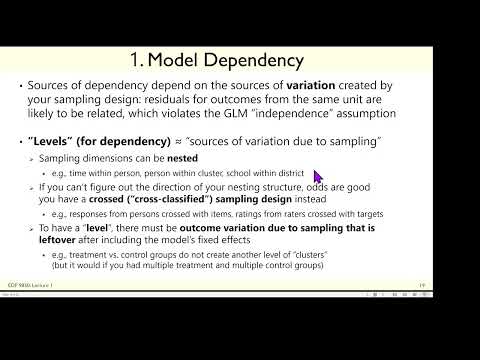
- A sampling level is a source of leftover outcome variation; nested structures are hierarchical, while person-by-item designs can be crossed.
- A random intercept represents cluster mean differences and creates exchangeable correlation among outcomes from the same cluster.
- A random slope lets each cluster have its own effect of a person-level predictor, producing variance that changes with the predictor's value.
- Location-scale mixed-effects models can predict differences in within-cluster residual variance, such as disagreement across teams or mood variability across people.
- Ignoring dependency can make fixed-effect standard errors and p-values inaccurate, even when fixed-effect slope estimates are properly separated across analysis levels.
- Cluster indicators are useful with few clusters or when comparing specific units; six groups, for example, can be represented by five fixed-effect contrasts.
- Random effects are preferable when the goal is to explain why clusters differ, rather than only estimate each cluster's individual mean.
- For longitudinal data, multilevel models allow continuous time predictors, incomplete cases through likelihood estimation, long-format rows, and unbalanced measurement schedules.
Transcript excerpt
0:01 Hello folks, and welcome back to my home office. I'm here to finish the lecture that we did not finish on Thursday. So, I'm picking up where we left off at slide 13. So, I wanted to give you additional labels and language with which you can refer to these models, and also to try and describe more specifically how they differ from models that you might already be familiar with. So, thus the title statisticiany labels for organizing models. So, first is the distinction between general and generalized, and that broadly pertains to what kind of outcome you're trying to predict and what its assumptions are about its distribution. General models, despite the term, actually have a very specific definition. They refer to models with conditionally normal residuals. Generalized models are for many other
0:51 kinds of outcomes, such as categorical outcomes, count outcomes, um skewed continuous outcomes, and so forth. So, the terms general linear models and generalized linear models, both of those have in common that they are for predicting outcomes from one dimension of sampling at a time. So, across persons only for instance. And as an aside at the bottom here, I note that linear also has a very specific definition. It refers to how the slopes and predictor variables work together to create a predicted outcome as slope times predictor plus slope times predictor. In non-linear models, the terms enter in a different way, such as through an exponent or a log. So, linear models can create non-linear relationships by adding squared terms or things like
1:39 that, but the way that they create the relationships is in a linear form. Our world, then, has multiple dimensions of sampling. And so, that's where we enter the language mixed, which refers to the use of both fixed and random effects. So, this is
This is the start of the transcript. Save this video free for the whole transcript, searchable and time-coded.
In this course
Related notes
Summary, takeaways, and chapters were generated by AI from the video's transcript and may contain errors. The video belongs to its creator, Lesa Hoffman.