EDF9850_Unit4_Review_Part2
 Watch on YouTube →
Overview
Lesa Hoffman explains how centering choices in multilevel models determine whether predictor slopes represent within-cluster, between-cluster, or contextual effects, and how those interpretations change when predictors and interactions enter the same model. She also gives practical guidance on cross-level moderation, random-slope model building, multilevel data structure, and ways to learn the material through real data, simulation, and teaching.
Key takeaways
- A cluster-mean-centered level-one predictor estimates a within-cluster slope; if its cluster mean is omitted, the model assumes the between-cluster slope is zero.
- Entering an uncentered or constant-centered level-one predictor by itself combines within and between information and assumes the two slopes are equal.
- A contextual effect measures the added association of a cluster's average predictor value after controlling for the individual's own value; it equals the between effect minus the within effect.
- For level-one predictors with cross-level interactions, a lone interaction can combine within- and between-slope moderation; including matching predictor and cluster-mean terms separates those effects.
- A sound model-building order is fixed slope, random slope, then cross-level interaction, because the interaction explains variation in the random slope.
- Working with meaningful data, simulating multilevel data, and teaching the model to someone else are practical ways to deepen understanding of its assumptions and components.
Chapters
0:00
Cluster-Mean and Constant Centering of Level-One Predictors
- Cluster-mean centering subtracts each cluster's mean from a level-one predictor, isolating within-cluster variation.
- Including only the centered level-one predictor estimates a within effect while assuming the between effect is zero; omitting it while including the cluster mean assumes the within effect is zero.
- Constant centering subtracts a chosen value; grand-mean centering is the special case that uses the sample mean. For binary predictors, retaining the original 0/1 coding is often more interpretable than cluster-mean centering.
6:30
How Predictor Combinations Define Within, Between, and Contextual Effects
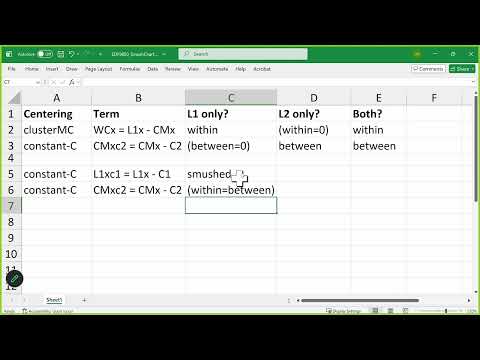
- A level-one predictor entered alone without separating its cluster mean has a smooshed slope: the model assumes within- and between-cluster effects are equal.
- With constant centering, entering both the level-one predictor and its cluster mean separates the level-one within effect from the level-two contextual effect.
- A between effect equals the within effect plus the contextual effect; equivalently, contextual equals between minus within, which can be tested using linear combinations of fixed slopes.
- A contextual effect asks whether the group's average predictor value matters after controlling for the individual's predictor value—for example, whether a student's school-average SCES adds an effect beyond the student's own SCES.
13:00
Cross-Level Interactions and Moderation of Within and Between Slopes
- A level-two moderator Z can interact with the cluster-mean-centered level-one predictor to let the within slope change across clusters.
- Interacting Z with the cluster mean lets the between slope vary with Z; both interactions can be included when both forms of moderation matter.
- With constant-centered level-one predictors, an interaction entered alone combines the within and between moderation effects; adding the corresponding cluster-mean interaction separates them into within and contextual components.
- When using constant centering, Hoffman advises applying the same transformation to a level-one predictor and its level-two mean to avoid unintentionally combining effects.
17:30
Why a Cluster-Mean Moderator Creates Quadratic Terms
- If the moderator is the cluster mean of the predictor itself, interactions between the individual-level predictor and that mean produce quadratic-style terms.
- These terms allow the within effect or between effect to depend on the cluster's average predictor level.
- The cluster-mean interaction is needed to separate moderation under the constant-centering parameterization, but not when the model has already separated within and between components.
20:00
Choosing a Model and Ordering Random Slopes and Interactions
- Choose the parameterization based on the target: cluster-mean centering plus cluster means gives between effects directly, while constant centering can yield contextual effects.
- For categorical predictors, constant centering is often easier to interpret; continuous predictors can also be cluster-mean centered to estimate within and between effects.
- Add the fixed slope before its random slope, then add cross-level interactions, because the interaction is intended to explain variation in the random slope.
- To assess variance explained, build models from a baseline and add random components before predictors that explain them; when effect sizes are not the goal, a fuller model may be fitted at once if its random structure is appropriate.
26:00
Studying Multilevel Models, Higher Levels, and Next Steps
- Hoffman recommends applying models to data that matter to the researcher, simulating data to understand how level-one and level-two variables and random effects fit together, and explaining the model to someone else.
- For a possible six-level model, assess variance at each level with empty models; higher levels may contribute less, and a level with only about six groups may be better represented with fixed categorical effects.
- Cross-level interactions can use binary or continuous level-two moderators; they answer why a slope varies across clusters rather than being required automatically.
- Hoffman closes by encouraging students to persist with the difficult material, noting applications in workshops, research collaborations, and authorship, and reminds them that Homework 2 is due the following week.
Summary, takeaways, and chapters were generated by AI from the video's transcript and may contain errors. The video belongs to its creator, Lesa Hoffman.