CE 312 Lecture 36: Influence Lines V, AASHTO Live Loads (2026.11.11)
Overview
Gregory Michaelson applies influence-line analysis to AASHTO HL-93 bridge live loads, combining a 0.64 kip/ft lane load with either a design truck or tandem to find worst-case shear and moment. An 80-foot simply supported bridge example shows how to position each load, calculate response envelopes, and interpret software output; the lecture closes by contrasting straight influence lines for determinate structures with curved lines for indeterminate structures.
Key takeaways
- HL-93 bridge live loading uses a design truck or design tandem together with a 0.64 kip/ft lane load to model demanding traffic effects.
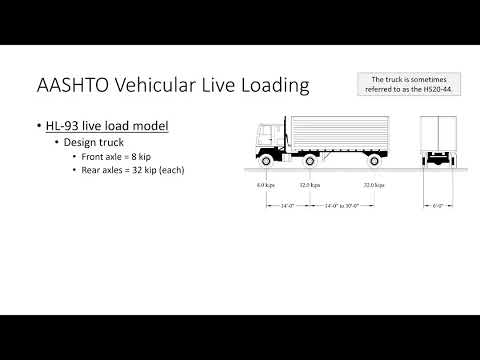
- The HL-93 design truck has an 8-kip front axle and two 32-kip rear axles, with rear spacing adjustable from 14 to 30 feet; the engineer must test positions that maximize response.
- For a distributed lane load, the response at a section equals the load intensity multiplied by the relevant signed area under that section’s influence line.
- On the 80-foot simply supported example at 30 feet from the left support, the lane load produces about +10 kips shear and 480 ft-kips positive moment; the tandem produces 900 ft-kips positive moment.
- Bridge software commonly computes load envelopes at ten-percent span increments, and interpolation can estimate responses between those stations.
- Determinate structures have piecewise straight influence lines, while indeterminate structures generally have curved influence lines because their deformation is not rigid-segment motion.
Chapters
- The class has 43 meetings, with about six lectures remaining after this session; upcoming topics move from influence lines to matrix analysis.
- Students are asked to bring laptops for Excel work beginning Friday.
- Homework 8.2 is graded, 8.3 is in progress, and 8.4 is due; course-evaluation proof can earn bonus homework points.
- Gregory Michaelson plans to email an “at home game” spreadsheet where students can enter attendance, homework, project, and exam grades.
- The spreadsheet estimates the exam and final-exam scores needed to reach a target course grade.
- Final grades are rounded up at half points, so 79.5 earns a B.
- AASHTO, the American Association of State Highway and Transportation Officials, develops widely used U.S. road and bridge design standards.
- Bridge live-load design focuses on trucks and other heavy vehicles, including exclusion vehicles such as concrete mixers, rather than ordinary cars.
- AASHTO weigh-in-motion studies informed a standardized model intended to represent extreme highway-bridge traffic effects.
- HL-93 comprises a design truck, a design tandem, and a lane load; design cases combine the lane load with either the truck or the tandem.
- The design truck has an 8-kip front axle and two 32-kip rear axles; rear-axle spacing can vary from 14 to 30 feet.
- The truck is also known as HS20-44: 20 reflects a 4-kip front wheel plus a 16-kip rear wheel, and 44 refers to its 1944 introduction.
- The 1993 recalibration retained the established truck model and combined truck-or-tandem loading with lane loading.
- The worked example uses an 80-foot simply supported bridge and evaluates a section 30 feet from the left support.
- The AASHTO lane load is 0.64 kip/ft; distributed load response is found by multiplying load intensity by the loaded influence-line area.
- Placing the lane load on the appropriate shear regions gives about +10 kips and -3.6 kips; the maximum positive moment is 480 ft-kips.
- The negative-moment envelope is zero for this simply supported span because the influence line has no negative-moment region.
- The design tandem consists of two 25-kip axles spaced 4 feet apart.
- Linear interpolation on the shear influence line gives ordinates for the axle positions that maximize positive or negative shear.
- The resulting shear envelopes are approximately +30 kips and -7.5 kips.
- For positive moment, the tandem is placed so one axle is at the peak ordinate and the other at the larger of its two possible ordinates, producing 900 ft-kips; negative moment remains zero.
- The design truck uses 8-, 32-, and 32-kip axles; its rear spacing is minimized to 14 feet when that arrangement produces the governing response.
- The truck may face either direction, so the 32-kip axles are assigned to the influence-line positions that maximize demand, regardless of road markings.
- Linear interpolation of the shear influence line yields truck envelope responses of about +36.6 kips and -8.6 kips.
- For positive moment, the 32-kip axle is placed at the 18.75 ordinate, with the other axles assigned by comparing nearby ordinates; the resulting response is 1,104 ft-kips.
- Bridge software evaluates truck, tandem, and lane envelopes at stations typically spaced every tenth of the span.
- For the 80-foot example, software reports worst-case shear and moment values for each load case along the bridge.
- Excel plots of the truck envelopes allow interpolation between stations; values near the 30-foot section closely match the hand calculations.
- The Miller-Breslau principle also applies to statically indeterminate structures, but their influence lines are generally curved rather than piecewise straight.
- Removing a restraint and imposing a unit displacement does not produce rigid segments when the remaining structure is still indeterminate.
- Influence lines for shear and moment still follow useful boundary rules, including zero response at supports in the illustrated cases.
Transcript excerpt
0:02 Okay, there was a uh a very brief discussion before class and we realize that if you count today's lecture, we have seven lectures left in this class if you can believe that because there's a total of 43 class meetings and I guess I said seven lectures. I guess maybe it's six cuz lecture 40 is going to be our just uh troubleshooting on the project and our final final lecture the Friday of of uh when we come back from break that's just exam review. So um so we don't have a lot left um in terms of like content for the class we have today's lecture which is our last
0:48 lecture on influence lines and then for the rest of the semester we're in matrix analysis land. So, one thing I'll say is uh starting Friday and it's applying to just about everybody in here just by observation, but I would try and bring your laptops um for the rest of the semester uh after today because we'll be doing a lot of Excel stuff um together. Um attendance, I haven't yet updated attendance for this week. I I will do so. Uh everything through homework 8.2 has been graded. Uh 8.3 is still being worked on. By the way, there is the bonus uh homework assignment uh as well. And uh I have already started to um uh post those grades as they come. So if you submitted proof that you did your
1:35 course eval again, you could say whatever you want about me. That's fine. I just want to see that you've done it. But if you post proof that you've done it, um most likely I've already assigned uh those bonus homework points to you. Um homework 8.4 was due today. I'm hoping that was a pretty easy assignment
This is the start of the transcript. Save this video free for the whole transcript, searchable and time-coded.
In this course
Related notes
Summary, takeaways, and chapters were generated by AI from the video's transcript and may contain errors. The video belongs to its creator, Gregory Michaelson.