CE 312 Lecture 04: Reactions II, Inclined Loads/Rollers (2026.08.24)
Overview
Gregory Michaelson teaches CE 312 support-reaction methods for inclined loads and roller supports, emphasizing direct use of slope ratios to resolve forces and careful interpretation of assumed directions. Worked beam examples show how to replace distributed loads with equivalent point loads, apply equilibrium, and report reactions by magnitude and direction, including a roller reaction perpendicular to a 20° incline.
Key takeaways
- For inclined forces with a known slope ratio, use the rise and run over the triangle's hypotenuse to find components directly; a 3:4 ratio gives 3/5 and 4/5 of the force.
- Replace a uniform distributed load with its total force at the rectangle's center, and a triangular load with its area at the centroid, one-third of the base from the tall end.
- A roller contributes one independent reaction normal to its supporting surface; splitting that reaction into x and y components does not create two independent unknowns.
- For a roller on a 20° incline, the example's reaction components are 0.940 R_B vertically and 0.342 R_B horizontally, reflecting the perpendicular direction.
- A negative reaction result indicates that the actual direction is opposite the assumed direction; report the final force as a magnitude with its physical direction.
- In the 20-kip beam example, equilibrium yields A_x = 12 kips left, A_y = 15.08 kips up, and B_y = 14.92 kips up.
Chapters
- Homework 1 on structural stability and determinacy is graded, with grades expected later that day and the solution posted on Blackboard.
- Homework 2.1 on reactions was due, and Homework 2.2 is assigned for Wednesday.
- Upcoming topics include truss analysis and deflections, followed by the first exam, described as a celebration of learning.
- A uniformly distributed load is replaced by a concentrated force at the rectangle's center, while a triangular load acts at its centroid, one-third of the base from the right-angle end.
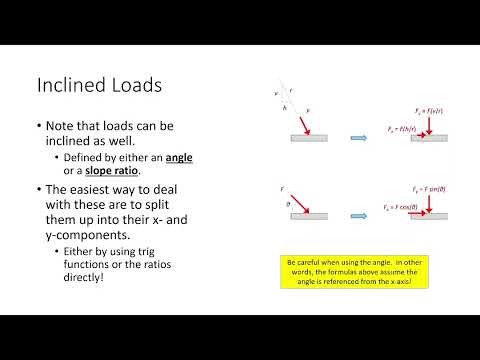
- Michaelson recommends resolving an inclined force into horizontal and vertical components rather than calculating an angle with inverse tangent first.
- For a 3:4 slope ratio, the 3-4-5 triangle gives component proportions of 3/5 horizontally and 4/5 vertically.
- The example beam has a pin at A, a roller at B, a 1.4-kip/ft load over 10 ft, and a 20-kip inclined force with a 3:4 slope ratio.
- The distributed load becomes 14 kips downward, positioned 5 ft from A.
- The 20-kip force becomes 12 kips to the right and 16 kips downward, using the 3-4-5 triangle.
- Summing moments about A eliminates the reactions at A; the 14-kip resultant acts at 5 ft, the 16-kip component at 18 ft, and the reaction at B at 24 ft.
- The 12-kip horizontal component passes through A and contributes no moment about that point.
- Moment equilibrium gives B_y = 14.92 kips upward.
- Vertical force equilibrium gives A_y = 15.08 kips upward after accounting for the 14-kip and 16-kip downward loads and B_y.
- The assumed rightward A_x produces a negative 12-kip result, meaning the actual reaction is 12 kips to the left.
- Michaelson emphasizes that final vector answers should state magnitude and direction, since students may begin with different sign assumptions.
- A pin support has independent horizontal and vertical reactions regardless of its orientation, but a roller has one reaction normal to its contact surface.
- For an inclined roller, the perpendicular reaction direction uses the flipped slope ratio, with the sign adjusted for the chosen coordinate convention.
- An ADA ramp example illustrates why a gentle surface slope produces a reaction that is much more vertical than horizontal.
- The second beam example has a pin at A, a roller at B on a 20° incline, and a triangular distributed load over 36 ft.
- The triangular load has a 4-kip/ft maximum, so its equivalent force is 72 kips downward, located 12 ft from A.
- Because the roller reaction is perpendicular to the surface, its components are 0.940 R_B vertically and 0.342 R_B horizontally, not the usual direct cosine-horizontal assignment.
- Summing moments about A removes A_x and A_y; only the 72-kip load at 12 ft and the roller's vertical component at 36 ft contribute.
- The equation 72 × 12 = 0.940 R_B × 36 gives an inclined reaction R_B of about 25.53 kips.
- Since the solved quantity is the full roller reaction, it is reported along its inclined direction rather than as an upward or horizontal force.
- Vertical equilibrium gives A_y = 48 kips upward; horizontal equilibrium gives A_x = 0.342 × 25.53 = 8.73 kips to the right.
- The completed reactions are A_x = 8.73 kips right, A_y = 48 kips up, and R_B = 25.53 kips along the inclined roller's normal direction.
- The next Wednesday lecture will cover concentrated moments and fixed supports; two related homework problems are due then.
Transcript excerpt
0:00 All right everybody, lecture four. Let's get started. We are rocking and rolling. Okay. Um so uh homework one that was the homework on uh classification and um uh determining stability and determinacy of structures. Uh that's being graded. Uh it should be po the grades for that should be posted uh sometime later today. Uh but the solution to that homework has been posted. Okay, I'm going to pull that up here in a second just to sort of show you a little bit about how the um uh how we'll organize things on Blackboard um just to help you sort of um keep track
0:49 of things given the fact that there's a lot of assignments uh in here and whatnot. Uh 2.1 was due today. That was your first reactions assignment. How did that go? Hoping that went pretty smooth, pretty pretty straightforward. Uh, okay. So, uh, homework 2.2 that's going to be assigned today. It's due Wednesday. Um, and our, um, our basic theme for today is dealing with loads, uh, or supports, roller supports that are at an incline. So, if we take instead vertical loads and sort of do that to them a little bit. Um, and so it's going to be um a little bit of trig, but more often than not, we try and avoid using a lot of uh trigonometric functions like s, cosine, tangent. Uh, bless you. Um, and you'll see what I mean because, uh, what we try
1:37 and do more often than not is utilize slope ratios. Uh, mainly because that's how the dimensions tend to present themselves on engineering drawings quite a bit. Um, the whole rise overrun uh, uh, mentality. And so if we can use that more directly, it tends to lead to less button crunching. And the fewer steps
This is the start of the transcript. Save this video free for the whole transcript, searchable and time-coded.
In this course
Related notes
Summary, takeaways, and chapters were generated by AI from the video's transcript and may contain errors. The video belongs to its creator, Gregory Michaelson.