CE 312 Lecture 39: Matrix Structural Analysis III, 1D Bar Example (2026.11.18)
Overview
Gregory Michaelson works through a one-dimensional bar structure in Excel, showing how to assemble element stiffness matrices, apply boundary conditions, solve for displacements, and recover support reactions and member forces. The example connects the matrix workflow to structural-analysis software such as MASTAN and a short MATLAB implementation, with results including 130-kip tension, 170-kip compression, and support reactions that satisfy equilibrium.
Key takeaways
- A 1D bar element contributes k = EA/L [[1, -1], [-1, 1]] to the global stiffness matrix, with terms placed and summed according to the element's node or degree-of-freedom codes.
- For restrained degrees of freedom with known zero displacement, deleting their stiffness-matrix columns removes zero contributions; deleting their equations temporarily leaves a solvable system for the free displacements.
- After solving the reduced system, multiplying the full global stiffness matrix by the full displacement vector recovers support reactions as well as the applied loads.
- Element forces come from a separate calculation, f = k delta, using each element's own stiffness matrix and its endpoint displacements.
- In the example, the member-force results include 130 kips in tension and 170 kips in compression; the recovered force vector also balances to zero in the global direction.
- A node matrix and an element matrix provide enough information for a compact MATLAB bar-analysis program, illustrating the same assembly and solution process used by structural software such as MASTAN.
Chapters
- Friday's class is an optional, attendance-free troubleshooting session for the class project, with no prepared lecture.
- Homework 8.4, 8.5, and 9.1 are still being graded; homework 9.2 and 9.3 are due the Wednesday and Friday after Thanksgiving.
- Of 50 students, 38 submitted proof for the bonus assignment while 41 completed the survey, leaving three students who may still claim 10 bonus homework points.
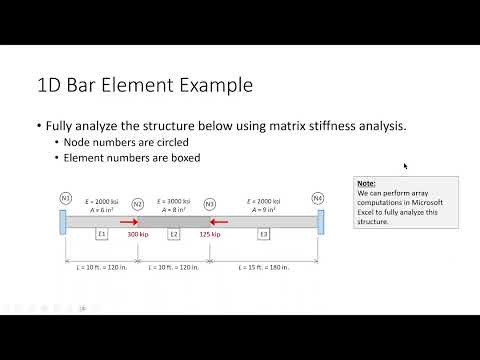
- The workflow has four stages: assemble the structure stiffness matrix, form the force vector, solve for unknown displacements, then calculate reactions and element forces.
- Each bar element uses k = EA/L multiplied by the 2-by-2 matrix [[1, -1], [-1, 1]].
- Michaelson distinguishes lowercase k, delta, and f for individual elements from uppercase K, Delta, and F for the whole structure.
- The Excel template holds each element's stiffness matrix and its degree-of-freedom codes, such as 1-2, 2-3, and 3-4.
- Element stiffness values are calculated as EA/L, with lengths converted to consistent inch units, including examples using 120-inch and 180-inch members.
- Element matrix terms are placed into the global K matrix by matching degree-of-freedom codes; overlapping entries are added term by term.
- Excel range-based addition can assemble corresponding matrix blocks at once, and the result matches the hand-assembled global matrix.
- The global force vector records applied loads by direction: the example uses +300 and -125, with unknown support reactions at the ends.
- Degrees of freedom 1 and 4 are restrained, so their displacements are zero; degrees of freedom 2 and 3 remain unknown.
- Removing columns for fixed zero displacements reduces the matrix multiplication, while removing the corresponding rows leaves equations for the unknown displacements.
- The removed equations remain useful later because they determine the support reactions.
- The reduced stiffness matrix and force vector retain only free degrees of freedom 2 and 3.
- The displacement solution uses Delta_R = K_R inverse times F_R, implemented with Excel's MINVERSE and MMULT functions.
- The calculated free-node displacements are 1.3 and 0.45; restrained-node displacements are zero.
- The four displacement values together represent the structure's displaced shape, the same kind of result expected from MASTAN.
- Michaelson restores the full global stiffness matrix and constructs the full displacement vector by combining solved values with zeros at restrained nodes.
- Multiplying the full K matrix by the full displacement vector recovers the global force vector, including unknown reactions.
- The example gives support reactions of 130 kips and 45 kips to the left, while reproducing the known +300- and -125-kip loads.
- The resulting force vector sums to zero, providing a static-equilibrium check on the calculation.
- For each element, Michaelson pairs its 2-by-2 stiffness matrix with the element displacement vector selected using its node codes.
- Excel applies f = k delta separately to elements 1, 2, and 3.
- Each element force vector has equal-magnitude, opposite-sign endpoint forces, as required for equilibrium of an unloaded bar element.
- The computed member-force magnitudes are 130, 170, and 45 kips.
- Element 1 has endpoint forces of -130 and +130 kips, which pull outward and indicate 130 kips in tension.
- Element 2 has forces of +170 and -170 kips, which push inward and indicate 170 kips in compression.
- With the stated node ordering and tension-positive convention, the second value in the element force vector is positive for tension and negative for compression.
- The sign shortcut avoids drawing a separate free-body diagram for every member, while the force-vector pattern remains a useful check.
- The complete workflow assembles element stiffnesses and loads, reduces for boundary conditions, solves displacements, then recovers reactions and member forces.
- Michaelson's basic MATLAB example uses node and element matrices: node data encode fixed or free degrees of freedom and applied loads, while element data encode connectivity and EA/L.
- A roughly 30-to-40-line MATLAB program can solve general 1D bar problems; MASTAN and other structural-analysis programs perform the same core operations.
- The lecture closes by encouraging students to use Friday's optional project troubleshooting session and remember the project deadline.
Transcript excerpt
0:04 All right everybody, [clears throat] the end is in sight, isn't it? So, as uh uh a few students were discussing right before class, this is lecture 39 and we have 43. And as for the lecture on Friday, I'm not taking attendance because all it is is a uh troubleshooting Q&A session uh regarding your class project. I think a couple of you might have already even submitted your project. If you've already done that uh or you uh feel that you're good, you don't need to come on Friday uh because um that's all we're going to be doing. I don't have any lecture notes prepared. I'm not taking [snorts] attendance. I'm just coming in and we're troubleshooting any uh issues you might have with the class project. Um just
0:53 throwing my stock, you know, sort of checklist that I've been putting on the slides for the past uh few lectures in terms of what needs to be done for the final project. Okay. Um couple other updates. Um my TA is still working on uh chipping away at some outstanding homework assignments. So homework's 8.4 through 9.1. So that's 8.4 4, 8.5, 9.1 are still being graded, but all the solutions are posted and available. As for what's left, you don't have any homework assignments due um you know, prior to Thanksgiving break. You do have homework 9.2, which is due the Wednesday we come back, and homework 9.3, which is due the Friday we come back. Um the only other assignment I wanted to mention is the bonus homework assignment. Um I took a look at some of the numbers, and I think most of you are noticing I'm
1:40 applying those bonus points as they come in. Um, out of So, here's what I know. What I know is two things. I know that
This is the start of the transcript. Save this video free for the whole transcript, searchable and time-coded.
In this course
Related notes
Summary, takeaways, and chapters were generated by AI from the video's transcript and may contain errors. The video belongs to its creator, Gregory Michaelson.