CE 312 Lecture 35: Influence Lines IV, Applications of ILs (2026.11.09)
Overview
Gregory Michaelson shows how influence lines convert structural response calculations into load-and-ordinate or load-and-area products, then uses them to identify worst-case effects from moving loads. A worked beam example distinguishes stationary dead loads from movable live loads and builds shear and moment envelopes, with a final combined range of 17.84 kips to about -25.34 kips in shear and 193.8 to -76.8 kip-ft in moment.
Key takeaways
- For a point load, multiply its magnitude by the influence-line ordinate at the load location; for a distributed load, multiply its intensity by the signed influence-line area beneath the loaded region.
- Influence lines identify adverse live-load placements: point loads go at the largest positive or negative ordinate, while distributed loads cover the corresponding positive or negative area.
- Dead loads act everywhere and produce one response; movable live loads can produce separate positive and negative response extremes that must both be considered in design.
- At section 11, the 1.2-kip-per-foot full-span dead load produces zero shear because the shear influence-line net area is zero, but it produces 21.6 kip-ft of moment because the moment net area is 18.
- Combining the example's dead and live loads gives a design envelope of about -25.34 to 17.84 kips in shear and -76.8 to 193.8 kip-ft in moment.
Chapters
- Attendance and most homework grades were current; Gregory Michaelson provided the Homework 8.2 solution because Homework 8.4 uses its influence line.
- Project submission 2 was due Friday, November 20 at 5:00 p.m., including a final MASTAN file, computations, complete CAD drawing, and reflection statement.
- The final MASTAN model should use real loads and final member selections, with deflections matching the design-iteration calculations.
- A course-evaluation assignment offered 10 bonus homework points; students were encouraged to bring laptops for upcoming Excel-based matrix analysis.
- Using the Müller-Breslau principle, an influence line records a response as a unit load moves across a structure.
- A point load's response is its magnitude multiplied by the influence-line ordinate at its location.
- A distributed load's response is its intensity multiplied by the corresponding signed area under the influence line.
- These products can replace writing and solving static-equilibrium equations for each load arrangement.
- For an 80-foot simply supported beam, the conventional method converts a 1.3-kip-per-foot load over 20 feet into a 26-kip resultant acting 10 feet from support A.
- Taking moments about A with 25-kip and 42-kip point loads at 40 and 60 feet gives a reaction at D of 47.25 kips.
- The reaction-at-D influence line rises linearly from 0 at A to 1 at D, giving ordinates of 0.125 at 10 feet, 0.5 at 40 feet, and 0.75 at 60 feet.
- The distributed-load region has influence-line area 2.5; calculating 1.3 × 2.5 + 25 × 0.5 + 42 × 0.75 also gives 47.25 kips.
- For a response that increases with the reaction-at-D influence line, movable point loads should be placed where the ordinate is largest, near support D.
- A movable distributed load should cover the positive influence-line region that contributes to the target response.
- The design objective is to find the most adverse load placement, not merely calculate the response for one fixed arrangement.
- For the example shear influence line, a 2-kip-per-foot distributed load produces maximum positive shear when placed over the positive influence-line region.
- Maximum negative shear comes from placing that load over the negative region; the two placements create a response range at the same beam section.
- Moment sign can determine which side of a reinforced-concrete beam needs reinforcement: positive bending places tension at the bottom, while negative bending can place it at the top.
- Dead loads are permanent and applied everywhere; a W12×50 beam, for example, has a self-weight of 50 pounds per foot along its span.
- Live loads, such as bridge traffic, can move and are positioned to maximize positive or negative response.
- A dead load produces one response for a given influence line, while a live load generally produces a positive and negative response envelope.
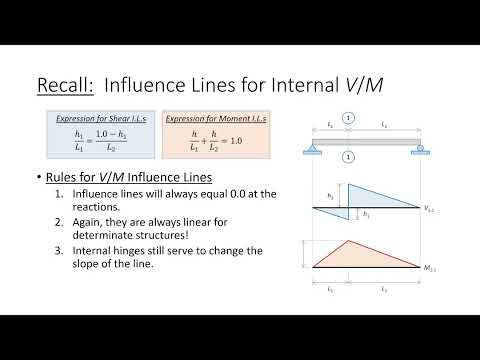
- Michaelson revisits shear and moment influence lines at section 11, noting that both are zero at the beam supports.
- The shear influence line has positive area 4.9 and negative area -4.9, for a net area of zero.
- The moment influence line has positive area 42 and negative area -24, for a net area of 18.
- These signed area totals let distributed loads be evaluated without redrawing shear and moment diagrams for every load placement.
- A 1.2-kip-per-foot dead load acts over the entire beam, so its response uses the net area of each influence line.
- At section 11, the shear response is 1.2 × 0 = 0 kips because the shear influence-line areas cancel.
- The moment response is 1.2 × 18 = 21.6 kip-ft using the moment influence line's net area.
- Adding the persistent dead-load response to the live-load extremes gives a total shear range of 17.84 to about -25.34 kips.
- The combined moment range is 21.6 + 67.2 + 105 = 193.8 kip-ft on the positive side and 21.6 - 38.4 - 60 = -76.8 kip-ft on the negative side.
- For a bridge, the same influence-line process is repeated at many sections; structural-analysis software automates those repeated envelope calculations.
- The next lecture was scheduled to cover AASHTO bridge load models and their application.
Transcript excerpt
0:05 All right, everybody. I was busy this weekend. Not really so much with the exams because they were largely done. Uh but sort of getting stuff set up for the rest of the semester in here. I did a little bit of work over the weekend. So, um just a couple of housekeeping items. Um okay. So let's go through it one by one uh in terms of your grade for this course because I think the best way of of discussing logistics is just to go through the grade. So attendance attendance is up to date as of today. Okay. Homework um everything uh is graded. Uh I don't know if my TA posted the grades for seven and 8.1, but everything's graded up through 8.1. The only thing that hadn't been graded as of this morning was homework 8.2. too uh
0:53 and everything else uh the solutions and whatnot are available and I do mention that the solution explicitly for homework 8.2 is available because on the homework I'm assigning today it requires an influence line from 8.2. So I'm giving you the solution to 8.2. So um uh regardless of how you did on 8.2 everybody can at least start from the same point. Um, everybody got their grade report on exam 2. Class as a whole did fantastic. So, I was very happy with that. Homework uh 8.3 was due today. That was the last of what I'll call the theoretical influence lines. I think last week was a week of faith where I just sort of said, "Everybody trust me. It'll all make sense in the end." And today is hopefully when it starts making
1:41 sense and you'll understand what we're doing with this whole thing called influence lines. Um I'll assign a homework on that today due uh due
This is the start of the transcript. Save this video free for the whole transcript, searchable and time-coded.
In this course
Related notes
Summary, takeaways, and chapters were generated by AI from the video's transcript and may contain errors. The video belongs to its creator, Gregory Michaelson.