CE 312 Lecture 07: Plane Truss Analysis I, Method of Joints (2026.08.31)
Overview
Gregory Michaelson introduces plane-truss analysis by the method of joints, explaining how idealized pin-connected members carry only axial tension or compression and how each joint is solved using horizontal and vertical equilibrium. He develops a joint-by-joint solution plan and works through a truss with 3:4:5 diagonals, finding AB = 24.375 kips in tension, AD = 15.625 kips in compression, and at joint D, BD = 3.125 kips in tension and DE = 11.25 kips in compression.
Key takeaways
- Under the standard truss assumptions of frictionless joints, joint-applied loads, and coincident member axes, each member carries only an axial force: tension, compression, or zero.
- Method-of-joints analysis offers only two equilibrium equations per joint, so begin at a joint with no more than two unknown member forces.
- Plan the analysis sequence before calculating: solving a joint can reveal member forces that make adjacent joints solvable, as with A followed by D in the worked example.
- For a diagonal with a 3:4 slope ratio, its horizontal and vertical force components have the same 3:4 ratio; knowing one component determines the other.
- A truss member's tension or compression is identified by its force direction relative to the joint: arrows pointing away indicate tension, while arrows pointing toward the joint indicate compression.
- For the worked example, joint A gives AB = 24.375 kips in tension and AD = 15.625 kips in compression; joint D gives BD = 3.125 kips in tension and DE = 11.25 kips in compression.
Chapters
- Gregory Michaelson says Homework 2.3 on concentrated moments has been graded and its solutions posted.
- Homework 3.1 is the first truss assignment, assigned during this lecture and due Wednesday.
- The week focuses on trusses, followed by method of sections after Labor Day; exam review is scheduled for September 18.
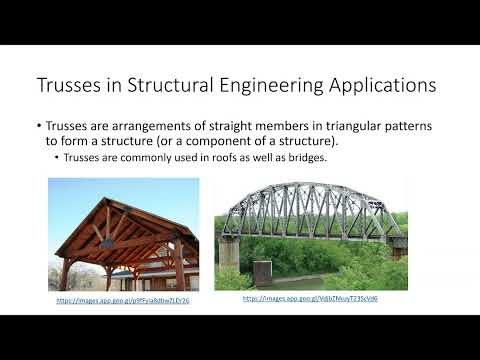
- A truss is an arrangement of straight members, typically forming triangles, used as part or all of a structure.
- Roof trusses provide a slope for draining rain and snow, while bridge trusses can serve as the primary structure.
- Trusses are lightweight and stiff, meaning they generally deflect little under load, but their fabrication and erection can be expensive.
- The analysis assumes frictionless joints, with external loads and support reactions applied only at joints.
- Member centroidal axes are assumed to meet at each joint; gusset plates and aligned member connections illustrate this arrangement in real bridges.
- Together, these assumptions eliminate modeled bending, shear, and torsion, leaving each member with an axial force that may be tension, compression, or zero.
- The method of joints examines equilibrium at individual joints and is suitable for finding forces throughout the truss.
- The method of sections cuts through a truss to find selected member forces without solving every joint.
- Michaelson emphasizes the method of joints because structural design often requires force information for every member.
- Each idealized truss joint is a concurrent-force, particle-statics problem, so it has no moment equation.
- Only two equilibrium equations are available at a joint: the sums of forces in the x and y directions.
- A solvable starting joint therefore has at most two unknown member forces; joint D is initially unsuitable because it has three unknowns.
- For the example truss, the proposed sequence is joint A, then D, then B, followed by C and the remaining joint.
- Solving joint A reveals forces in AB and AD, which makes joint D solvable next.
- The example uses 3:4:5 diagonal slope ratios throughout to simplify component calculations and keep attention on the analysis procedure.
- At joint A, the known reactions are 15 kips horizontally and 12.5 kips vertically; the diagonal member AD has a 3:4 component ratio.
- Vertical equilibrium gives AD's vertical component as 12.5 kips downward, and the slope ratio gives a 9.375-kip horizontal component to the left.
- Horizontal equilibrium gives AB = 24.375 kips; its force points away from the joint, so AB is in tension.
- The AD components combine to a 15.625-kip axial force, and its arrows point toward the joint, so AD is in compression.
- At joint D, the known AD components are 9.375 kips horizontally and 12.5 kips vertically, alongside a 10-kip downward load.
- Vertical equilibrium gives BD's vertical component as 2.5 kips downward; the 3:4 ratio gives its horizontal component as 1.875 kips.
- The resultant in BD is 3.125 kips and acts in tension; horizontal equilibrium gives DE = 11.25 kips in compression.
- Michaelson recommends recording each solved member force on a truss diagram, since the final result is a diagram labeled with all internal forces.
- He says the remaining joints can be completed as practice, with solutions to be included in OneNote.
- The next lecture will show a faster way to solve multiple joints together and will use diagonals with different slope ratios.
Transcript excerpt
0:01 All right. Uh, did I get the right microphone listed? I did. >> All right, everybody. Lecture seven, week three. Let's get started. I think it's fair to say we are now sort of settled into our um, fall 2026 semester. Um, hopefully my relocation of the QR code to the top of the slide makes it a little easier to scan. Um just a couple housekeeping items. So um your uh homework 2.3 uh that was the homework with concentrated moments. Uh that's been graded uh solutions posted. How did internal hinges go uh this weekend? Go well. Okay, good. Um a couple uh other items. So, uh, if you check Blackboard
0:51 right now, what you will see is I've posted all of the lecture slides and notes through exam one. Okay. Um, the other thing that you will see in relation to that is some slides and some content related to the class project. None of it is uh incredibly time-sensitive, but there's a couple of additional files there in addition to just slides, and that'll make sense when we get uh uh into project discussion land. Um homework 3.1 is going to be our first trust assignment. It's going to be assigned today, due Wednesday. Um the other thing I'm going to do here in a second is pull up a slide that goes through just a quick schedule for the next few weeks. Uh, everybody get the QR
1:38 code. All right. I'm I'm certainly not uh ignorant of the fact that uh I'm not your only uh instructor this semester and you all I have a lot of um things that you're juggling and whatnot right now. And so I like uh in my classes like this periodically just to take a quick run through of the schedule um and
This is the start of the transcript. Save this video free for the whole transcript, searchable and time-coded.
In this course
Related notes
Summary, takeaways, and chapters were generated by AI from the video's transcript and may contain errors. The video belongs to its creator, Gregory Michaelson.