CE 312 Lecture 05: Reactions III, Concentrated Moments & Fixed Supports (2026.08.26)
Overview
Gregory Michaelson explains how to include concentrated moments in equilibrium equations and how to find reactions at fixed supports, emphasizing that a moment is added directly in a moment sum and omitted from force sums. Worked examples yield reactions of 24.8 kips at B and 15.2 kips at A for a simply supported beam, then 6 kips horizontally, 28 kips vertically, and 480 kip-feet of counterclockwise moment at a cantilever’s fixed support.
Key takeaways
- A concentrated moment is already a rotational action, so include its signed kip-foot value directly in a moment equation without multiplying by a distance.
- Do not include a concentrated moment in a force-equilibrium equation; it affects rotational balance, not net horizontal or vertical translation.
- For the simply supported beam example, replacing the 3-kip-per-foot load over 10 feet with a 30-kip resultant at 5 feet supports the calculation of By = 24.8 kips and Ay = 15.2 kips.
- A planar fixed support has three reaction components: Ax, Ay, and MA, allowing cantilever reactions to be solved with horizontal-force, vertical-force, and moment equilibrium.
- For the cantilever example, resolving the 10-kip inclined load with a 3-4-5 triangle gives 6 kips horizontally and 8 kips vertically; the complete reactions are 6 kips right, 28 kips up, and 480 kip-feet counterclockwise.
Chapters
- Gregory Michaelson introduces two problem types: applied concentrated moments and moments that arise as fixed-support reactions.
- Homework 2.2 is due, and Homework 2.3 is assigned for Friday.
- The lecture reviews point loads, uniformly and linearly distributed loads, inclined loads, pins, and rollers before adding concentrated moments and internal hinges to the course toolkit.
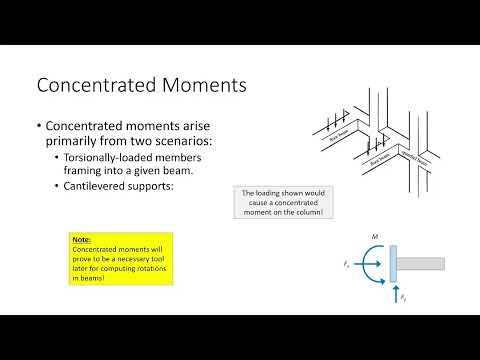
- A bent floor beam can transfer a concentrated rotational action into a connected spandrel and column.
- A cantilever support must provide both force reactions and a moment reaction to prevent the structure from rotating.
- Concentrated moments also serve as analysis tools for calculating rotations, such as support rotation needed when designing bridge bearings.
- The simply supported beam carries a 3-kip-per-foot distributed load over 10 feet, a 10-kip point load, and a 20-kip-foot concentrated moment.
- Replace the distributed load with its 30-kip resultant acting 5 feet from the start of the loaded region.
- Assume vertical reactions at A and B and a horizontal reaction at A; the horizontal-force balance gives Ax = 0 because no horizontal external load is applied.
- Taking moments about A eliminates the reactions at A and gives 30 × 5 + 20 + 10 × 45 = By × 25, with the 20-kip-foot couple added without a lever arm.
- The moment equation gives By = 24.8 kips upward; summing vertical forces then gives Ay = 15.2 kips upward.
- The 20-kip-foot moment is excluded from both horizontal- and vertical-force sums because it produces rotation rather than translation.
- A cantilever has one primary fixed support, which supplies horizontal force, vertical force, and moment reactions.
- Michaelson notes that the usual simply supported beam strategy of choosing a moment center to eliminate reactions matters less because all three unknown reactions occur at the same support.
- The example’s 10-kip inclined load is resolved using a 3-4-5 triangle into 6 kips horizontally and 8 kips vertically.
- The 6-kip horizontal component acts left, so the fixed support supplies Ax = 6 kips to the right.
- The downward loads are 8 kips at 10 feet and 20 kips at 20 feet, requiring Ay = 28 kips upward.
- Their clockwise moments total 8 × 10 + 20 × 20 = 480 kip-feet, so the support supplies MA = 480 kip-feet counterclockwise.
Transcript excerpt
0:00 He's >> I That's not what I said. >> He's reteing us. >> We're presenting things in a different light. >> Oh, Lord. Okay, everybody. Lecture five. Um I imagine uh of the three homework assignments we've done so far that the last one was just a little trickier than the other two. This one's easier, the one that we're doing today. I I think so. Um, in fact, I think that the um handling of concentrated moments is is easy in and of itself. Um, we're going to be doing two types of problems today. We're going to be doing ones with um concentrated moments as an applied force effect like it's a load on the
0:47 system and then you need to determine the reactions when there's a concentrated moment present. And then the other type of problem is dealing with fixed supports where the concentrated moment is a reaction. Okay. But I would argue that uh dealing with fixed supports or canal levered beams in general, it like can levered beams are among the easiest class of problems we do uh in structural analysis. So uh and you'll see what I mean. The strategy uh that you have to apply to a simply supported beam just sort of melts away when you're doing a can of levered structure and it just it's it's kind of easy. um announcements and announcements I'm hoping for the um the next few lectures are going to be kind of boring. You know, for example, the attendance is up to date. Uh homework 2.1 is graded. Uh the solutions posted, homework 2.2
1:36 was due right before you walked in here. Homework 2.3 is assigned today, due Friday. And it's just going to keep on with that pattern for a little while. Okay, everybody good? All right,
This is the start of the transcript. Save this video free for the whole transcript, searchable and time-coded.
In this course
Related notes
Summary, takeaways, and chapters were generated by AI from the video's transcript and may contain errors. The video belongs to its creator, Gregory Michaelson.