CE 312 Lecture 11: Deflections of Trusses I, Explaining Virtual Work (2026.09.11)
Overview
Gregory Michaelson introduces the unit load method, also called virtual work, for calculating truss deflections and derives it from the balance between external work and stored axial strain energy. He applies the method to a symmetric aluminum truss, combining real member forces with forces from a unit load at joint B to calculate a downward deflection of 0.237 inches.
Key takeaways
- For a truss joint deflection, analyze the real loading to obtain F, analyze a unit load at the target joint and direction to obtain f, then sum fFL/(EA) over every member.
- The unit load belongs at the location and in the direction of the displacement being sought; a positive result confirms the assumed direction, while a negative result indicates the opposite direction.
- Deflection depends on material stiffness and member geometry through E and A, unlike the earlier equilibrium-only truss analyses.
- For an axial bar in linear elasticity, δ = FL/(EA) and the stored strain energy is F²L/(2EA); the virtual-work method follows by equating the cross-terms from virtual and real loading.
- Use consistent US customary units: kips for real forces, kips per square inch for E, square inches for A, and inches for L, yielding deflection in inches.
- In the worked aluminum truss, the real and virtual member-force products sum to a 0.237-inch downward displacement at joint B.
Chapters
- Lecture 11 begins the final topic before the first exam: structural deflections.
- Force-equilibrium analysis did not require member material properties, but deflection calculations depend on each member’s area and Young’s modulus.
- Serviceability limits constrain deformation; a common building-beam limit is L/360, which helps prevent problems such as cracked plaster ceilings.
- Deflection analysis is also necessary to understand force-deformation relationships in statically indeterminate structures.
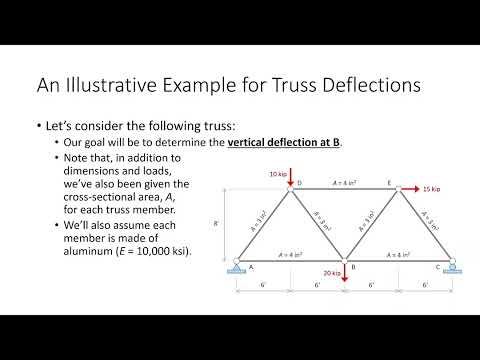
- To find vertical deflection at joint B, first analyze the truss under its actual loads and label the resulting member forces with capital F.
- Next remove the real loads and apply a downward unit load at B, the point and direction of the desired deflection; label virtual member forces with lowercase f.
- For each truss member, record f, F, length L, Young’s modulus E, and cross-sectional area A.
- Calculate the deflection by summing fFL/(EA) across all members; this procedure is also called the unit load method.
- Michaelson connects structural analysis to conservation of energy, using a falling Mario Goomba to illustrate gravitational potential energy converting into kinetic energy.
- A loaded truss behaves conceptually like a bow or spring: its members stretch or compress and store energy as the structure deforms.
- For the trusses considered here, the relevant stored energy comes from axial member forces; bending, shear, and torsion are outside this calculation.
- Assuming linear elastic behavior, external work done on the structure equals the strain energy stored in it.
- For a linearly elastic bar, the force-displacement graph is linear, so external work is the triangular area, 1/2 Pδ.
- Using σ = F/A, σ = Eε, and ε = δ/L gives the axial deformation relationship δ = FL/(EA).
- The axial strain energy stored in one member is the area under its force-displacement graph: F²L/(2EA).
- In a truss, the externally applied load P and an individual member’s internal force F are generally different, so the member forces must be found by structural analysis.
- A direct real-work calculation is inconvenient when loads act at many locations, because the desired displacement may be at a joint without an applied load.
- Michaelson introduces a fictitious load at the point of interest to track the energy associated with the desired displacement.
- In the two-load bar derivation, P1 is the virtual load and P2 is the real load; the cross-term in the work and energy expressions links the virtual load to the real-load deflection.
- Choosing P1 = 1 reduces the relation to the unit load method, giving the sum of fFL/(EA) for a truss.
- The worked example seeks the vertical deflection at joint B in a truss whose member areas and lengths are specified and whose members share the aluminum modulus E.
- The real-load analysis provides capital-F member forces, including both tension and compression results.
- The second analysis removes the real loads and applies a downward unit load at B; lowercase-f forces are unitless because the applied virtual load has magnitude one.
- Symmetry can reduce the work in the virtual analysis, and zero-force members can further simplify either analysis.
- For each member, enter virtual force f, real force F, length L, modulus E, and area A, then compute fFL/(EA) in a table or spreadsheet such as Excel.
- In US customary units, use real forces in kips, E in kips per square inch, area in square inches, and member lengths in inches to obtain deflection in inches.
- Assign tension positive and compression negative; members with matching real and virtual force signs contribute positive terms to the sum.
- The example’s contributions sum to a vertical deflection of 0.237 inches downward at joint B.
- The homework is due Wednesday rather than Monday, leaving time for the method to settle before the next in-class problem.
- The next class will work through a truss deflection problem from start to finish, including both vertical and horizontal displacement.
- Solving the real truss in advance and organizing the calculations in Excel can make the upcoming example more efficient.
Transcript excerpt
0:00 All right, everybody. >> Lecture 11. Let's get started. Um, one thing. Hold on. Let me make sure. Did my mic get picked up? Give me one second. I didn't check to see if it was Wait, hold on. >> Yep. Okay. I was making sure my microphone was getting picked up. Okay, let's get started. Um uh so uh your sort of your last trust assignment was due today. The trust assignment on the method of sections. I'm hoping the assignment was fairly quick even though it was probably the most sort of drawing intense assignment that you have just because it takes a while to draw a section. Um I'm giving you a homework
0:48 today that is not due Monday. >> Yay. But you know, equilibrium shock, I know. Um, it'll you'll understand why today. Um, so what we're going to do is introduce our next sort of big topic, which is deflections. And this is going to be our last topic prior to the first exam. Um, so today is going to feel a little bit like movie time. Um, what we're going to do is today I'm going to explain the method. Um and then on Monday we're going to exercise the method. Um it's a a very straight it so let me put like this. It's very straightforward to apply but I do want to make sure that you understand it. This method that we are going to use to compute deflections and trusses is the
1:36 same method that we're going to use uh for beams and frames etc. Your textbook has quite a few other methods. Um this is going to be the only one that we use and and you'll understand uh why today. And it and it is an energybased approach and there's a reason why we're using it
This is the start of the transcript. Save this video free for the whole transcript, searchable and time-coded.
In this course
Related notes
Summary, takeaways, and chapters were generated by AI from the video's transcript and may contain errors. The video belongs to its creator, Gregory Michaelson.