CE 312 Lecture 10: Plane Truss Analysis IV, Method of Sections (2026.09.09)
Overview
Gregory Michaelson explains when the method of sections is useful in plane-truss analysis: it quickly finds selected member forces and is a classic FE exam technique, while the method of joints remains preferable when every member force is needed. Using a 45-kip and 55-kip reaction example, he cuts through members CD, CK, and JK, chooses moment center C, and derives CD = 75 kips in tension, CK = 12.73 kips in tension, and JK = 85.16 kips in compression.
Key takeaways
- Method of sections is most efficient when only a few truss-member forces are needed, while method of joints is more appropriate when a complete force inventory is required for design or deflection analysis.
- A cut through three unknown truss members can be solved with the two force-equilibrium equations and one moment-equilibrium equation available for the section free-body diagram.
- Choose a moment center that eliminates two unknown member forces; for the example cut through CD, CK, and JK, moments about C isolate JK while avoiding unnecessary unknowns.
- The principle of transmissibility lets a cut-member force move along its line of action on the free-body diagram, which can eliminate a component's moment contribution.
- A negative result for an assumed tensile member force indicates that the member is actually in compression; the final result should state magnitude and force type.
- For the example, the computed forces are CD = 75 kips tension, CK = 12.73 kips tension, and JK = 85.16 kips compression.
Chapters
- Gregory Michaelson notes that Homework 3.3 is due September 9 and previews virtual work for the following class.
- He describes method of sections as less comprehensive than method of joints, but useful for quickly finding a member force in a large truss.
- A typical FE exam problem may ask for one force deep inside a truss, where cutting a section avoids solving many joints.
- Both truss-analysis methods use frictionless joints, loads and reactions applied at joints, and coincident member centroidal axes at each joint.
- Under these assumptions, truss members carry axial tension, axial compression, or zero force, rather than bending, shear, or torsion.
- Method of joints is suited to finding every member force for design and deflection calculations; sections are useful for spot checks and selected forces.
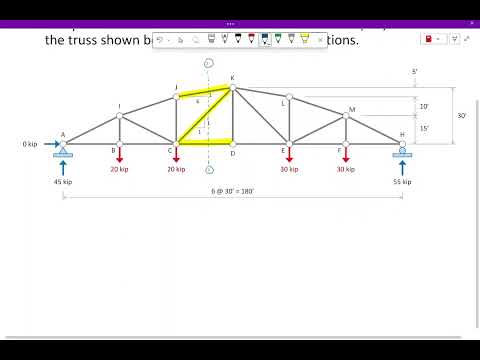
- Michaelson targets members CD, CK, and JK, so the cut passes through those three unknown members.
- Unlike a joint free-body diagram, a section free-body diagram permits three equilibrium equations, including moment equilibrium.
- He recommends examining both sides of a cut and choosing the side with fewer forces and less truss to redraw.
- The example uses support reactions of 45 kips on the left and 55 kips on the right, consistent with the load distribution.
- Michaelson draws the portion to the left of section 1-1, retaining joints A, B, C, D, I, and J as a frame of reference.
- The diagram includes 30-foot panel dimensions, additional 10-foot and 15-foot dimensions, and applied loads of 20, 20, and 45 kips.
- The CK diagonal has a 1:1 horizontal-to-vertical slope ratio, while JK has a 1:6 ratio.
- Michaelson initially assumes all three cut members are in tension and resolves the diagonal forces into horizontal and vertical components.
- The principle of transmissibility allows a force to move along its line of action without changing its static effect, enabling component placement that simplifies moments.
- Taking moments at K would isolate CD but leave two diagonal unknowns for two equations; a remote point X is another option but requires locating it.
- He chooses joint C as the practical moment center because it eliminates CD and CK and keeps the calculation straightforward.
- About C, the 45-kip reaction has a 60-foot moment arm and the 20-kip load has a 30-foot moment arm; the other 20-kip load passes through C.
- Transmissibility moves the JK force along its line of action so its vertical component has no moment arm, leaving JKx with a 25-foot arm.
- The moment balance is 45 × 60 + 25(JKx) = 20 × 30, giving JKx = -84 kips.
- The negative result reverses the assumed tensile direction, so JKx acts leftward and member JK is in compression.
- The JK slope ratio is 1 horizontal to 6 vertical, so the vertical component is one-sixth the horizontal component.
- With JKx = 84 kips in magnitude, JKy = 14 kips and acts downward under the corrected force direction.
- The member force is the vector magnitude, √(84² + 14²) = 85.16 kips, in compression.
- Summing vertical forces on the left section gives CKy + 45 - 20 - 20 - 14 = 0, so CKy = 9 kips upward.
- CK has a 1:1 slope ratio, making CKx = 9 kips; together the components give CK = √(9² + 9²) = 12.73 kips.
- The positive CK components agree with the initial tension assumption, so CK is in tension.
- Horizontal equilibrium combines the 9-kip CKx component, the 84-kip leftward JKx component, and CD, yielding CD = 75 kips to the right.
- The final member-force results are CD = 75 kips in tension, CK = 12.73 kips in tension, and JK = 85.16 kips in compression.
- Michaelson emphasizes reporting each member's force magnitude and tension or compression, rather than treating component arrows as the requested answer.
- Assuming compression instead of tension at the outset is also valid if the sign and direction assumptions are followed consistently.
Transcript excerpt
0:00 No. >> Oh. I need to edit this before uh >> Okay, that's a little better. [clears throat] All right, let's get started. Okay, I think I mentioned this um some time ago, but this is our first semester in in a long time where Labor Day has been after week three as opposed to week two.
0:48 So, it sort of threw off my uh my equilibrium a little bit, no pun intended. Um equilibrium. So, um I hope everybody Thank you. Thank you. I hope everybody had a good uh uh 3-day weekend and whatnot. Um, homework 3.3 was due today. I'm hoping that like it wasn't it didn't come across as me taking advantage of the longer weekend because I don't think the homework was particularly long. If I was a betting man, I'd say homework 31 or 32 probably felt longer than this one. So, um, but hopefully that went pretty well. Um, homework 3.2, I say it's being graded. It actually already is graded. reg. I hadn't gotten a chance to post them yet right before class. So, I'll post those uh sometime today, but 3.3 is due today
1:35 and then we'll have our last trust assignment uh today. Uh today's topic is going to be on the method of sections. Um I I think that just based on the way the class is organized, I think you'll uh maybe get my feeling about the method of sections, which is that it's the lesser of of importance of the two methods. Um, I show it because it is a valid way to analyze trusses. And while I really don't like being the type uh uh of professor that just teaches for the exam, the method of sections is a very valuable tool for use on the FE. Okay?
This is the start of the transcript. Save this video free for the whole transcript, searchable and time-coded.
In this course
Related notes
Summary, takeaways, and chapters were generated by AI from the video's transcript and may contain errors. The video belongs to its creator, Gregory Michaelson.