CE 312 Lecture 12: Deflections of Trusses II, In-Class Example (2026.09.14)
 Watch on YouTube →
Overview
Gregory Michaelson demonstrates the truss method of virtual work, using separate real-load and unit-load analyses and summing fFL/(EA) across members to calculate deflection. In a 6 ft by 8 ft steel truss with 29,000 ksi modulus, mostly 2 in² members, a 1.5 in² diagonal, and 60 kip and 80 kip real loads, the worked example finds joint C moves 0.401 in downward; a second unit-load analysis shows how to set up the horizontal deflection at B.
Key takeaways
- Truss deflection by virtual work is found by summing fFL/(EA) for every member, using real and unit-load member forces, member length, elastic modulus, and cross-sectional area.
- Place the unit load at the target joint in the assumed direction of displacement; if the final deflection is negative, the actual direction is opposite the assumption.
- For the worked steel truss, E is 29,000 ksi, most members have area 2 in², the diagonal has area 1.5 in², and joint C's vertical deflection is 0.401 in downward.
- Member tension and compression signs must be tracked consistently: the real-load analysis identifies 60 kips tension in CD, 60 kips compression in AB, and 100 kips tension in the diagonal.
- Unit consistency matters in fFL/(EA): when E is in ksi and area is in square inches, convert the example's 6 ft, 8 ft, and 10 ft member lengths to 72 in, 96 in, and 120 in.
- A unit-load truss often has many zero-force members, which can make its analysis much faster; in the horizontal-deflection setup at B, only AB carries a nonzero virtual force.
Chapters
- The first CE 312 exam is seven days away, with an in-class review planned for Friday.
- Homework 3.4 is being graded, and the final homework before the exam is due Wednesday.
- Lecture notes through Exam 2 and beyond are available on Blackboard; matrix analysis notes are the remaining exception.
- Michaelson connects deformation and stored strain energy with the example of drawing a bow.
- A virtual load makes it possible to calculate deflection at an arbitrary point, including one without a real applied load.
- The method requires one analysis for the real loads and another for a unit load placed at the point and in the direction of the desired displacement.
- For each truss member, multiply the real force F, virtual force f, and member length L, then divide by elastic modulus E and area A.
- Sum fFL/(EA) across all members; tensile forces are positive and compressive forces are negative.
- Keep units consistent, such as converting member lengths from feet to inches when E is in ksi and A is in square inches.
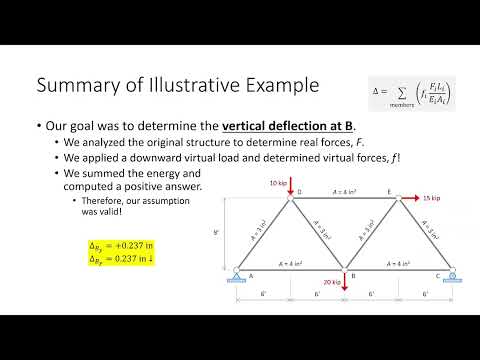
- A preliminary example produces a downward deflection of 0.237 in at joint B.
- The example seeks the vertical deflection at C and horizontal deflection at B, requiring one real-load analysis and a separate virtual analysis for each target displacement.
- The truss uses E = 29,000 ksi, 2 in² areas for most members, and a 1.5 in² area for the diagonal.
- Real loads are 60 kips horizontally to the right at C and 80 kips vertically downward at B; the truss geometry forms a 3:4:5 diagonal.
- The support reactions are found from equilibrium: the vertical reaction is 80 kips, the horizontal reaction at A is 60 kips, and the reaction at D balances the horizontal loads.
- Joint analysis identifies two zero-force members and gives 60 kips tension in CD and 60 kips compression in AB.
- At joint B, the 3:4:5 geometry gives 60 kip and 80 kip components for the diagonal, yielding 100 kips tension in BD.
- For vertical deflection at C, Michaelson applies a 1.0 upward virtual load, matching an initial assumption that C moves upward.
- The virtual structure has a 1.0 vertical reaction and equal-and-opposite horizontal reactions; those horizontal reactions are nonzero because they balance moments.
- Joint equilibrium and zero-force-member checks determine the virtual member forces needed for the deflection calculation.
- The calculation table lists each member's real force, virtual force, length in inches, E, and A, then evaluates fFL/(EA).
- Member lengths are 72 in for the 6 ft horizontals, 96 in for the 8 ft verticals, and 120 in for the 10 ft diagonal.
- The summed result is negative, so the assumed upward direction was incorrect: joint C deflects 0.401 in downward.
- The second target is the horizontal deflection at joint B, with a unit load applied to the left based on the expected movement.
- The virtual structure has zero vertical reaction at D and a horizontal reaction at A of magnitude 1, found by taking moments about D.
- Joint analysis leaves AB as the only nonzero virtual-force member; the other member forces are zero, simplifying the same fFL/(EA) calculation.
- The horizontal-deflection calculation reuses the real-force results and the existing Excel table, changing only the virtual forces.
- A similar truss practice problem asking for horizontal and vertical deflections is due Wednesday.
- The next class is scheduled to introduce the semester analysis project.
Transcript excerpt
0:12 Okay, lecture 12. Let's get started. Okay, so um we're getting uh we're getting close to celebration time. So um just a heads up, we are seven days out from our first exam here in C312. Um, just to give everybody a quick overview of the schedule. You know, I've been putting a um a calendar uh on the slide sort of at the start of each week here recently. So, today what we're going to do is we're going to do a full in-class example on uh trust deflections um which will uh hopefully be pretty straightforward. Wednesday, we're talking about our class project. That's going to be the analysis project we do throughout the semester um where we have two deliverables. One of the deliverables for the uh the class
0:59 project is going to be right after our October break and the second deliverable is going to be um right before we go on Thanksgiving break. So you won't have any outstanding work for this class during turkey time. Okay. So um now on Friday we are going to have an in-class uh exam review. And just so everybody is aware, the way that I conduct exam reviews is I come in and for about five or 10 minutes, I'll come in and um just sort of give you the layown for uh the structure of the exam, how it's formatted, what topics will be covered on the exam, and then I sort of shut up and let you all ask whatever questions you want to me. uh if that's uh you want to go through some homework problems,
1:45 you want to go through some in-class examples, you want to do a problem, we can do that. One thing I would suggest on exam review day is if you um are
This is the start of the transcript. Save this video free for the whole transcript, searchable and time-coded.
Related notes
Summary, takeaways, and chapters were generated by AI from the video's transcript and may contain errors. The video belongs to its creator, Gregory Michaelson.