CE 312 Lecture 09: Plane Truss Analysis III, 2x2 Sys. & Zero-Force Members (2026.09.04)
Overview
Gregory Michaelson shows how to analyze truss joints with two diagonal unknowns by converting member forces into x and y components, forming a 2×2 system, and solving it with a scientific calculator. He then teaches three joint-equilibrium rules for spotting zero-force members, demonstrating how several members in a loaded truss can be classified without solving the full structure.
Key takeaways
- When two diagonal members meet at a joint, express each member force through its slope-based x and y ratios, then solve the two equilibrium equations simultaneously rather than sequentially.
- For the scissor-truss example, AB/√2 + 2AC/√5 = 40 and AB/√2 + AC/√5 = -25 produce AB = -127.28 kips and AC = 145.34 kips; the negative sign identifies AB as compression under a tension-positive assumption.
- A Casio fx-115ES Plus solves a 2×2 system through Mode 5, option 1, and a 3×3 system through Mode 5, option 2.
- At an unloaded joint with two non-collinear members, equilibrium requires both member forces to be zero; at an unloaded joint with three members, a non-collinear member is zero when the other two are collinear.
- Zero-force status depends on the load case, and a member with zero force in one arrangement may carry force after loads move or a new load is applied.
- Zero-force rules can be applied iteratively: removing identified members may reveal additional zero-force members at neighboring joints, as at joint E in the example.
Chapters
- Gregory Michaelson explains that Homework 3.1 grading was delayed because he initially prepared a solution for problem 4.16 instead of 4.6.
- The lecture focuses on two truss-analysis tools: 2×2 systems for joints with two diagonals and visual rules for finding zero-force members.
- Michaelson frames the material as practical truss-analysis techniques following Homework 3.1 and 3.2.
- A sample system, x + 2y = 3 and 2x + 3y = 4, has solution x = -1 and y = 2.
- Substitution isolates one variable and inserts it into the other equation; elimination scales equations so a variable cancels.
- Matrix form organizes coefficients, unknowns, and constants, a foundation for later indeterminate analysis and structural software.
- On a Casio fx-115ES Plus, use Mode 5 and select option 1 for a 2×2 system or option 2 for a 3×3 system.
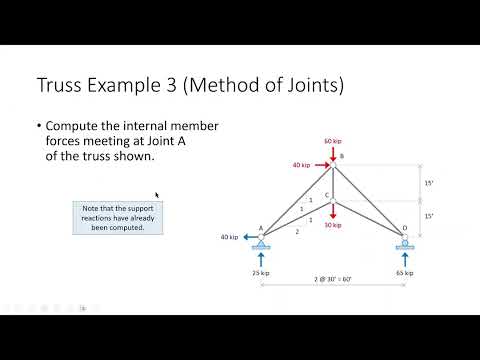
- Michaelson’s scissor truss has five members, three reactions, and four joints, so M + R = 2J = 8 and it is statically determinate.
- The support reactions are found as 25 kips upward at A, 65 kips upward at D, and a 40-kip horizontal reaction.
- At joint A, both diagonal members contribute horizontal and vertical components, so neither equilibrium equation can be solved independently first.
- Member AB has a 1:1 slope, giving component ratios ABx = AB/√2 and ABy = AB/√2.
- Member AC has a 2:1 slope, giving ACx = 2AC/√5 and ACy = AC/√5.
- Expressing both components using the full member force makes AB and AC the two unknowns in the joint equations.
- Assume both AB and AC are in tension, with their forces directed away from joint A; negative results will indicate compression.
- Horizontal equilibrium gives AB/√2 + 2AC/√5 = 40.
- Vertical equilibrium gives AB/√2 + AC/√5 = -25, after moving the 25-kip upward reaction to the right-hand side.
- Enter the coefficients of AB and AC, along with constants 40 and -25, into the calculator’s 2×2 equation solver.
- The calculated member forces are AB = -127.28 kips and AC = 145.34 kips.
- Because the assumed directions were tension, AB’s negative result means 127.28 kips in compression, while AC is in 145.34 kips of tension.
- A zero-force member carries neither tension nor compression for the particular loading being analyzed.
- Some members serve as braces in real structures even when they carry no force under a specific load case.
- A member classified as zero-force under one load arrangement may carry force if the loads move.
- At an unloaded joint with two non-collinear members, both members are zero-force members.
- At a joint with two members and an external load collinear with one member, the collinear member carries the load and the other is zero-force.
- At an unloaded joint with three members, if two are collinear, the third, non-collinear member is zero-force.
- After identifying zero-force members, remove them from consideration and apply the rules again at connected joints.
- In the example truss, joints D, G, and H reveal zero-force members, and removing those members exposes another zero-force member at E.
- At joint E, the identified zero-force member leaves no horizontal force to balance, so the other horizontal member is also zero-force; the vertical member carries 50 kips in tension.
- The assigned work is due Wednesday: analyze one specified joint with two diagonals, then identify and highlight the zero-force members in a separate truss.
- A zero-force member can remain zero when a load reverses direction, but adding a load in a direction with no other supporting member changes that conclusion.
Transcript excerpt
0:05 All right, everybody. Lecture nine. Right before our long weekend. Um So, I I have to uh admit to a um uh a a slight um hiccup on my part. So, homework 3.1 is not yet graded, but it is not my TA's fault. It was my fault. Typically, what I do is I try and solutions like as the homeworks are being created, but with trusses, I uh I sort of like created a lot of the assignments and then said I would do the solutions later. Well, my TA messaged me and he said, "So, here's the thing, uh Dr. Mike, you um your solution is for problem 4.16 and everybody did 4.6." So, I did the wrong problem on the solution. So, I had to
0:55 redo the solution. So, the solution that's posted is the right one. The TA just hasn't graded them yet. So, that one was on me. So, my apologies. But, uh we'll get it uh knocked out pretty quickly. Um homework 3.2 was due today. How did that go? Was that I'm hoping that was pretty smooth compared I mean, between like I I think what I'm hoping is that between 3.1 and 3.2, that you're smooth on trusses. At least like the rust has been shaken off and we're feeling a little bit more comfortable with them. Is that fair? Okay. So, today is tips and tricks day for truss analysis. So, what I want to do is cover two things today. I want to cover um how to identify zero force members.
1:43 That's something we're going to do at the end. But, the other thing I want to cover is matrix math. I want to cover two by two systems of equations because there is a particular type of joint analysis that we haven't done yet, okay?
This is the start of the transcript. Save this video free for the whole transcript, searchable and time-coded.
In this course
Related notes
Summary, takeaways, and chapters were generated by AI from the video's transcript and may contain errors. The video belongs to its creator, Gregory Michaelson.