CE 312 Lecture 08: Plane Truss Analysis II, Indeterminacy & More Joints (2026.09.02)
Overview
Gregory Michaelson explains how to classify plane-truss stability and determinacy using the internal-indeterminacy equation I_T = M + R - 2J, then applies the method of joints to a symmetric 21-member truss. He demonstrates a large-diagram workflow that solves only half the truss, uses member slope ratios to resolve force components, identifies a zero-force member, and checks the remaining joint by symmetry.
Key takeaways
- For a plane truss, internal indeterminacy is I_T = M + R - 2J because every member and support reaction is an unknown, while each joint supplies two equilibrium equations.
- A zero value of I_T only suggests internal determinacy: external stability and geometric stability, including adequate triangular bracing, must also be checked.
- The example truss is internally determinate because 21 members plus 3 reactions equal the 24 equations supplied by 12 joints.
- When geometry, loading, and supports are symmetric, corresponding member forces match, so solving one half of a truss can avoid repeating the analysis.
- Slope ratios convert a known vertical or horizontal force component into the other component without immediately calculating the diagonal member's full magnitude.
- A zero-force member can still be structurally necessary for stability, buckling restraint, or load cases that change position.
Chapters
- The ideal truss model assumes frictionless joints, loads and reactions applied at joints, and member centroids meeting at each joint.
- Under those assumptions, each member carries only axial tension, compression, or zero force.
- The method of joints solves the full truss, while the method of sections is introduced as a later spot-checking approach.
- External indeterminacy compares support-reaction unknowns with three planar equilibrium equations and any additional equations of condition.
- A truss can be externally stable yet internally indeterminate: the example has no joint where the method of joints can begin because every joint has more than two unknowns.
- For a plane truss, count unknowns as M + R and available joint equations as 2J, giving I_T = M + R - 2J.
- I_T < 0 indicates internal instability, I_T = 0 suggests internal static determinacy, and I_T > 0 suggests internal static indeterminacy.
- These classifications assume the truss is externally stable; a negative external-indeterminacy result invalidates the internal classification.
- A region without triangular bracing can signal instability because its joints may move and the truss can collapse internally.
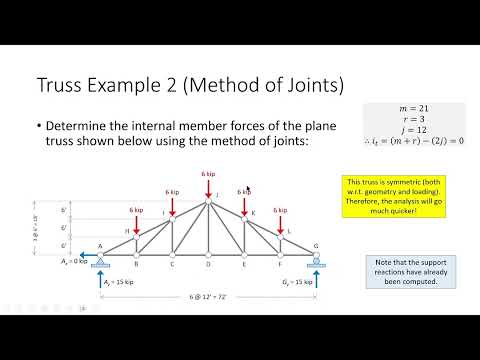
- The example has 21 members, 3 support reactions, and 12 joints, so I_T = 21 + 3 - 2(12) = 0.
- Its geometry, loading, and support reactions are symmetric, with equal vertical reactions and zero horizontal reaction.
- Symmetry lets the analysis stop at the center: corresponding members have equal forces, and the center member DJ is the only unique member on the symmetry line.
- The planned sequence is A, H, B, I, C, then D, choosing joints where no more than two member forces are unknown.
- The repeated sloping members rise 6 ft over 12 ft horizontally, giving a rise-to-run ratio of 1:2.
- Member BI has a 1:1 slope ratio, while CJ rises 18 ft over 12 ft horizontally, giving a 3:2 rise-to-run ratio.
- Michaelson redraws the six-joint half-truss as one large diagram, labeling joints A, H, I, J, B, C, and D and marking applied loads.
- He distinguishes known forces from unknown forces with different colors and records the A, H, B, I, C, D solution order beside the drawing.
- Rather than calculate each diagonal hypotenuse immediately, he postpones repeated hypotenuse calculations until the end and uses slope ratios first.
- At joint A, the 15-kip vertical load leads to a 15-kip vertical component and a 30-kip horizontal component through the 1:2 slope ratio.
- At joint H, the known 30-kip horizontal and 15-kip vertical forces are balanced with the adjoining members; the vertical member carries 6 kips under the applied load.
- At joint B, the known 30-kip and 6-kip forces are carried into the joint, and the 1:2 slope ratio prevents incorrectly treating a 6-kip vertical component as a 12-kip member force.
- At joint I, the horizontal balance gives a 24-kip component, and the vertical balance gives a 12-kip component; the remaining vertical member is 9 kips.
- At joint C, balancing the 9-kip vertical component with the 3:2 slope ratio gives a 6-kip horizontal component, followed by an 18-kip horizontal member force.
- At joint D, symmetry and horizontal equilibrium give equal 18-kip forces on either side, leaving the vertical member as a zero-force member.
- A zero-force member may still be needed to preserve stability, brace a compression member against buckling, or carry force when moving loads change position, as on a bridge.
- The unused center joint J provides a check: apply joint equilibrium using symmetry-related member forces and the 6-kip load to verify the results.
- After solving components, complete any remaining Pythagorean calculations and report each member as tension, compression, or zero force; Michaelson recommends bringing a calculator for 2-by-2 equations to the next class.
Transcript excerpt
0:00 Yeah. >> All right. Apologies for starting a couple minutes late today. I had a meeting in Old Main that went up right until class. I sort of ran over here and realized I forgot my microphone in my office, so I had to scramble up there and get it. My apologies. Okay. Excuse me. So, um last time what we did is we went through our first trust homework, which I I'm hoping that it was a as I said last time sort of a shake the rust off day. Today, we're going to maybe take it a little bit slower, but I'm going to show you maybe a different way of looking at truss analysis that might help you get some of the through the problems a little bit faster. So, um to be crystal clear, the method that I show
0:50 you today, if you don't like it, you don't have to use it. You can just do it the way that we have been, but maybe it's a little bit easier. It requires bigger drawings, but you can get through the math a little bit faster. Okay. The other thing we're going to discuss today is we're going to take a little bit of a detour, something that I sort of skipped last time, and I do that on purpose because, you know, lecture one with trusses sort of meant to shake the rust off. Now, I want to present things a little bit more formally. So, I want to discuss stability and determinacy, which we haven't talked about. We talked about it, but not for internal determination. Okay. Break it down. I can't be too upset. I was late myself,
1:37 so it's okay. All right. Everybody good? Come on. Okay. All right. So, just to recap from
This is the start of the transcript. Save this video free for the whole transcript, searchable and time-coded.
In this course
Related notes
Summary, takeaways, and chapters were generated by AI from the video's transcript and may contain errors. The video belongs to its creator, Gregory Michaelson.