Area by limit of Riemann sums (Calc 1; Lecture 3-7; Fall 26)
Overview
The lecture develops area as the limit of Riemann sums, starting with finite rectangle approximations and deriving the equally spaced right-endpoint formula on [0,b]. Applying it to f(x)=1, x, x², and eˣ produces areas b, b²/2, b³/3, and eᵇ−1, while illustrating geometric-series and limit techniques.
Key takeaways
- For n equal subintervals of [0,b], the right-endpoint sample points are xₖ=bk/n and the width is b/n, giving the Riemann-sum template (b/n)Σₖ₌₁ⁿf(bk/n).
- A five-piece left Riemann sum for f(x)=x²+2 on [−2,3] uses endpoints −2 through 2 and gives 20.
- The identities Σₖ₌₁ⁿk=n(n+1)/2 and Σₖ₌₁ⁿk²=n(n+1)(2n+1)/6 reduce the sums for y=x and y=x² to limits yielding b²/2 and b³/3.
- For y=eˣ on [0,b], setting r=e^(b/n) converts the sample values into a geometric series and leads to the exact area eᵇ−1.
- The results b, b²/2, b³/3, and eᵇ−1 differentiate with respect to b to give 1, b, b², and eᵇ, respectively, linking accumulated area to the original function.
Chapters
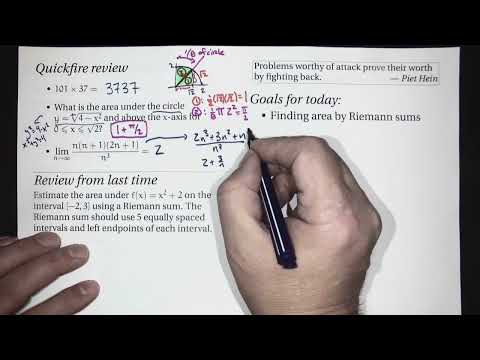
- Reviews the curve y=√(4−x²) as part of a circle with radius 2 and uses a 45° sector to motivate geometric area reasoning.
- Evaluates lim n→∞ n(n+1)(2n+1)/n³ by expanding the numerator and observing that the leading term gives 2.
- Explains that a curved region can be approximated by many vertical rectangles, with each rectangle's area estimated as height times width.
- Notes that continuous functions make these approximations reliable as the number of rectangles increases.
- Uses f(x)=x²+2 on [−2,3], divided into five equal intervals, so each rectangle has width (3−(−2))/5=1.
- Left endpoints are −2, −1, 0, 1, and 2; their function values are 6, 3, 2, 3, and 6.
- Adds the five rectangle areas to obtain the left Riemann-sum estimate 20, and checks that five intervals produce exactly five terms.
- Frames the goal as increasing the number of rectangles n without bound to obtain an exact total.
- Reviews sigma notation: k runs from 1 to n, and each term represents a function height multiplied by an interval width.
- Restricts the general construction to a continuous or piecewise-continuous function on [0,b], with equally spaced intervals and right endpoints.
- The interval [0,b] has length b, so dividing it into n equal pieces gives width Δx=b/n.
- The right endpoints are b/n, 2b/n, through nb/n=b, so the kth sample point is xₖ=bk/n.
- Combines the heights and widths into the area limit lim n→∞ (b/n) Σₖ₌₁ⁿ f(bk/n).
- On [0,b], y=1 forms a rectangle with base b and height 1, giving geometric area b.
- The Riemann sum is lim n→∞ (b/n)Σₖ₌₁ⁿ1; the sum contains n ones, so it simplifies to b.
- Distinguishes signed totals from ordinary geometric area, explaining why area is sometimes placed in quotation marks.
- The graph y=x on [0,b] bounds a triangle with base b and height b, giving area b²/2.
- Substituting xₖ=bk/n into the Riemann sum yields (b²/n²)Σₖ₌₁ⁿk.
- Uses the pairing argument associated with Carl Friedrich Gauss to derive Σₖ₌₁ⁿk=n(n+1)/2, then takes the limit to recover b²/2.
- For f(x)=x², evaluating at xₖ=bk/n gives f(xₖ)=b²k²/n², with the rectangle width contributing another factor of b/n.
- Applies Σₖ₌₁ⁿk²=n(n+1)(2n+1)/6 to rewrite the Riemann sum as a polynomial expression in n.
- Taking n→∞ gives the area b³/3; the result's derivative with respect to b is b², matching the original function.
- For f(x)=eˣ on [0,b], the right-endpoint sum contains terms e^(bk/n), which can be rewritten as rᵏ with r=e^(b/n).
- Derives Σₖ₌₁ⁿrᵏ=(rⁿ⁺¹−1)/(r−1) by multiplying the series by r and subtracting the original series.
- Substitutes r=e^(b/n) to express the Riemann sum without a summation, preparing it for a limit evaluation.
- Rewrites the exponential Riemann-sum expression using s=b/n, so n→∞ corresponds to s→0.
- Applies L'Hôpital's rule to the resulting 0/0 quotient involving eˢ−1.
- Obtains the exact area eᵇ−1, whose derivative with respect to b is eᵇ, matching the curve y=eˣ.
Transcript excerpt
0:03 and we'll start with our quickfire review. Okay. All right. Uh the first problem, 101 * 37. Oh, that's a big number. 101. But okay, let's see if we can't figure this one out. What's 101 * 37? >> 37. >> Yeah, it's 3737. Okay. 3,737. That's right. We can do math. Excellent. Uh the second one a little bit of geometry foreshadowing things to come. What is the area under the circle y = square 4 - x^2 and above the xaxis for 0 less than or equal to x less than equal to 2?
0:58 Do you have an answer? Okay. Well, good. Well, great. Now we can talk about this. We'll roll up our sleeves and get to work. All right. Now, this is a little bit of an interesting question because it's it's not, you know, the uh normal part of the circle we might be used to. Uh we know it's a circle cuz they told us that. So, that sort of gives it away. We'll have very circlacious thinking here as we approach this problem. Uh what's the radius of this circle? two, right? You you could rewrite this circle. This is the same as y^2 = 4 - x^2 or x^2 + y^2 = 4 and 4 is 2^2. So
1:49 our radius is 2. Uh and specifically this is the top half because it's a positive square root. And so if we do a quick sketch, we have two coming down. Here's two over here. And uh 2 is smaller than two. It's a little bit more than halfway through. So this is roughly 2. So we are being asked to find the area here. I'm going to shade it in. All right. So that's our goal. That's our goal. Now, let's see if we can't simplify this
This is the start of the transcript. Save this video free for the whole transcript, searchable and time-coded.
In this course
Related notes
Summary, takeaways, and chapters were generated by AI from the video's transcript and may contain errors. The video belongs to its creator, Beard Meets Calculus.